
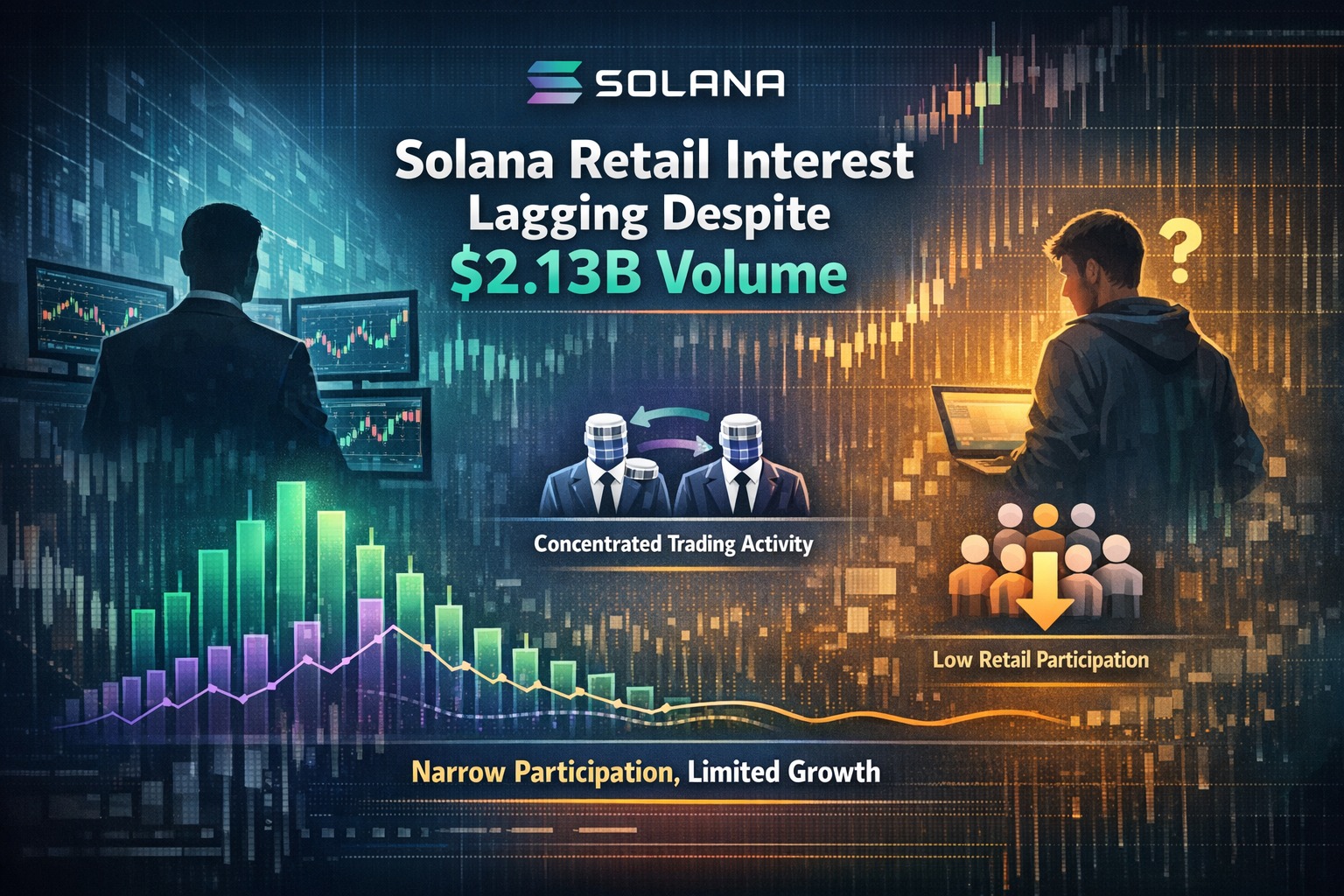
Solana Retail Interest Missing Despite $2.13B Volume
Solana Retail Interest tends to emerge when participation feels accessible, not just active, and that distinction becomes visible in moments like this. A market can process billions in trades while still failing to invite new entrants if the activity appears dominated by fast-moving or opaque strategies. Retail participants are sensitive to whether they can interpret price behavior, not just whether it exists. When that interpretability breaks down, engagement often pauses even as volume continues to rise.
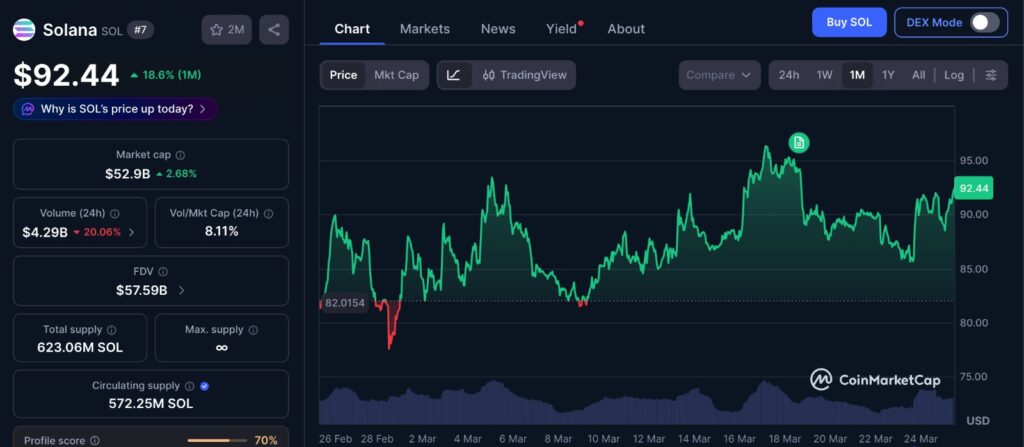
Over the past month, SOL’s price structure shows a recovery phase rather than a clear expansion in participation. The chart highlights how price has moved within a relatively defined range, with periods of sharp moves followed by quick stabilization. This type of behavior often aligns with liquidity-driven activity rather than broad retail accumulation. While price has regained strength from recent lows, the absence of sustained directional follow-through suggests that momentum is being maintained by active trading rather than new demand entering the market.
Solana Retail Interest remains weak despite high volume
Solana’s recent $2.13 billion trading volume would typically coincide with a visible increase in smaller participants entering the market. In previous cycles, this kind of activity tended to pull in retail traders through momentum, social traction, and rising transaction counts. That pattern is absent here.
Instead, participation appears concentrated. The volume is high, but it is not spreading across a wider base of users. This suggests that the trades are being generated by entities capable of deploying larger capital repeatedly, rather than by a growing number of individual investors.
When volume is concentrated, it changes what that number represents. Rather than signaling expanding demand, it can indicate that liquidity is being actively traded within a closed loop.
Why Solana Retail Interest is lagging behind
The structure of this activity points toward institutional or high-frequency trading behavior. These participants are not entering the market to accumulate long-term positions in the same way retail investors typically do. Their objective is efficiency, capturing spreads, arbitrage opportunities, or short-term price dislocations.
For example, high-frequency strategies can generate large volumes by rapidly executing trades across exchanges or liquidity pools. Each trade contributes to total volume, but does not represent new capital entering the ecosystem. This creates the appearance of strong activity without actual expansion in participation.
Retail traders, on the other hand, tend to respond to narrative and visible momentum. When price action does not clearly align with rising volume, or when broader sentiment remains cautious, their participation often stays limited.
Solana Retail Interest and on-chain signals
On-chain data supports the idea that activity is not broadening. While total trading volume has increased, metrics tied to user participation have not shown the same growth. Indicators such as active addresses or transaction distribution help distinguish between widespread usage and concentrated trading.
Here, the imbalance suggests that the same participants are responsible for a significant share of activity. This reduces the diversity of market participants, which is typically a key component of sustainable growth.
A market driven by a narrow group behaves differently. It can remain active, but it becomes more dependent on the continued presence of those specific players.
Solana Retail Interest reflects changing market structure
Crypto markets are no longer driven in the same way they were during earlier retail-heavy cycles. Volume used to expand alongside user growth, with new participants contributing to both liquidity and demand. That relationship is less consistent now.
Large participants can generate substantial activity without triggering the same ripple effects. Their strategies are often detached from broader sentiment, focused instead on execution efficiency and short-term positioning.
This changes how volume should be interpreted. A high number does not automatically imply strong adoption. It may instead indicate that the market has become more professionalized, where fewer participants account for a larger share of activity.
Solana Retail Interest and price behavior implications
When participation is concentrated, price behavior tends to reflect that structure. Larger players can move in and out of positions with greater impact, especially when there is limited counterbalance from retail demand.
This can lead to sharper movements that are less anchored by consistent inflows from smaller investors. Retail participation often acts as a stabilizing layer, providing gradual demand that supports trends over time.
Without that layer, price action can become more reactive. Movements may still occur with high volume, but they are not necessarily supported by a broad base of conviction.
Solana Retail Interest and the bigger picture
The current gap between trading volume and participation highlights a limitation in relying on surface-level metrics. Volume alone cannot distinguish between recycled liquidity and genuine expansion of the user base.
For Solana, the data suggests that activity is being sustained by capital efficiency rather than user growth. This distinction matters because long-term network strength is typically tied to increasing participation, not just higher turnover of existing liquidity.
Evaluating performance requires looking at how many participants are involved, not just how much is being traded. Without growth in participation, volume can remain high while underlying adoption stays relatively unchanged.
Editor’s View: Participation does not follow volume automatically
Retail does not respond to volume in isolation, it responds to clarity. When price action feels fragmented or driven by flows that are difficult to interpret, smaller participants tend to step back rather than engage. What appears as inactivity is often hesitation, not absence of interest. In this case, the structure of the market may be signaling complexity rather than opportunity, which keeps participation limited despite the scale of activity.
Conclusion: Solana Retail Interest remains limited
Solana Retail Interest continues to lag behind the scale of trading activity on the network. The $2.13 billion in volume reflects active markets, but not necessarily expanding participation. The concentration of activity among a smaller group of participants changes how that volume should be interpreted.
Without a broader base of users contributing to demand, the market remains dependent on the same sources of liquidity. This keeps activity elevated but limits the depth typically associated with sustained growth.
Disclaimer: This content is for informational purposes only and does not constitute financial advice.
Keep yourself updated with the latest crypto news with FYI Gazette
Read more about Memecoins with FYI Gazette
Keep yourself updated with the latest Altcoin News with FYI Gazette
 Bitcoin
  Ethereum
  Tether
  BNB
BNB  XRP
XRP  Solana
  TRON
TRON  Dogecoin
  Litecoin
  Pepe
Pepe