
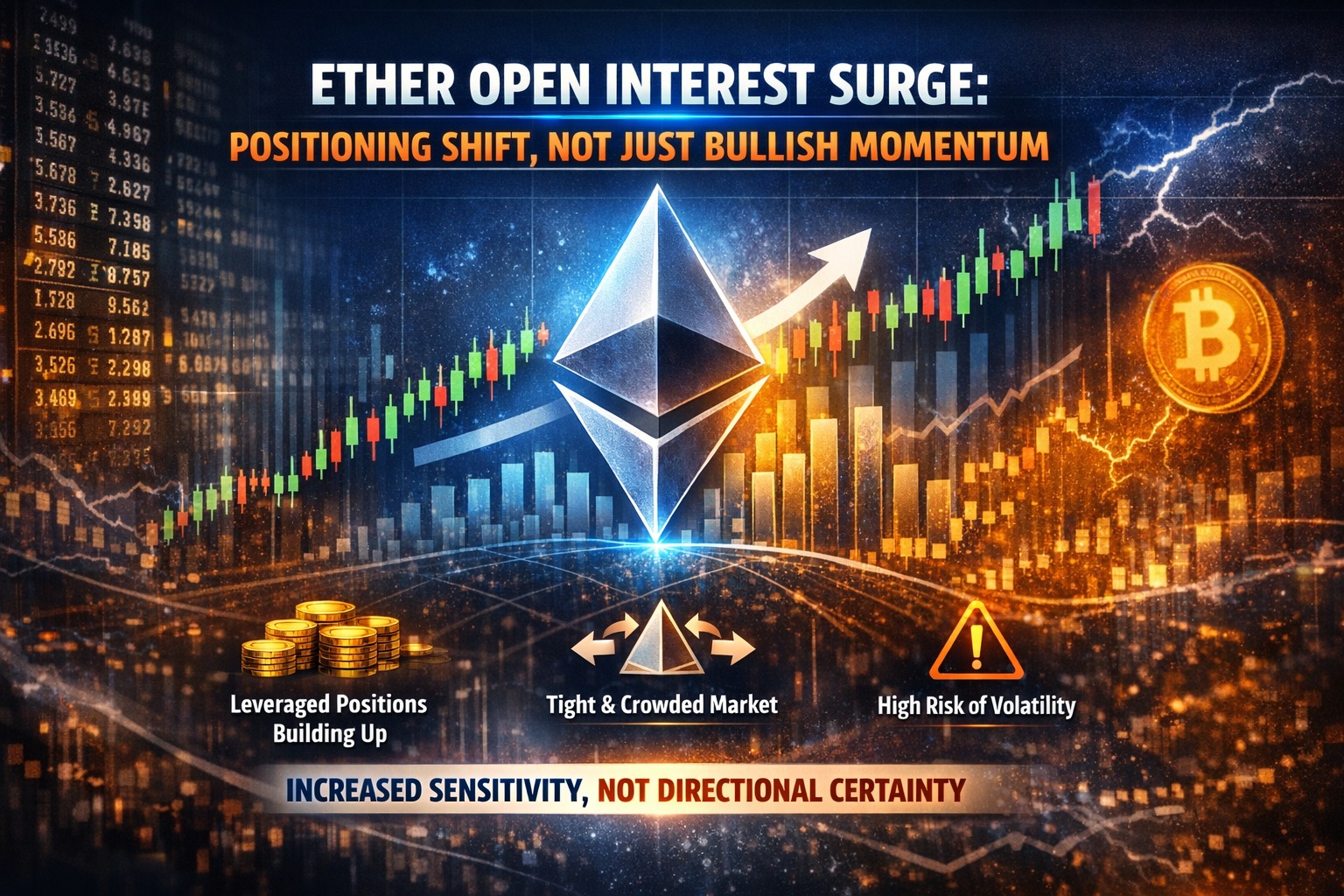
Ether Open Interest Surge Signals Positioning Shift, Not Just Bullish Momentum
Ether open interest expansion is not simply a sign of optimism, it reflects how aggressively traders are choosing to express exposure. When leveraged positioning rises alongside price, the market is not just moving higher, it is becoming more committed. This distinction matters because price can trend without conviction, but rising open interest shows that participants are actively increasing risk rather than reacting passively.
Recent data shows Ether’s open interest rising sharply during the latest market rally, increasing by roughly 20 to 26% in a short period as price approached key levels. This type of expansion typically indicates that new positions are being opened rather than old ones being closed, suggesting fresh participation entering the market.
But rising participation alone does not define direction. It defines pressure.
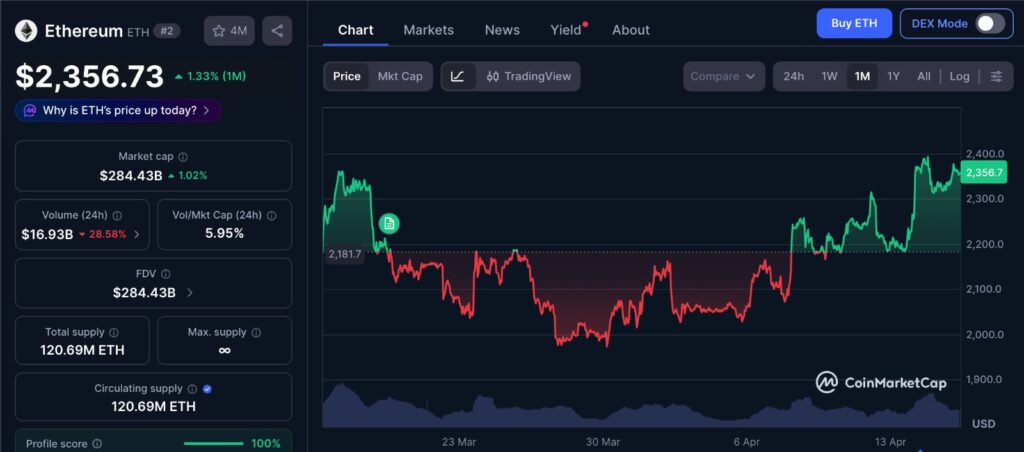
The 1-month chart reflects a steady transition from passive movement to more active participation. Periods of gradual price expansion align with phases where open interest has increased, suggesting that recent momentum has been supported by positioning rather than purely organic demand. This type of structure often shows that price is not just reacting to buying, but moving through conditions where liquidity has already been reduced. Over the past month, similar setups have tended to build pressure before resolving, as sustained positioning leaves the market more sensitive to even small shifts in participation.
Open Interest Growth Reflects Aggressive Positioning
Open interest measures the total value of outstanding derivative contracts. When it increases, it means traders are adding new exposure, often through leveraged positions.
During the recent rally, Ether’s open interest climbed significantly as price moved toward the $2,200 region, showing that traders were not waiting for confirmation, they were positioning into the move.
This behavior is structurally important.
Markets do not move because traders are right, they move because traders are positioned.
When open interest rises with price, it creates a layered market structure:
- Existing holders remain in position
- New traders add leverage
- Liquidity begins to thin around key levels
This combination increases sensitivity. Price no longer needs strong demand to move, it needs imbalance. As positions build in the same direction, execution becomes tighter because fewer resting orders are available to absorb flow without adjusting price.
Why Rising Open Interest Can Be Risk, Not Strength
There is a common assumption that rising open interest is bullish. In reality, it is neutral, it simply reflects increased participation.
What matters is how that participation is structured.
If the majority of new positions are directional and crowded, the market becomes fragile. Leveraged positions require continuation to remain stable. If price slows or stalls, even without reversing, those positions begin to lose efficiency, and that alone can trigger exits. A similar dynamic can be observed in XRP consolidation around the $1.40 level, where repeated tests without resolution reflect how positioning builds pressure before a decisive move.
Recent derivatives data suggests that while participation increased, traders were not uniformly confident. This often shows up around resistance, where repeated attempts without follow through indicate that liquidity is still absorbing pressure.
This creates a specific type of market condition:
- Price is rising
- Participation is increasing
- Conviction is uneven
That combination often leads to sharp moves, not because the trend is strong, but because the structure is tight.
Markets don’t break because selling increases, they break because buyers run out of room to keep pushing.
Ethereum vs Bitcoin: A Subtle Rotation Signal
Another important layer is relative positioning between Ether and Bitcoin.
Historically, when Ether’s open interest grows faster or gains relative share, it reflects a shift in trader preference toward higher beta exposure. This does not mean Ethereum is fundamentally stronger, it means traders are seeking more responsive assets where smaller imbalances can create larger moves.
This shift matters because it changes how liquidity behaves.
Bitcoin tends to anchor the market with deeper liquidity and slower movement. Ethereum, by contrast, reacts more quickly when positioning builds. As capital rotates into ETH derivatives, price becomes more sensitive to positioning changes rather than pure demand.
Bitcoin absorbs pressure, Ethereum amplifies it.
Real World Market Context
Recent sessions have shown that Ether’s price advances are often accompanied by sharp increases in derivatives activity rather than spot driven accumulation.
This suggests that:
- The rally is being driven by positioning, not just organic demand
- Traders are entering during movement rather than before it
- Liquidity conditions are tightening as leverage builds
At the same time, repeated tests of resistance without clean breakouts indicate that opposing liquidity is still present. Larger participants appear willing to absorb flow without allowing price to move freely, which keeps the market contained despite rising participation.
Editor’s View: Where the Pressure Is Building
What stands out is not just the increase in open interest, but where it is happening. Traders are adding exposure into strength, which reflects behavior driven more by urgency than clarity.
This type of positioning does not immediately create instability, but it builds dependence. The market begins to rely on continuation to sustain itself. If price keeps moving, positions remain intact. If movement slows, even without a reversal, the same traders who added exposure become the source of pressure.
The market is not choosing direction here, it is compressing reactions into a smaller space.
What Comes Next Depends on Structure, Not Sentiment
Rising open interest tells us one thing clearly, the market is becoming more crowded.
Crowded markets do not move smoothly. They resolve.
If price continues higher with sustained participation, the structure can support further expansion. However, if momentum slows while leverage remains elevated, the probability of sharp, forced moves increases.
The key takeaway is simple:
Open interest does not predict direction, it defines how sensitive the market is to change.
And right now, Ether is building a structure where even small shifts can have outsized effects.
Disclaimer: This content is for informational purposes only and does not constitute financial advice.
Keep yourself updated with the latest Altcoin News with FYI Gazette
 Bitcoin
  Ethereum
  Tether
  BNB
BNB  XRP
XRP  Solana
  TRON
TRON  Dogecoin
  Litecoin
  Pepe
Pepe