

Bitcoin Weekly Close Signals Why $80K Still Isn’t Breaking
Bitcoin price is not struggling because demand is missing. It is struggling because the market has not yet reached a point where resistance can no longer hold. The repeated failure to reclaim $80,000 is not random rejection. It reflects how liquidity is being absorbed and redistributed across key levels.
Recent sessions have shown Bitcoin pushing toward local highs, triggering short liquidations, and then fading without follow-through. That pattern matters. It shows buyers are active, but not strong enough to sustain a move beyond overhead supply.
What looks like hesitation is often positioning still being built.
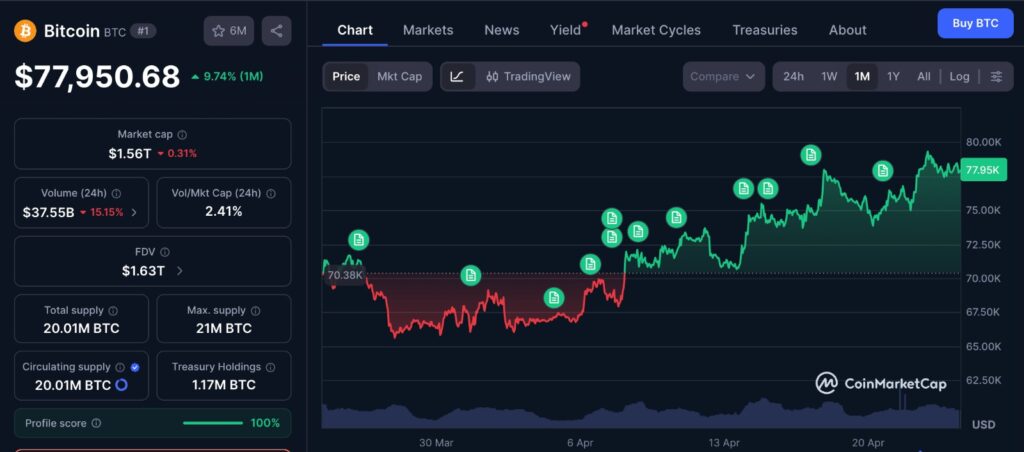
Over the past month, Bitcoin’s price action has remained compressed within a relatively tight range, with repeated pushes toward higher levels failing to sustain follow-through. The chart reflects a market that is actively testing liquidity on both sides rather than trending decisively. Each move higher has been met with supply, while pullbacks have found support before breaking down, reinforcing the idea that the market is still in a phase of absorption. This kind of structure typically forms when positioning builds on both sides, and price remains contained until one side is no longer able to hold.
Why the Weekly Close Matters More Than Intraday Moves
Bitcoin recently approached the $79,500 region before pulling back toward the mid-$77,000 range, keeping the $80,000 level just out of reach.
At first glance, this looks like a simple rejection. But the real signal lies in the weekly close.
On higher timeframes, Bitcoin is attempting to reclaim a critical structure known as the bull market support band, which includes the 20-week and 21-week moving averages. This band has historically separated continuation from weakness.
Bitcoin has not held above this band since late 2025, which changes how the current move should be viewed.
A weekly close above it would signal acceptance of higher prices.
Failure to reclaim it suggests the market is still transitioning, not trending.
Higher timeframes matter because they reflect where participants are willing to hold positions, not just react to short-term moves.
What the Repeated $80K Rejection Is Really Showing
The market is not failing at $80K because buyers are absent. It is failing because liquidity above that level is still strong enough to absorb aggressive positioning.
In recent price action:
- Bitcoin has taken out local highs
- Short positions have been squeezed
- But price has not expanded afterward
This behavior signals liquidity generation, not trend confirmation. This kind of reaction often follows events like recent crypto liquidations near $78K, where forced positioning gets cleared but fails to create sustained continuation.
Each move into resistance creates volume that allows larger participants to execute positions without pushing price higher. A similar pattern can be seen in the surge in taker volume and liquidity consumption, where aggressive execution increases activity without guaranteeing follow-through. When price stalls after a squeeze, incoming demand is being met with prepared supply.
Over the past week, this pattern has repeated, with price pushing into resistance, triggering reactions, and then stabilizing rather than breaking through. That consistency suggests the level is still being used for positioning, not cleared.
Liquidity is not continuous. Once nearby orders are absorbed, price must move to find the next available interest. If that next layer of demand is not strong enough, price stalls instead of expanding.
In simple terms:
The breakout attempt is being used, not supported.
The 21-Week EMA Is Acting as a Structural Gate
Another key reason Bitcoin is struggling lies in the 21-week exponential moving average.
This level has become a consistent rejection zone, preventing price from transitioning into a stronger trend phase.
Historically, when Bitcoin trades above this level:
- Pullbacks tend to be shallow
- Trend continuation becomes more likely
But when price stays below it:
- Moves become uneven
- Breakouts fail more often
- Liquidity traps increase
Right now, Bitcoin is still below that threshold. This reflects where the market is willing to hold positions over time, not just react intraday.
Market Positioning Is Still Fragile
On-chain and derivatives signals add another layer to this structure.
Recent data shows:
- Bitcoin reclaiming the $78K region
- Short positions building alongside the move
- Spot demand improving but not dominant
This combination creates a market that can move higher, but only temporarily. At the same time, rising open interest and trader exposure shows that positioning is increasing without clear resolution, which often leads to unstable moves rather than sustained trends.
Short squeezes can push price upward, but they do not create sustained trends. For a breakout to hold, the market needs consistent spot demand from participants willing to hold exposure, not just trade volatility.
Until that shift happens, upside moves remain driven by positioning imbalances rather than conviction.
Macro Conditions Are Quiet But Not Neutral
Another factor influencing this setup is the broader macro environment.
Markets are currently in a low-volatility phase, with major economic data releases and Federal Reserve decisions expected in the coming week.
This matters because:
- Low volatility compresses price
- Compression builds potential energy
- Direction depends on catalysts
In this case, Bitcoin is compressing just below resistance, not above support. That positioning delays breakouts, as the market continues to test liquidity before enough imbalance builds to move through it.
Editor’s View: This Is a Market Testing Commitment
What stands out is not that Bitcoin failed to break $80K. It is how it failed.
Price is still pushing higher, but each push is being absorbed rather than extended. That usually happens when the market is testing how much demand is actually committed, not just reactive.
Repeated attempts are often seen as strength, but without continuation, they signal that the market is still building the conditions required for a larger move.
Strong markets do not just reach resistance. They establish acceptance above it.
Right now, Bitcoin is still testing whether participants are willing to hold higher prices, not just trade around them.
How This Impacts the Broader Crypto Market
Bitcoin’s inability to decisively reclaim $80K has wider implications across the crypto market.
- Altcoins remain reactive. Without Bitcoin confirming strength, capital rotation stays limited
- Liquidity stays concentrated. Traders continue to focus on BTC
- Volatility remains compressed. No dominant trend reduces directional opportunities
In effect, Bitcoin continues to act as the market’s anchor.
Until it establishes acceptance above key resistance, the broader market is likely to remain constrained rather than expanding.
The Bottom Line
Bitcoin is not breaking $80K yet because supply at that level is still being absorbed.
The weekly close will determine whether:
- Price is accepted back into a bullish structure
- Or continues operating in a transitional phase
Price does not move because it reaches resistance.
It moves when that resistance is no longer able to hold.
Disclaimer: This content is for informational purposes only and does not constitute financial advice.
Keep yourself updated with the latest Altcoin News with FYI Gazette
 Bitcoin
  Ethereum
  Tether
  BNB
BNB  XRP
XRP  Solana
  TRON
TRON  Dogecoin
  Litecoin
  Pepe
Pepe