

Bitcoin Structure Shift Signals Strength as Bullish Bias Builds Beneath $80K
Bitcoin is once again approaching a familiar threshold, but this time the story is not just about price.
After briefly pushing toward the $80,000 level and pulling back, the market is showing early signs of structural confirmation rather than exhaustion. What looks like a simple retrace is often the phase that determines whether a breakout holds or fades.
The difference lies in what happens after the breakout.
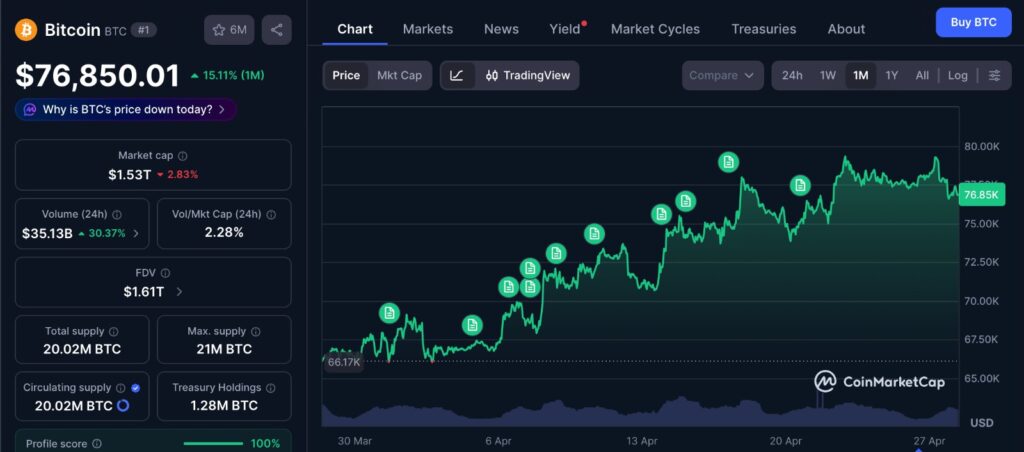
Bitcoin’s price action over the past month shows a clear transition from compression to expansion, followed by a controlled pullback. The chart highlights how price pushed toward the $80,000 region before retracing into the previous breakout zone, where activity has started to stabilize. This type of movement often reflects a shift in participation, where early buyers take profits while new demand begins to absorb supply at higher levels, reinforcing the developing structure rather than breaking it.
The Breakout Has Happened. Now Comes the Real Test
Bitcoin recently broke out of a multi-month descending channel that had capped price action since early February. That breakout matters, but structurally, it is only the first step.
The real test is the retest.
Following the move, Bitcoin pulled back toward the previous resistance zone around $76,600. This level had rejected rallies for months. Now, price is interacting with it again under different conditions.
This is the support-resistance flip.
When resistance turns into support, it signals that transactions are now happening comfortably at higher prices. The shift occurs when earlier selling pressure is absorbed and new demand prevents price from slipping back into the prior range.
This matters because once sellers at a level are absorbed, price no longer finds enough liquidity there to move lower, forcing it to seek the next area where orders exist.
Why the Pullback Is Not Weakness
Markets rarely move in straight lines, especially after breaking key structures.
The rejection below $80,000 and the pullback that followed are part of a normal process:
- Breakout
- Retest
- Continuation attempt
During this phase, short-term traders take profits while longer-term participants reassess positions. This creates temporary selling pressure, but also rebuilds liquidity around the new range. This phase often reflects a gap between price movement and underlying demand strength, where price continues higher even as participation builds gradually, a pattern seen in Bitcoin bull run demand lags behind price.
A retest toward areas like the 20-day average near $75,000 remains within normal behavior.
What matters is not how far price pulls back, but whether buyers continue to respond at higher levels. If each pullback attracts demand sooner than the last, it suggests that control is gradually shifting.
Markets weaken when pullbacks deepen. They strengthen when pullbacks get absorbed.
Positioning Data Is Quietly Supporting the Move
Beyond price action, derivatives data is starting to reflect a shift in positioning.
The long-to-short delta shows that long positions are gaining an advantage. More capital is leaning toward the upside, and that imbalance increases as price pushes higher.
This matters because positioning shapes how price reacts under pressure:
- Confidence builds as price holds higher levels
- Short exposure becomes more fragile
- Liquidity builds above price through potential liquidations
When price approaches areas where many short positions are placed, those positions can be forced to close. Large liquidation clusters have already shown how quickly leveraged positioning can unwind, as seen in recent events where over $820M in positions were cleared in a short span, highlighting how crypto liquidations surged across Bitcoin positions. This creates additional buying pressure that can push price further.
Leverage concentrates risk into narrow zones. Once those zones are breached, exits happen quickly and often together, accelerating the move.
The Real Barrier Still Hasn’t Moved
Despite the improving structure, one thing remains unchanged.
The $79,700 to $80,000 range continues to act as a major supply zone. Order book data shows a concentration of sell orders in this region, making it difficult for price to break through immediately.
This explains the recent rejection. Recent sessions have shown repeated hesitation around this level, with Bitcoin struggling at the $80K weekly close, reinforcing its role as a persistent supply zone.
From a structural perspective, this area reflects earlier distribution where larger participants reduced exposure. Until that supply is absorbed, upward movement is likely to face resistance.
For now, the market is caught between two forces:
- Below: A developing support zone near the breakout level
- Above: A dense cluster of sell orders near $80K
Until one side gives way, price is likely to remain reactive.
Editor’s View
What stands out is not the rejection, but how price behaves around it.
Recent sessions have shown that even after strong upward moves, price is not falling back into the previous range. Instead, it is holding higher levels and retesting structure with controlled volatility.
That stability is meaningful.
It suggests that selling pressure is being absorbed rather than expanding, which is often how markets transition from sharp moves into more sustained trends.
Stronger markets tend to stabilize before expanding.
What This Means for the Broader Crypto Market
Bitcoin holding above its former resistance has implications beyond BTC.
When support forms at higher levels:
- Capital tends to stay within the market
- Volatility compresses before expanding
- Altcoins often lag initially but follow once stability is established
At the same time, the presence of heavy resistance above suggests that progress may take time. The market may need multiple attempts to clear the supply zone.
This creates an environment where positioning and liquidity matter more than short-term price moves.
Final Take
Bitcoin is not just testing a price level. It is testing whether the market can sustain higher positioning.
The breakout has happened. The retest is underway. Supply above remains intact.
Price does not move higher because resistance breaks. It moves higher when there is no longer enough supply left to hold it back.
Disclaimer: This content is for informational purposes only and does not constitute financial advice.
Keep yourself updated with the latest crypto news with FYI Gazette
 Bitcoin
  Ethereum
  Tether
  BNB
BNB  XRP
XRP  Solana
  TRON
TRON  Dogecoin
  Litecoin
  Pepe
Pepe