

Bitcoin Bear Trap Forms as Shorts Crowd Below $80K
The Bitcoin bear trap setup is becoming one of the most important signals in the market as BTC trades below the $80,000 level and short exposure continues to build.
At first, the move looks simple. Bitcoin slipped under $78,000 for the first time since early May, weakening sentiment and giving bears a fresh reason to press lower. But the deeper signal is not only that price has fallen. It is how traders are responding to the decline.
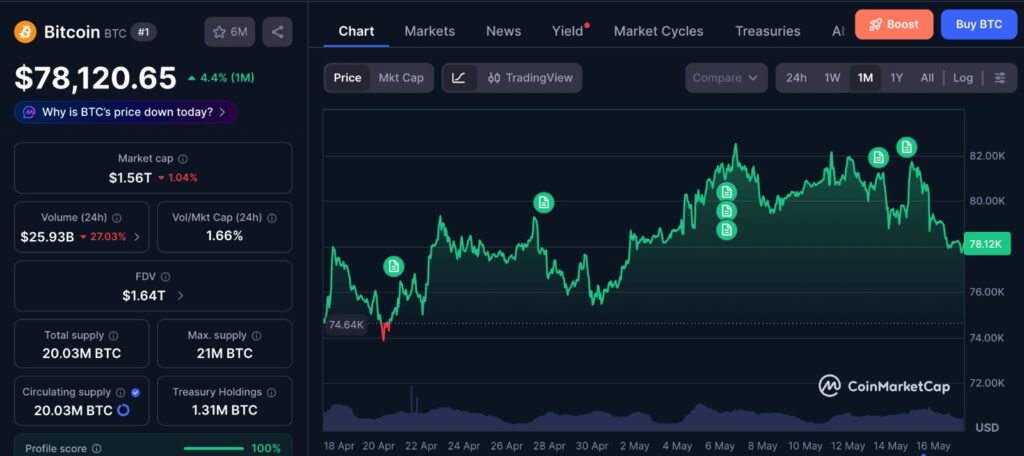
The one-month Bitcoin price chart gives useful context for the current bear trap setup. BTC has not only slipped below the $80,000 level, but has also spent recent sessions moving around a heavily watched area where traders are likely adjusting positions. This kind of price behavior matters because sharp breakdowns near crowded levels can attract late shorts, while any slowdown in downside momentum can leave those same positions exposed if Bitcoin begins to reclaim lost ground.
Open interest has been rising while funding rates have flipped negative. That combination suggests more traders are adding short positions as Bitcoin moves lower. In a normal breakdown, that can show confidence from sellers. But when too many traders enter the same downside trade before the move is fully confirmed, the market can become vulnerable to a sharp reversal.
That is where the Bitcoin bear trap risk begins.
A bear trap happens when price appears to confirm weakness, pulls in late short sellers, then reverses quickly enough to force those positions to close. In Bitcoin, this can create fast upside pressure because short traders must buy back BTC to exit.
The market does not need to turn strongly bullish for a bear trap to develop. It only needs enough short exposure, enough trapped positioning, and enough liquidity above price to make a squeeze possible.
Why The Bitcoin Bear Trap Setup Matters Now
The current setup is different from a simple support breakdown because traders are not only reacting to price. They are building positions around it.
When open interest rises during a decline, it usually means new futures positions are entering the market. If funding rates are negative at the same time, it suggests shorts are becoming more aggressive. Traders are betting that the breakdown will continue, and they are willing to pay to hold that bearish exposure.
That can become dangerous when price is already near a crowded level.
Bitcoin has spent time compressing around the $80,000 region. The longer price stays near a major psychological area, the more liquidity tends to build on both sides. Stop losses, liquidation levels, breakout orders, and short entries can all cluster around the same zone.
Recent sessions have shown that Bitcoin’s weakness is not only about price slipping lower. It is also about traders adding downside exposure while BTC trades near a heavily watched level.
This matters because crowded positioning can change how price reacts. If too many traders short after the decline has already started, there may be fewer fresh sellers left to keep pushing the market lower.
If Bitcoin continues lower with strong spot selling, bears may stay in control. But if downside momentum slows while shorts keep adding exposure, the setup can flip. The same bearish positioning that pushed sentiment lower can become fuel for a rebound.
The trap is not the drop. The trap is when traders short the drop after the easiest part of the move has already happened.
Negative Funding Shows Bears Are Getting More Confident
Negative funding does not automatically mean Bitcoin will bounce. But it does show that sentiment in the futures market has shifted. This shift also connects with broader concerns around Bitcoin funding rates and cautious leverage, where futures positioning can become more important than the price move itself.
When funding turns negative, short traders are generally paying long traders to keep their positions open. That can happen when too many traders lean bearish at the same time. In a weak market, this can continue. In a crowded market, it can also create squeeze risk.
A clean bearish trend usually has strong follow-through, steady selling, and controlled positioning. A trap setup often looks different. Price falls, traders rush to short, funding turns negative, and liquidity starts building around nearby levels. If price then refuses to extend lower, the market becomes uncomfortable for late bears.
That discomfort can grow quickly.
Short sellers need price to keep falling. If Bitcoin stalls, even without a major rally, those positions become less attractive. If price begins to push higher, some shorts exit. If enough shorts exit together, the move can become faster than normal buying alone would suggest.
That is how a bearish setup can turn into a forced move upward.
Liquidity Below $80K Could Shape The Next Move
The $80,000 area remains important, but not only as a support or resistance level. It is now a liquidity zone.
This is where many traders are making decisions. Some see the break below $80,000 as confirmation of weakness. Others see the same move as a possible false breakdown. That disagreement creates positioning on both sides of the market.
Liquidity below price can still attract Bitcoin lower. If there are larger liquidation zones beneath the market, price may move toward them before any stronger recovery attempt. That means the bear trap setup does not require an immediate bounce.
In fact, some traps become more convincing because price first pushes slightly lower.
A move toward deeper liquidity can pull in more short sellers. It can also shake out weak longs who entered too early. Once those positions are cleared, the market may become less heavy. If sellers then fail to maintain control, Bitcoin can reverse into the short exposure built during the decline.
The reason this happens is simple. Liquidity is not continuous. Once nearby orders are absorbed, price has to move toward the next area where stops, exits, and forced-close levels are waiting.
That is also where execution risk increases. When too many traders are positioned the same way, there may not be enough fresh sellers left to support the next leg lower. If price turns, exits can become crowded because shorts are forced to buy back into the same liquidity they expected to break. This is why forced exits matter, especially after periods when crypto liquidations surge near key Bitcoin levels and leveraged traders are pushed out quickly.
That is why the next reaction matters more than the first breakdown.
The Key Signal Is Seller Follow-Through
For now, the market needs confirmation.
If Bitcoin remains under pressure and spot selling continues, the bearish case stays alive. A crowded short trade can remain profitable if real demand is absent and sellers keep control of execution. Negative funding alone is not enough to call a bottom.
But if Bitcoin stops making meaningful downside progress while short exposure keeps rising, the bear trap risk becomes stronger. That same caution has appeared in Bitcoin whale short positioning, where large downside bets can signal pressure but also increase risk if the market fails to extend lower.
The clearest signal would be a failed breakdown. That means BTC trades below a key area, attracts shorts, then quickly reclaims the level with stronger buying pressure. In that case, late bears may become trapped below $80,000, and the market could move higher as those positions unwind.
This is why the current move should not be read too simply.
Bitcoin is not only testing price levels. It is testing positioning. The market is asking whether sellers have real follow-through or whether bears are becoming too confident too late.
Markets do not punish bearish views. They punish crowded trades that run out of fresh sellers.
Bitcoin Is In A Positioning Test, Not Just A Price Test
The current Bitcoin bear trap setup shows why price alone can be misleading.
A move below $80,000 looks bearish on the chart, but futures positioning adds another layer. Rising open interest and negative funding suggest that more traders are betting on downside after the decline has already started. That does not guarantee a reversal, but it does make the market more sensitive to any upside move.
If shorts are right, Bitcoin may continue searching for lower liquidity. If they are wrong, the rebound could be sharper because the market would not only be buying. It would also be forcing bears to exit.
That is the real story here.
Bitcoin is not simply falling below a round number. It is building a setup where late bearish positioning could become a problem if price refuses to extend lower.
For now, the Bitcoin bear trap has not been confirmed. But the ingredients are visible: rising short exposure, negative funding, liquidity below $80,000, and a market where too many traders may be leaning in the same direction.
Price does not turn because bears are wrong. It turns when sellers lose control and trapped shorts are forced to become buyers.
Disclaimer: This content is for informational purposes only and does not constitute financial advice.
Keep yourself updated with the latest crypto news with FYI Gazette
 Bitcoin
  Ethereum
  Tether
  BNB
BNB  XRP
XRP  Solana
  TRON
TRON  Dogecoin
  Litecoin
  Pepe
Pepe