

Bitcoin Retail Demand Drops as Futures Selling Takes Control of BTC Price Action
Bitcoin retail demand has weakened sharply on Binance, and that may be one of the clearest signals behind the latest pressure on BTC.
Bitcoin’s problem is not just that price slipped below the $80K region. The deeper issue is that retail spot participation has faded while futures activity continues to drive much of the move. That creates a different kind of market from a normal pullback, because the pressure is not only coming from price rejection. It is coming from a gap between real spot demand and aggressive derivatives positioning.
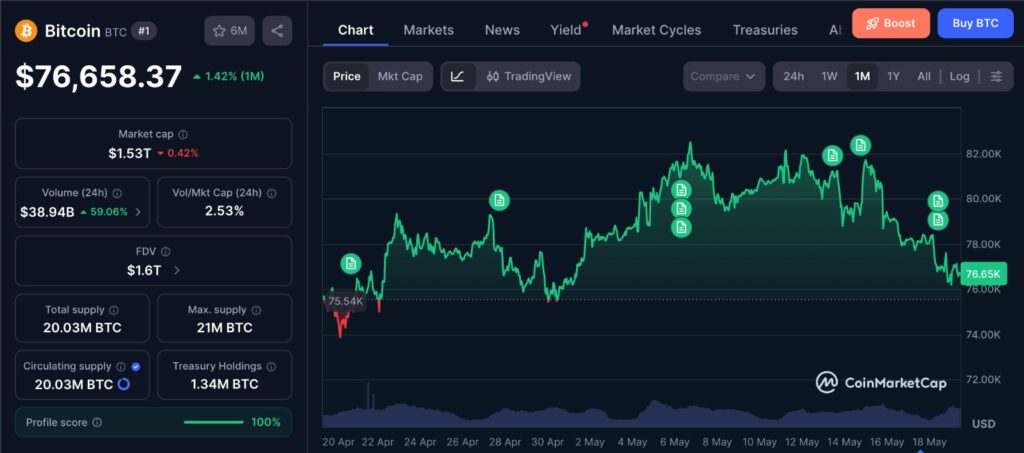
The one-month Bitcoin price chart helps show why this setup matters. BTC has not just moved lower in isolation; it has struggled to hold momentum while spot demand remains weak and futures activity continues to influence short-term direction. That makes the recent price action less about one failed level and more about whether buyers are showing enough depth to absorb selling pressure over time.
That distinction matters.
When Bitcoin falls in a market where spot demand remains strong, dips can be absorbed more easily. Buyers step in, exchange demand becomes clearer, and futures pressure has less control over the broader move. But when spot demand weakens while futures selling expands, price action becomes more fragile. Moves below key levels can accelerate because the market is being pushed more by positioning than by steady buyer absorption.
Recent Binance data points to that exact problem.
Retail Bitcoin inflows on Binance have fallen to historically low levels, with monthly retail BTC inflows averaging around 314 BTC in 2026. That is far below the roughly 1,200 BTC range seen around Bitcoin’s March 2024 local top near $75,000. It is also much lower than levels seen in earlier cycles, when retail participation was far more active.
This does not automatically mean Bitcoin is entering a deeper bear trend. But it does show that one major source of spot-market support has cooled at a time when BTC needs stronger demand to stabilize its structure.
Why Weak Retail Demand Matters More Than the Price Drop
Bitcoin trading below $80K is the visible headline. Weak retail demand is the structure underneath it.
Retail demand is not always the smartest money in the market, but it still matters because it adds depth, activity, and participation during key phases. When smaller buyers are active, they help absorb selling pressure across exchanges. When they step back, the market becomes more dependent on institutional flows, ETF demand, whales, and derivatives traders.
That makes the current setup harder to trust.
The latest data shows that Bitcoin retail demand growth cooled sharply. The 30-day change in retail investor demand dropped from 7.39% to 3.12% after briefly showing stronger expansion. That is still positive, but the slowdown matters because it happened while Bitcoin was already struggling to rebuild momentum.
In simple terms, retail demand did not disappear completely. But it weakened at the wrong time. This also connects with the broader concern that Bitcoin demand has been lagging during the current bull run, making each recovery attempt more dependent on real buyer follow-through.
Markets do not weaken only because sellers appear. They weaken when buyers stop absorbing supply with the same urgency.
A healthy recovery usually needs more than short liquidations, funding resets, or temporary futures support. It needs spot buyers to keep taking supply off the market. Without that, price can bounce, but the move often remains vulnerable because it is not backed by broad participation.
This matters because liquidity is not continuous. Once nearby orders are absorbed, price has to move to find the next pocket of real buying interest. When that demand is thin, futures pressure can push price faster than the spot market can stabilize it.
That is why this setup should not be viewed only through the lens of whether Bitcoin reclaims $80K. The better question is whether spot demand improves enough to support any recovery attempt.
Over the past week, Bitcoin’s price action has shown how quickly momentum can fade when futures activity is active but spot participation remains soft.
If spot demand stays weak, BTC may continue reacting sharply to futures flows. Price can still move fast in both directions, but the structure behind the move remains less stable.
Futures Selling Is Driving the Short-Term Pressure
The futures market has become a major part of Bitcoin’s current weakness.
Recent Binance activity showed large taker sell volume spikes during the decline, including one move of roughly $1.5 billion on May 15 and another above $1.1 billion as Bitcoin fell below $77,000. That kind of selling pressure shows that derivatives traders were not just reacting passively. They were actively pushing the move.
This matters because futures-driven moves can look stronger than they really are.
When futures selling dominates, price can break levels quickly. But the move may not always reflect broad spot-market conviction. It may reflect leveraged positioning, forced exits, or aggressive short-term selling. That can create sharp downside pressure without proving that long-term holders are abandoning Bitcoin. That is why Bitcoin funding rates and cautious leverage positioning remain important to watch when futures activity starts controlling short-term price direction.
Still, the risk is real.
When futures selling hits a market with weak spot demand, there are fewer natural buyers to absorb the pressure. That can make support levels less reliable and rebounds less convincing, because the market needs more than a futures reset to rebuild confidence. That same pressure was visible when crypto liquidations surged across the market, showing how quickly leveraged positions can unwind when BTC loses support.
This is where Bitcoin’s current structure becomes different from a normal resistance rejection.
The issue is not simply that sellers appeared near $80K. The issue is that the spot side of the market has not shown enough strength to balance futures activity. When one side of the market moves quickly and the other side is thin, execution becomes harder. Large orders can move price more sharply because there is less demand sitting underneath them.
That keeps BTC exposed to volatility if derivatives traders continue to control short-term direction.
Spot Demand Is the Missing Confirmation
The clearest concern is the gap between futures demand and spot demand.
Recent data showed BTC futures demand remained positive over 30 days, while spot demand stayed negative. Spot demand has reportedly remained below zero for 65 consecutive days, while futures demand stayed firmly positive. That means the market has not been supported evenly across both sides.
This is a major difference from stronger Bitcoin rallies in previous periods.
During healthier rallies, spot and futures demand usually rise together. Futures activity may amplify the move, but spot demand gives it a stronger base. In the current setup, futures demand appears active while spot demand remains weak. That creates an uneven structure.
Bitcoin can still bounce in that kind of market. But the bounce needs confirmation.
A futures-led recovery can move quickly, especially if shorts are forced out. But without spot buyers following through, that move can fade just as quickly. That is why every rebound needs to be judged by participation, not only by speed.
The market does not need retail demand alone to recover. But it does need evidence that spot buyers are returning somewhere. That could come through stronger exchange demand, improved ETF flows, reduced selling pressure, or clearer accumulation behavior. This is why Bitcoin ETF outflows around the $80K level matter, because institutional demand can either support spot strength or leave BTC more exposed to futures-led moves.
Until that happens, the market remains vulnerable to futures-led noise.
Binance Retail Inflows Show a Different Kind of Weakness
The decline in Binance retail inflows adds another layer to the picture.
Wallets holding less than 1 BTC are often used as a rough measure of smaller retail investor behavior. According to recent data, those inflows have fallen near historic lows on Binance. Monthly retail BTC inflows around 314 BTC are far below past cycle levels.
There are a few possible reasons for this.
Some retail investors may be less active because Bitcoin’s price is already high compared to earlier cycle stages. Others may be using spot Bitcoin ETFs instead of buying BTC directly on exchanges. Some may simply be waiting for clearer confirmation before entering again.
That means weak Binance retail inflows should not be interpreted too narrowly. It does not automatically prove that retail investors have lost interest in Bitcoin completely.
But it does show that Binance spot activity from smaller holders is not providing the same level of support seen in previous periods. For a market trying to recover from weakness, that matters.
Bitcoin does not need every small buyer to return immediately. But if retail participation stays muted while futures traders dominate, price may remain reactive instead of stable.
Thin demand does not always create a collapse. But it makes every large order matter more.
That is the core risk.
What This Means for Bitcoin Below $80K
Bitcoin’s move below $80K should be read as a demand problem first and a price problem second.
The market is not only asking whether BTC can reclaim a psychological level. It is asking whether the recovery has enough real spot demand behind it. Without that, $80K becomes less important as a number and more important as a test of participation.
If Bitcoin moves back above $80K but spot demand remains weak, the recovery may still look incomplete. Buyers would need to show that they are not only reacting to price, but absorbing supply with stronger conviction.
If Bitcoin stays below $80K while futures selling remains active, the market could remain under pressure. That does not guarantee a breakdown, but it does keep risk elevated because derivatives flows can continue setting the tone.
The important signal now is not just price direction. It is the quality of the move.
A stronger Bitcoin recovery would likely need three things: better spot demand, less futures-led selling pressure, and clearer evidence that buyers are willing to defend higher levels. Without those signals, the market may continue producing sharp rebounds that struggle to hold.
Editor’s View
This is not a simple bearish story. It is a participation story.
Bitcoin’s weakness below $80K matters, but the bigger issue is that spot demand has not kept pace with futures activity. That makes the market more vulnerable because futures can move price, but spot demand usually decides whether the move can last.
The cleanest read is this: Bitcoin is not breaking down only because sellers are strong. It is struggling because buyers have not yet shown enough depth where it matters.
That is why the current setup should not be judged only by whether BTC trades above or below one level. The better signal is whether spot demand starts improving after this futures-led pressure.
For now, Bitcoin remains in a fragile structure. Futures activity is loud, retail demand is quiet, and spot confirmation is still missing. Price does not stabilize because pressure pauses. It stabilizes when real demand is deep enough to absorb the next wave of selling.
Disclaimer: This content is for informational purposes only and does not constitute financial advice.
Keep yourself updated with the latest Altcoin News with FYI Gazette
 Bitcoin
  Ethereum
  Tether
  BNB
BNB  XRP
XRP  Solana
  TRON
TRON  Dogecoin
  Litecoin
  Pepe
Pepe