

Bitcoin Long Exposure Is Rising, But This Is Not a Clean Bullish Signal
Bitcoin long exposure is rising among top traders, but the move does not yet look like the kind of clean bullish signal that confirms a strong market breakout.
That is the important distinction in the latest Bitcoin setup. Professional traders appear to be increasing long exposure near the $76,000 region, suggesting that some larger market participants are becoming more comfortable defending that area. However, the broader market backdrop remains mixed. Bitcoin recently moved near $78,000 but failed to hold stronger upside momentum, while macro uncertainty, ETF outflows, and neutral funding conditions continue to limit conviction.
This makes the current move different from a simple “traders are bullish” headline.
The main angle is more precise: Bitcoin bulls are defending support, but they have not yet proven control of the trend. Top traders may be positioning around $76,000, but they are not doing so in a market where every major input is aligned in Bitcoin’s favor.
Bitcoin is not being rejected by price alone. It is being tested by whether enough real demand is willing to absorb supply at higher levels.
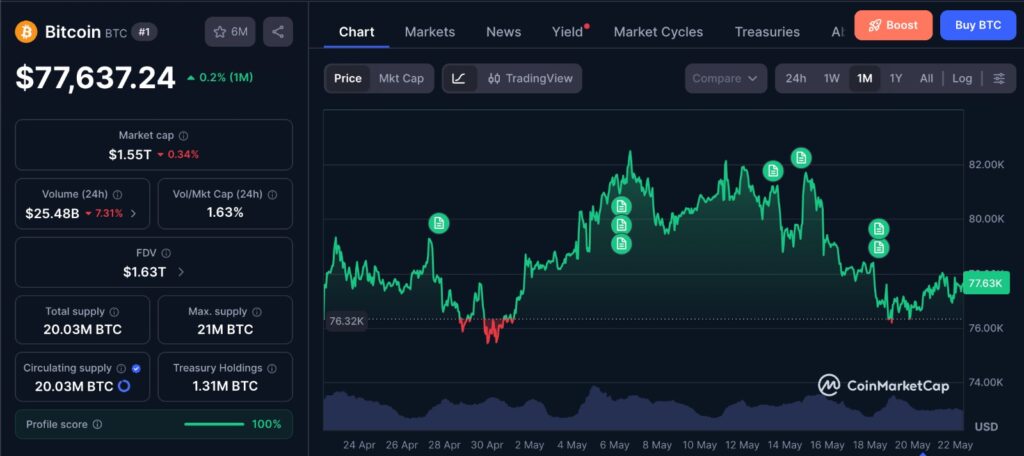
Why Top Traders Are Watching The $76K Bitcoin Support Zone
Recent derivatives data shows that top traders on major exchanges have increased their long-to-short exposure, with the ratio reportedly reaching its strongest level in roughly two weeks. On Binance, the ratio remained slightly tilted toward longs for several sessions, while traders on OKX reduced short exposure.
At first glance, that looks constructive.
It suggests that professional traders are not aggressively abandoning Bitcoin near the $76,000 area. Instead, some appear to be treating that region as a support zone where downside risk has become more measured. When top traders reduce shorts and increase longs near a key level, it can help stabilize price because fewer large accounts are pressing the market lower.
But the key phrase is “stabilize price,” not “confirm breakout.”
A stronger long-to-short ratio can support the floor, but it does not create demand by itself. Bitcoin still needs follow-through from spot buyers, ETF flows, and broader risk appetite. Without those, long positioning can remain defensive rather than expansionary. That is why the distinction between derivatives activity and real demand remains important, as discussed in our analysis of Bitcoin retail demand weakening while futures selling dominated the move. Traders may be betting that $76,000 holds, not that Bitcoin immediately pushes toward $82,000.
A support defense is not the same as momentum confirmation.
The structure also matters because large traders often adjust exposure around levels where liquidity is concentrated. If many traders are watching the same support zone, orders tend to build around it. That can create short-term stability, but it can also make the level more sensitive if price breaks below it.
If buyers absorb selling near $76,000, the level becomes stronger. If that absorption fails, long exposure can quickly turn from support into pressure as traders reduce risk.
This matters because liquidity is not spread evenly across the market. Once nearby orders are absorbed, price has to move toward the next area where buyers or sellers are willing to act.
ETF Outflows Still Limit Bitcoin Breakout Confidence
One of the main reasons the current Bitcoin long exposure signal should be viewed carefully is the continued pressure from US spot Bitcoin ETF outflows.
ETF flows matter because they reflect one of the clearest institutional demand channels in the current market cycle. When ETFs attract steady inflows, Bitcoin can absorb selling pressure more easily because fresh capital is entering through regulated products. When ETFs record persistent outflows, the market may still bounce, but the bounce has less institutional fuel behind it.
Recent data cited in market reports showed more than $2 billion in net outflows from US-listed spot Bitcoin ETFs since May 12. That does not mean Bitcoin must fall, but it does mean the market is trying to recover without the same level of ETF support that helped earlier upside moves. This same pressure was visible in our earlier analysis of how Bitcoin ETF outflows kept BTC stalled near $80K, showing why institutional flow still matters for breakout confidence.
This is where the setup becomes divided.
Top traders are increasing long exposure, but ETF investors have not clearly returned with strong conviction. Derivatives positioning is improving, while institutional spot flow remains cautious.
In a stronger Bitcoin rally, those forces usually move together. Traders increase exposure, ETF demand strengthens, spot premiums improve, and funding begins to reflect broader confidence. Right now, the picture is less synchronized.
Bitcoin is not weak enough to show full breakdown pressure, but it is not strong enough to show broad confirmation either.
Markets do not strengthen just because traders lean long. They strengthen when fresh buyers are willing to absorb supply.
Weak US Macro Data Makes Traders More Cautious
The macro backdrop is another reason this Bitcoin setup remains cautious.
Bitcoin still trades as a risk asset during periods of economic uncertainty. When investors worry about inflation, interest rates, consumer weakness, or tighter policy, risk appetite can fade across markets. That affects Bitcoin even when crypto-specific positioning looks stronger.
Recent pressure came alongside concerns about the US consumer and a more difficult inflation backdrop. Weak guidance from a major US retailer added to concerns about consumer stress, while elevated oil prices kept inflation fears alive. Higher inflation pressure can reduce the Federal Reserve’s room to ease policy, which matters because Bitcoin often performs better when liquidity expectations improve.
Macro risk does not need to break Bitcoin by itself. It only needs to make buyers less willing to chase price above resistance.
That is why the recent increase in long exposure should not be treated as a standalone bullish signal. It is happening inside a macro environment where investors are still questioning growth, inflation, and policy direction.
In simple terms, Bitcoin traders may be leaning long, but macro conditions are not giving them a clean runway.
This also affects execution. In uncertain macro conditions, buyers often become less aggressive. Instead of chasing higher prices, they wait for lower entries, which makes rallies harder to sustain. Price can still bounce, but each move higher needs stronger confirmation because liquidity above the market may not be as committed.
Recent sessions have shown this clearly: Bitcoin has found buyers near support, but each push higher has struggled to attract enough follow-through.
Neutral Funding Shows The Market Is Not Overheated
Another important part of the current setup is Bitcoin funding.
Funding rates have reportedly returned to more neutral levels after a previous period where shorts were paying to keep positions open. Neutral funding is useful because it shows the market is not extremely one-sided. It also reduces the risk that Bitcoin is being pushed higher by overcrowded leverage alone. That cautious leverage backdrop also connects with our earlier breakdown of Bitcoin funding rates and why traders remain careful even when price appears to stabilize.
That is healthier than a market where funding is aggressively positive and everyone is chasing upside.
However, neutral funding also shows that conviction is still limited. If traders were fully confident in a strong Bitcoin breakout, funding would likely show more aggressive demand for long exposure. Instead, the current funding backdrop suggests balance.
Bitcoin bulls are present, but they are not dominating the market. The current structure looks more like cautious positioning around support than a full leverage-driven expansion.
That makes the $76,000 region important. If Bitcoin holds that level while funding stays balanced and ETF outflows slow, the market could gradually rebuild confidence. But if support fails while ETF flows remain negative, the long exposure that currently looks supportive could quickly become vulnerable.
Neutral funding is not a weakness by itself. It simply shows that the market is waiting for proof before committing harder.
Why $82K Is Still A Difficult Bitcoin Target
The $82,000 level remains important because it represents the next upside area traders are watching. But getting there requires more than higher long exposure among top traders.
Bitcoin needs broader confirmation.
That confirmation would need to come from improving ETF flows, stronger spot demand, and buyers continuing to absorb supply as price rises. Without those signals, a move toward $82,000 may remain fragile even if top traders stay long. This is also why weaker US spot demand matters, especially after the Bitcoin Coinbase premium showed US buyer interest cooling during recent sessions.
This is the part many simple market updates miss.
A market can have enough positioning to bounce but not enough conviction to break out. That appears to be the current Bitcoin problem. Traders are showing more confidence near support, but the capital signals around the market are still cautious.
If Bitcoin moves higher from here, the quality of the move will matter more than the move itself. A slow push upward with weak spot demand and continued ETF outflows would be less convincing. A move backed by improving ETF flows, stronger spot participation, and steady funding would carry more weight.
That is the difference between price movement and market confirmation.
For Bitcoin to make a stronger attempt toward $82,000, buyers need to do more than defend dips. They need to absorb offers as price rises. That is where many rallies either build strength or lose momentum.
Editor’s View: Bitcoin Bulls Are Defending, Not Controlling
The most important takeaway is that Bitcoin bulls are defending the market, but they are not fully controlling it yet.
Top traders increasing long exposure near $76,000 shows that the market has not lost confidence in Bitcoin’s support structure. It suggests larger traders are not treating the latest weakness as an automatic breakdown.
But the signal is not strong enough on its own.
ETF outflows show institutional demand is still cautious. Neutral funding shows derivatives traders are not aggressively chasing upside. Weak macro data shows Bitcoin is still moving inside a difficult risk environment. Together, these factors make the current setup more about support defense than breakout conviction.
That is what makes this article different from a normal bullish Bitcoin headline.
The story is not simply that traders are going long. The real story is that traders are becoming more comfortable defending Bitcoin while the broader market still refuses to confirm a clean bullish turn.
This is usually where patience matters. If support keeps holding and stronger demand starts to appear, the market can slowly rebuild confidence. But if Bitcoin continues to rely mainly on derivatives positioning while ETF flows stay weak, the recovery remains easier to question.
Until that changes, $82,000 remains a target that needs confirmation, not just positioning.
Final Takeaway
Bitcoin long exposure is rising among top traders, and that supports the idea that the $76,000 region has become an important defensive zone. However, weak US macro signals, ongoing ETF outflows, a negative Coinbase premium, and neutral funding all suggest that the market has not yet built enough conviction for a clean breakout.
Bitcoin may be stabilizing, but stabilization is not the same as strength.
The next signal is not only whether BTC can move toward $82,000. It is whether buyers can absorb supply above support without relying mainly on derivatives positioning.
Price does not strengthen because one level is defended. It strengthens when real demand keeps showing up after the bounce.
Disclaimer: This content is for informational purposes only and does not constitute financial advice.
Keep yourself updated with the latest Altcoin News with FYI Gazette
 Bitcoin
  Ethereum
  Tether
  BNB
BNB  XRP
XRP  Solana
  TRON
TRON  Dogecoin
  Litecoin
  Pepe
Pepe