
Chainlink Exchange Outflows Put $8 LINK Support in Focus
Chainlink exchange outflows are drawing fresh attention as LINK trades near one of its most important support zones, but the real story is not simply whether the token can bounce.
The bigger question is whether reduced exchange supply can become real price support near $8.
LINK recently moved back toward the $8 area after several days of downside pressure, placing the token near a support region that traders have watched closely since earlier this year. The level matters because LINK has reacted from this area before, but repeated support tests also carry risk. The more often a level is tested, the more important real demand becomes.
Recent sessions have shown LINK reacting near support, but not yet building the clean follow-through that would confirm stronger buyer control.
That is why the exchange outflow data matters.
A reported decline of around 197,000 LINK in exchange reserves over the past week suggests that some holders may be moving tokens away from trading venues. In simple terms, fewer tokens sitting on exchanges can reduce immediate sell-side pressure. But that only matters if buyers step in near support.
Exchange outflows are the supply signal. Demand confirmation comes from buyers defending $8 and pushing LINK through nearby resistance.
For LINK to move beyond a short-term bounce, the market needs more than coins leaving exchanges. It needs buyers willing to absorb supply at higher prices, traders avoiding forced exits, and broader crypto conditions that allow altcoins to recover without being dragged down by Bitcoin weakness.
Chainlink Exchange Outflows Show Supply Pressure May Be Easing
Chainlink exchange outflows can be constructive when they reflect reduced intent to sell. If investors are withdrawing LINK to wallets, custody, or longer-term storage, it may show that fewer tokens are immediately available on trading venues.
That matters more when price is sitting near a key support zone.
When an asset trades near support while exchange reserves fall, the setup becomes more interesting because sellers may be testing the level while spot supply becomes thinner. If buyers step in, that combination can create a stronger reaction than price action alone would suggest.
This matters because supply leaving exchanges can reduce the amount available for immediate selling, but it does not create demand by itself. Liquidity is not continuous. Once nearby orders are absorbed, price has to move toward the next area where buyers or sellers are willing to act. This is similar to how exchange outflows only matter when demand confirms them, because reduced supply alone cannot force price higher.
That is where many traders overread the data.
Outflows do not prove that whales are aggressively accumulating. They do not prove that a breakout is coming. They only show that tokens have moved away from exchanges, and the reason behind that movement can vary.
This is why LINK’s next move depends on confirmation. If price holds above the support region and volume remains active, the outflow data becomes more meaningful. If price breaks down despite falling exchange reserves, the market is showing that reduced exchange supply was not enough to stop selling pressure.
Strong markets turn supply signals into continuation. Weak markets leave them unresolved.
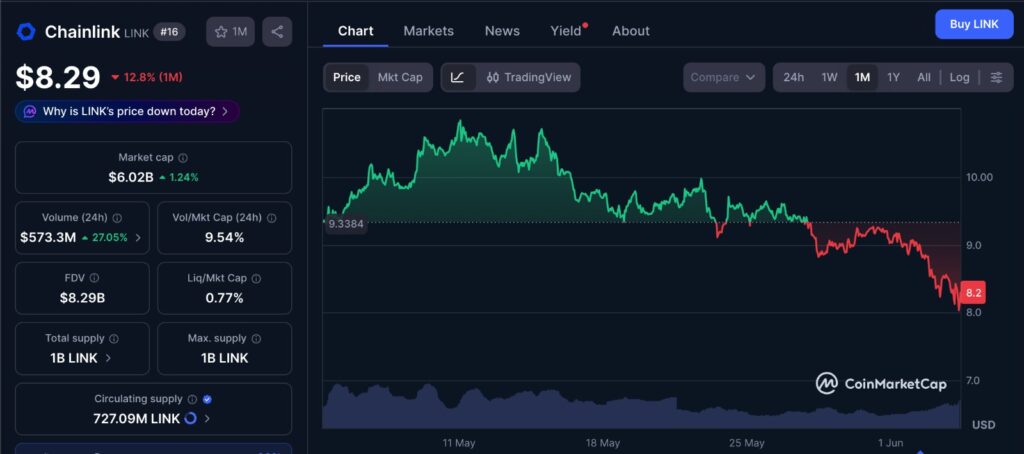
The one-month Chainlink price chart shows why the $8 region matters so much for the current setup. LINK has spent recent weeks under pressure, with each recovery attempt still needing stronger follow-through to prove that buyers are taking control. The chart also helps separate a normal bounce from a real shift in structure. If price continues to hold near $8 while exchange supply declines, the support zone becomes more meaningful. But if the chart shows weaker bounces and repeated returns to the same level, it would suggest that sellers are still testing demand rather than stepping away.
LINK Support Near $8 Is Now The Main Test
LINK’s price action has placed the $8 zone at the center of the market debate. The token reportedly moved near the $8.05 support area after recent downside pressure, while still trading below its 200-day exponential moving average.
That combination creates a mixed structure.
On one side, support near $8 has acted as an important reaction area. If buyers continue defending it, traders may treat the zone as a short-term accumulation base. On the other side, trading below a long-term moving average shows that the broader trend has not fully repaired.
This is not a clean bullish setup yet.
It is a pressure point.
A strong recovery from this area would suggest that sellers failed to push LINK into a deeper breakdown. A weak bounce would leave the token vulnerable to another test. If buyers keep absorbing selling near $8, the level becomes stronger. If each bounce gets weaker, the same support zone can turn into a liquidity target. The same idea applies across major crypto setups, where support levels only matter when buyers absorb selling instead of simply reacting for a short-term bounce.
That risk comes from how traders place orders around obvious levels. Stop losses, short entries, and forced exits often cluster near widely watched support, giving larger participants a clearer area to test.
Support is only strong when buyers defend it with conviction. If the market only sees temporary reactions without follow-through, the support zone becomes easier to challenge.
Funding Rates Show Traders Are Leaning Long
Derivatives data adds another layer to the LINK setup. The reported OI-weighted funding rate has turned positive, showing that traders are increasingly positioned for upside.
Positive funding can support a recovery narrative because it shows that long traders are willing to pay to maintain exposure. But it also introduces a different kind of risk. That is why funding rates can show when leverage becomes crowded, especially when traders are positioned in the same direction near an important support zone.
When too many traders lean in the same direction, the market becomes more sensitive to liquidation pressure. If price moves against those positions, long exposure can quickly turn into forced selling.
That is why LINK’s nearby liquidation zones matter. The downside level near $8.16 reportedly carries leveraged long exposure, while the upside level near $8.67 carries short exposure. This creates a narrow battlefield where both sides have something to lose.
If LINK pushes higher, short liquidations could help fuel a sharper move. If LINK slips lower, long liquidations could add pressure to the downside.
Markets do not move because traders want a bounce. They move when positioning has to adjust.
The market is not only deciding whether LINK is undervalued. It is also deciding which side of leverage gets pressured first.
Weak Trend Strength Keeps The Setup Unconfirmed
Another important detail is trend strength. LINK’s ADX was reportedly below the common 25 threshold, suggesting that the current trend lacks strong directional force.
In simple terms, LINK has not confirmed a recovery yet.
A weak trend can still produce sharp bounces, but those moves often fade if buyers do not stay active. Price may react from support, attract short-term traders, and then stall once momentum slows.
The better question is whether LINK can build structure.
A healthier recovery would require LINK to hold support, reclaim higher levels, and show stronger participation beyond short-term leverage. Without that, the move remains vulnerable to being a reaction rather than a reversal.
This is where the exchange outflow story is useful but not decisive.
Outflows can reduce potential sell pressure, but they do not remove the need for demand. A market can have lower exchange supply and still fail to rally if buyers remain cautious.
Why This LINK Setup Matters For The Wider Altcoin Market
Chainlink is not just another altcoin when it comes to market structure. LINK often attracts attention because of its role in oracle infrastructure, DeFi connectivity, and institutional-facing blockchain narratives.
That gives the token a stronger long-term identity than many smaller assets.
Still, in the short term, LINK trades inside the same liquidity environment as the rest of the crypto market. If Bitcoin remains under pressure or altcoin risk appetite weakens, LINK’s individual signals may struggle to translate into sustained upside.
This is the part many traders overlook.
Good token-specific data can help an asset outperform, but it does not always overpower broader market stress. If liquidity across crypto remains defensive, LINK may need stronger confirmation before buyers fully trust the setup.
In that sense, the current Chainlink exchange outflows improve the setup because selling pressure may be easing at a key level. But LINK still needs real demand near $8 to prove that reduced supply can become price support.
Editor’s View: LINK Needs Proof, Not Just Hope
The most important part of LINK’s current setup is the gap between supply behavior and price confirmation.
Exchange reserves falling near support is constructive. Positive funding shows traders are interested. The $8 region has history. But none of these signals, alone, confirms a durable recovery.
The market needs proof.
That proof would come from LINK holding the support zone, avoiding a liquidation-driven breakdown, and building enough demand to push beyond nearby resistance. Until then, this remains a high-attention setup rather than a confirmed shift in control.
The institutional-level point is simple: supply leaving exchanges only matters when committed demand is ready to meet price at higher levels. Otherwise, outflows can look bullish on-chain while price continues to move sideways or lower.
For now, LINK is not giving a clean answer.
It is giving a test.
If buyers defend the $8 area and push through nearby liquidity, Chainlink exchange outflows could become the early signal that supply pressure was easing before price reacted. If support breaks, the same data will look less like accumulation and more like a signal the market was not ready to respect.
That makes the next LINK move important.
Not because one support level decides Chainlink’s future, but because it may reveal whether current holders are quietly reducing sell pressure or whether the market is still too weak to reward the signal.
Price does not move because supply looks better on paper. It moves when that supply shift meets real demand and forces the market to accept higher levels.
Disclaimer: This content is for informational purposes only and does not constitute financial advice.
Keep yourself updated with the latest Altcoin News with FYI Gazette
 Bitcoin
  Ethereum
  Tether
  BNB
BNB  XRP
XRP  Solana
  TRON
TRON  Dogecoin
  Litecoin
  Pepe
Pepe