

Bitcoin Liquidation Reset Puts $60K Support in Focus
Bitcoin liquidation reset is now the main question facing the market after BTC crashed toward the $65,000 area and triggered one of the largest forced-selling events in recent months.
The move was not just another red candle.
Bitcoin fell sharply from the $71,000 region to a nine-week low near $65,360, wiping out heavily leveraged positions across the crypto market. Total crypto liquidations reportedly exceeded $1.8 billion, with long traders taking the largest hit. Bitcoin accounted for a major share of the forced selling, showing how heavily traders had been positioned for continued upside.
That makes this sell-off different from a normal correction.
A normal pullback can happen when buyers step aside. A liquidation-driven drop happens when traders are forced out of positions they can no longer support. This follows the same broader pattern seen during earlier crypto liquidation pressure, where leverage made downside moves sharper than normal spot selling. Once that process begins, selling becomes mechanical rather than emotional, and price can move faster than fundamentals.
Markets do not fall this sharply just because sentiment changes. They fall when weak positioning meets thin liquidity.
The key question now is whether this Bitcoin liquidation reset has cleared enough leverage, or whether forced selling is still pulling BTC toward the deeper $60,000 support zone.
Bitcoin Liquidation Reset Shows How Fragile Leverage Became
The most important detail in this move is not only the size of the decline. It is the structure behind it.
Bitcoin’s drop came as leveraged long positions were aggressively cleared from the market. Liquidations do not simply show traders losing money. They reveal where the market had become overcrowded.
When too many traders are positioned in the same direction, even a moderate downside move can trigger a chain reaction. Stop-losses are hit, margin positions are closed, liquidity thins, and forced selling pushes price toward lower levels where more positions become vulnerable.
The reason this happens is simple: leveraged traders have less room to wait. Once price moves against them, they become sellers at the exact moment the market needs buyers.
That is why liquidation events often feel more violent than the news around them. The market does not need a dramatic catalyst when leverage is already stretched. It only needs enough pressure to expose weak positioning.
In this case, Bitcoin’s fall toward $65,000 showed that part of the market was still built on borrowed conviction. Traders were positioned for continuation, but the market tested how much demand was real and how much depended on leverage staying intact.
Recent sessions have shown that rallies built on crowded leverage can unwind quickly when buyers are no longer willing to absorb every dip.
Strong demand absorbs selling. Crowded exposure becomes the selling.
Why The $60K Bitcoin Support Zone Now Matters
The $60,000 level is now the market’s deeper psychological and structural line to watch.
Bitcoin has already swept into the mid-$60,000 region, which may attract short-term relief buyers. However, the bigger test is whether BTC can stabilize above the $60,000 zone without depending on another wave of leveraged longs.
That distinction matters.
A bounce driven by fresh leverage would not prove that the market has healed. That is why Bitcoin funding rates and cautious leverage remain important to watch, because another leverage-heavy bounce could rebuild the same weakness that caused the reset. It would only rebuild the same weakness that caused the sell-off in the first place. A stronger recovery would need spot demand, slower selling pressure, and better absorption near support. This also connects with the wider issue of Bitcoin retail demand and futures selling, where futures-driven activity can move price without proving that organic demand is strong.
Liquidity is not continuous. Once nearby buy orders are absorbed, price often has to move lower to find the next area where buyers are willing to execute.
The $60,000 zone matters because it is where a leverage reset either becomes a base-building event or turns into a broader confidence problem. If BTC holds above that area, the crash may be viewed as a cleaner leverage flush. If it loses that zone with heavy volume and continued forced selling, traders may begin treating the move as a deeper shift in risk appetite.
That does not mean a breakdown is guaranteed.
It means Bitcoin has moved into a zone where reaction matters more than prediction.
The next important signal is not simply whether price bounces. It is whether buyers step in without quickly rebuilding the same leverage that was just cleared.
Forced Selling Is Different From Organic Selling
Forced selling can distort the market because liquidated traders are not choosing to sell based on a fresh view of Bitcoin. They are being removed because their margin can no longer support the trade.
That creates pressure that can exaggerate downside momentum.
However, forced selling can still cause real damage if buyers fail to absorb supply after the flush. In that case, the market can shift from a leverage reset into broader risk reduction.
This happens because many participants become constrained during volatility. Leveraged traders cut exposure, market makers often quote more cautiously, and buyers who might normally step in can wait for cleaner conditions before committing capital.
That makes support tests more fragile. When fewer buyers are willing to execute immediately, even ordinary selling can push price further than expected.
The cleanest reset would not be a sudden vertical recovery. It would be a slower rebuild where price holds support, leverage cools, and buyers absorb supply with less panic.
Bitcoin Price Chart Shows the Support Test
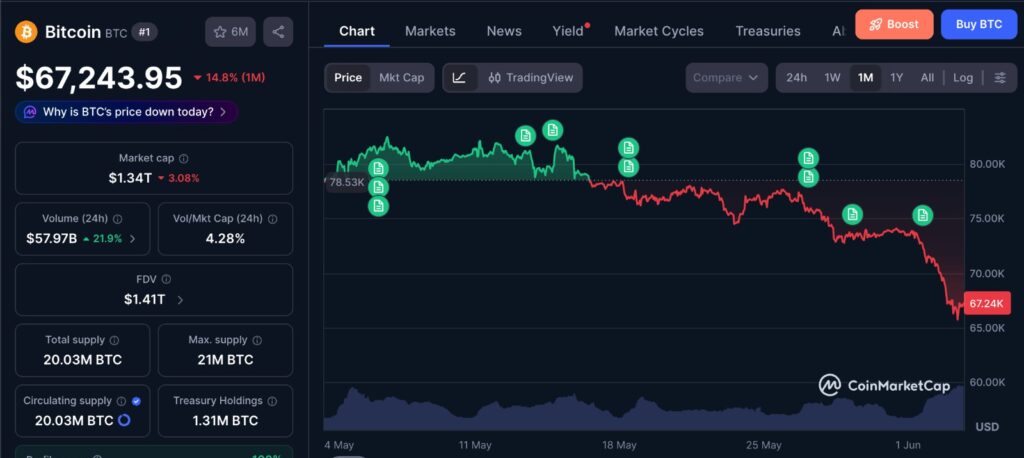
The one-month BTC chart helps show why this move matters beyond the headline liquidation figure. Bitcoin is no longer trading in a clean upside continuation pattern. It is now testing whether buyers can defend the mid-$60,000 area while the market watches the deeper $60,000 support zone. The key signal is not just whether BTC bounces, but whether that bounce comes with calmer price action and real demand rather than another quick rebuild of leveraged exposure.
That makes the current setup similar to Bitcoin’s earlier order book support test, where absorption mattered more than the headline level itself.
If BTC holds between $65,000 and $60,000 while volatility cools, the move may look more like a reset. If price keeps falling through support with heavy volume, the market may begin treating the liquidation wave as a deeper risk-off signal.
What The Crash Says About The Global Crypto Market
This liquidation event also affects the wider crypto market because Bitcoin remains the main liquidity anchor for risk appetite.
When BTC falls quickly, altcoins usually face pressure from two sides. Traders reduce risk across the board, while leveraged altcoin positions become harder to defend because Bitcoin weakness lowers confidence in broader market direction.
Ether also saw major long liquidations during the move, showing that the pressure was not isolated to Bitcoin. Large liquidation events often reset sentiment across the entire market, especially when traders had been leaning too heavily toward upside continuation.
The bigger impact is that capital becomes more cautious. Traders who were willing to chase upside may wait for confirmation, while short-term speculators may avoid adding leverage until volatility cools.
This is why Bitcoin’s reaction near support matters for the entire market. If BTC stabilizes, risk appetite can slowly return. If BTC keeps slipping, altcoins may struggle even if their individual narratives remain intact.
Editor’s View: This Is A Demand Test, Not Just A Crash
The market should not treat this Bitcoin move as a simple liquidation headline.
The real story is whether Bitcoin can still attract committed demand after leverage has been punished. Before the crash, traders were focused on upside continuation. After the crash, the market is asking a harder question: who is willing to buy when forced selling is still fresh?
That is the difference between a normal dip and a serious market test.
A calm stabilization would be more constructive than a sharp bounce fueled by fresh speculative longs. After a liquidation event of this size, the healthiest signal would be patience, not excitement.
The liquidation wave started when leverage could no longer hold, but the real test begins where forced selling ends and genuine demand has to stand on its own.
Bitcoin Liquidation Reset Leaves the Market at a Support Test
Bitcoin’s crash toward $65,000 cleared a large layer of fragile leverage from the market. That reset may be healthy if it reduces excess risk, but it does not automatically prove that demand has returned.
The deeper line is now the $60,000 support zone. Bitcoin does not need a fast bounce to repair the structure. It needs stable absorption, slower selling pressure, and buyers willing to step in without rebuilding excessive leverage.
That is what makes this Bitcoin liquidation reset important. The next signal is not speed. It is whether real demand can hold the market after forced selling has done its work.
Disclaimer: This content is for informational purposes only and does not constitute financial advice.
Keep yourself updated with the latest crypto news with FYI Gazette
 Bitcoin
  Ethereum
  Tether
  BNB
BNB  XRP
XRP  Solana
  TRON
TRON  Dogecoin
  Litecoin
  Pepe
Pepe