

Strategy Bitcoin Sale Exposes Bigger Risk Than 32 BTC
Strategy Bitcoin Sale news has triggered a debate far bigger than the size of the transaction.
Strategy disclosed that it sold 32 Bitcoin between May 26 and May 31, raising around $2.5 million at an average sale price of $77,135 per BTC. On paper, that is a small move for a company that still held 843,706 BTC as of May 31. The sale represented only a tiny fraction of its overall Bitcoin treasury.
But the amount is not the main issue.
The sharper question is whether the market still sees Strategy’s Bitcoin policy as unconditional. For years, many investors viewed the company as a one-way Bitcoin accumulator. A small sale does not change Bitcoin’s supply structure, but it does test that assumption.
That is why Strategy’s Bitcoin sale became more than a balance sheet update. It turned into a test of treasury policy, prediction-market rules, and the symbolic weight still attached to Michael Saylor’s long-standing Bitcoin narrative.
Strategy Bitcoin Sale Was Small, But Symbolically Loud
The first mistake traders can make is treating the 32 BTC sale as a major liquidity event.
It was not.
Bitcoin absorbs far larger flows across exchanges every day. A sale of 32 BTC does not suggest that Strategy is suddenly exiting Bitcoin, and it does not prove that institutional confidence in BTC has collapsed. The company’s remaining Bitcoin position is still massive, and the disclosed sale appears tied to preferred stock distribution funding rather than a broad retreat from Bitcoin exposure.
That distinction matters.
The size impact is limited. The signal impact is different. Strategy has spent years being viewed by many market participants as a permanent Bitcoin accumulator. When a company with that identity sells even a small amount, traders do not only measure the coins sold. They question whether the rulebook has changed.
That is where symbolic supply becomes market-relevant: not because it overwhelms liquidity, but because it forces investors to reprice the certainty they attached to the holder.
Markets do not move when supply changes alone. They move when investors start questioning the behavior they thought was fixed.
For Bitcoin bulls, Strategy has often represented long-duration conviction. For skeptics, it has represented leverage, financial engineering, and treasury concentration risk. This sale gives both sides something to argue about, even though the transaction itself remains small.
The more important question is not whether Strategy sold 32 BTC. The question is whether the market now has to price in a more flexible Bitcoin reserve policy than many investors previously assumed.
Polymarket Dispute Shows Why Timing Became The Real Issue
The more unusual part of the story came from Polymarket.
Users had wagered on whether Strategy would sell Bitcoin by May 31. The company’s filing later showed that a sale did occur between May 26 and May 31. However, the disclosure came on June 1, after the market’s date window had already closed.
That created the dispute.
For some traders, the sale date was enough. For others, the issue was whether the sale had been publicly confirmed within the market’s stated timeframe. That difference may sound technical, but in prediction markets, wording is the market.
This is where the event becomes bigger than one bet.
Prediction markets are not only about what happened. They are about what qualifies as proof inside the rules. If users believe outcomes are settled by narrow wording rather than economic reality, confidence can weaken. But if platforms ignore rules after the fact, markets become vulnerable to subjective interpretation.
That is the tension Polymarket now faces.
The Strategy sale exposed a problem that will likely become more common as crypto prediction markets grow. Real-world events do not always reveal themselves cleanly inside fixed deadlines. A company can act during one period and disclose during another. Regulatory filings may arrive after market close. Credible reporting may lag the actual event.
For traders, this means the real risk is not just predicting what happens. It is predicting what qualifies as proof.
Why Bitcoin Traders Should Care
For Bitcoin traders, the Strategy Bitcoin sale matters less as a supply event and more as a sentiment event.
Bitcoin did not face meaningful structural pressure from 32 BTC. But the reaction shows how sensitive traders remain to large treasury holders and their public narratives. When a major Bitcoin-linked company changes behavior, even slightly, it can affect confidence before it affects supply.
That matters in a market where liquidity can thin quickly around major headlines. When traders are already cautious, even a symbolic event can cause wider reactions because market makers pull back, short-term holders reduce risk, and buyers wait for clarity before stepping in. This is similar to how sharp positioning stress can turn into broader market pressure during periods of heavy crypto liquidations.
Liquidity is not continuous. Once nearby orders are absorbed or withdrawn, price has to move further to find the next willing buyer or seller.
Recent sessions have shown how quickly Bitcoin sentiment can shift when positioning is cautious and headlines challenge a widely held narrative. The selling pressure does not need to be large if enough participants decide to pause, hedge, or reduce exposure at the same time. That cautious positioning also connects with Bitcoin funding rates, which can show when leveraged traders are hesitant rather than confidently chasing direction.
In crypto, execution size is only one part of the story. The larger move often comes from how other participants reposition after the signal appears.
This does not mean Strategy has become bearish on Bitcoin. It also does not mean the company will begin selling aggressively. The available facts do not support that conclusion.
What it does suggest is that Bitcoin’s treasury narrative is becoming more complex.
A company can remain heavily exposed to Bitcoin while still selling small amounts for corporate purposes. That may be rational from a balance sheet perspective, but it changes the emotional story many investors attached to the company. “Never sell” is simple. “Sell selectively when needed for preferred stock distributions” is more nuanced, and markets often struggle with nuance in real time.
The Bigger Market Signal Is About Confidence
The strongest takeaway from this event is that Bitcoin is entering a phase where narrative discipline matters as much as capital flows. That makes underlying demand important, especially when Bitcoin’s bull run narrative depends on whether fresh buyers are strong enough to absorb changing market expectations.
Strategy still holds an enormous Bitcoin position. The sale was small. The proceeds were linked to preferred stock distributions. Those facts should prevent the story from becoming a panic narrative.
But the clash around Polymarket shows that traders are not only watching what institutions do. They are watching when actions are disclosed, how markets resolve those actions, and whether earlier assumptions still hold.
That is the part Google readers are likely to care about because it goes beyond the headline.
This was not simply a story about Strategy selling Bitcoin. It was a story about how a tiny transaction exposed three pressure points: investor dependence on treasury-holder narratives, prediction-market reliance on precise settlement language, and Bitcoin’s sensitivity to symbolic shifts from major public holders.
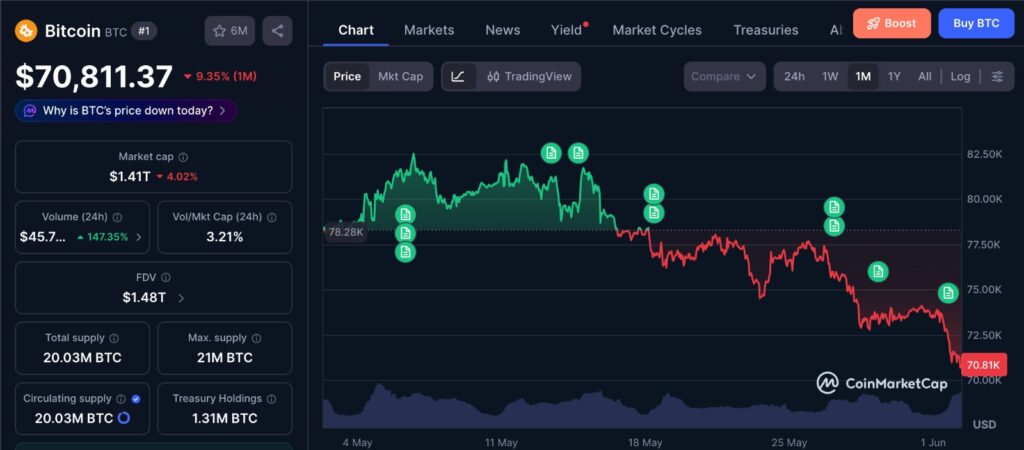
The one-month BTC chart from CoinMarketCap helps show why the Strategy Bitcoin Sale story matters beyond the actual 32 BTC transaction. The chart does not prove that Strategy’s sale drove Bitcoin’s entire move, but it gives readers useful context around how BTC traded as the disclosure entered the market. When price action is already sensitive, even a small treasury sale can become important because traders are not only reacting to supply. They are reacting to what the sale signals about confidence, positioning, and the assumptions built around major Bitcoin holders.
Editor’s View
The market should be careful not to overstate the sale itself.
Strategy did not dump Bitcoin in a way that changes the supply picture. The more important point is that corporate Bitcoin treasuries are not the same as personal cold storage. They sit inside companies with financing structures, shareholder expectations, distribution obligations, and disclosure timelines.
Public companies do not operate like anonymous cold wallets.
That is the real pressure point. A public company can remain deeply committed to Bitcoin while still needing flexibility around cash flow, preferred stock payments, and balance sheet management. That flexibility may be normal from a corporate finance perspective, but it makes the Bitcoin treasury story less absolute.
Bitcoin does not need Strategy to buy forever in order to survive. But when one of the most visible corporate Bitcoin holders sells even a small amount, the market is forced to ask a more mature question: is corporate Bitcoin adoption about pure conviction, or is it also about liquidity management and financing discipline?
The answer may be both.
That does not weaken Bitcoin’s long-term case by itself. It simply makes the Strategy story more realistic. The company can still be heavily aligned with Bitcoin, but the market may no longer treat every treasury decision as one-way accumulation.
That is why this story matters. Not because 32 BTC changes Bitcoin’s market structure, but because it shows how quickly a simple treasury action can reshape the assumptions around a major Bitcoin holder.
The real shift begins when the market can no longer treat a narrative as unconditional.
Disclaimer: This content is for informational purposes only and does not constitute financial advice.
Keep yourself updated with the latest crypto news with FYI Gazette
 Bitcoin
  Ethereum
  Tether
  BNB
BNB  XRP
XRP  Solana
  TRON
TRON  Dogecoin
  Litecoin
  Pepe
Pepe