

Ethereum 13-Month Low Turns ETH Into a Structural Confidence Test
Ethereum 13-month low pressure has become one of the clearest signs that ETH is no longer dealing with a simple market pullback.
Ether fell below the $1,600 level and reached a 13-month low near $1,540, extending a decline that has pushed Ethereum into a deeper phase of market repricing. The move matters because it does not only show weaker price action. It shows that confidence around ETH has shifted from hesitation into active stress.
That makes this decline different from an ordinary correction.
In a normal pullback, buyers usually step in around familiar support zones, traders debate whether the dip is overextended, and the market looks for a quick relief bounce. This time, Ethereum’s drop has carried a heavier message. ETH has failed to hold major psychological levels, risk appetite has weakened across crypto, and the market is now testing whether real demand can return before the market accepts a lower valuation range.
The key issue is not simply that ETH has fallen.
The issue is that Ethereum’s 13-month low has arrived after several failed attempts to rebuild confidence. That shift makes the current move less about short-term volatility and more about whether ETH can still defend its role as a core market asset during a deeper repricing cycle.
Ethereum 13-Month Low Shows a Failed Recovery Phase
Ethereum’s fall toward the $1,540 area shows that the previous recovery structure has broken down.
For months, ETH has struggled to turn rebounds into sustained upside. Each recovery attempt has faced selling pressure, weaker conviction, or limited follow-through from buyers. When that happens repeatedly, the market stops treating lower prices as a temporary discount and starts treating them as a new valuation zone.
That is what makes the current decline important.
Ethereum is not just reacting to one weak session. It is showing the result of a longer confidence drain. The market had several chances to prove that buyers were willing to defend ETH at higher levels. Instead, the latest breakdown suggests that those buyers either stepped back, became more cautious, or were not strong enough to absorb supply.
Markets do not reprice when one support level breaks. They reprice when buyers stop trusting the old range.
That is the main signal behind Ethereum’s 13-month low. ETH has moved from a failed recovery phase into a deeper test of whether the market still believes current prices reflect long-term value.
Why This ETH Drop Feels Different
The latest Ethereum decline feels more serious because it comes with a broader change in market behavior.
When ETH trades near major lows, price alone does not tell the full story. The more important question is how the market behaves around that weakness. Are buyers stepping in quickly? Are dips getting absorbed? Is selling pressure slowing down? Or is every bounce being treated as an opportunity to reduce exposure?
Right now, ETH is facing the second version.
Recent sessions have shown that Ethereum rebounds are still struggling to attract enough follow-through, while selling pressure returns quickly when price attempts to stabilize. That tells the market that buyers are present, but not yet strong enough to change the structure.
The market has not shown enough demand to turn the latest drop into a clear reversal. Instead, weakness has forced traders and investors to reassess Ethereum’s near-term setup. That does not mean ETH has lost its long-term relevance. Ethereum remains one of the most important blockchain networks in crypto. But market relevance and price strength are not the same thing.
A strong network can still face weak asset demand. That same Ethereum demand weakness has appeared in previous rallies where price strength failed to turn into sustained buyer follow-through.
That is the tension currently facing Ethereum. The network remains central to decentralized finance, tokenization, stablecoins, and smart contract activity. However, ETH the asset is being judged by price action, liquidity, and buyer conviction. If buyers are not absorbing supply, Ethereum can remain important while ETH price still struggles.
This is why the 13-month low matters. Ethereum’s long-term narrative is no longer enough by itself. ETH now needs visible absorption to prove that demand is returning near the lows.
ETH Confidence Is Now the Main Test
Ethereum’s biggest challenge is confidence.
Not hype. Not headlines. Not short-term relief candles. Confidence.
When a major crypto asset falls to a 13-month low, investors begin asking different questions. The question is no longer, “Can ETH bounce?” Most assets can bounce after a sharp decline. The real question becomes, “Will buyers trust the bounce enough to hold exposure?”
That distinction matters.
A weak relief bounce can happen simply because selling pressure slows. A stronger recovery needs buyers to believe that enough risk has already been priced in. Until that happens, rallies can fade quickly because traders use strength to exit rather than add.
Ethereum is now sitting in that zone.
The market needs to see whether lower prices attract patient buyers or whether the decline continues to create hesitation. If buyers absorb selling near the lows, the 13-month low can become a reset point. If they fail, the market may begin treating that area as the start of a lower accepted range.
This is where Ethereum’s price action becomes more than a chart.
It becomes a confidence vote.
Ethereum’s Profitability Signal Adds Pressure
One of the most important signals behind the move is the sharp decline in profitable ETH supply.
Recent market data cited by analysts showed that only about 30% of ETH supply was in profit based on the price at which coins last moved. That type of reading is rare and shows how deeply the latest sell-off has affected holders.
This does not automatically mean ETH must fall further. In some past cycles, deeply depressed profitability has appeared near major stress points. But it does show that Ethereum holders are operating in a more fragile environment.
Profitability stress changes supply behavior because holders are no longer deciding only between profit-taking and patience. They are deciding whether to realize losses, wait for recovery, or reduce risk before the market moves lower again. That makes ETH holder conviction important, because holder behavior can decide whether supply stays patient or returns during periods of stress.
That choice can make price action unstable.
Some investors become less willing to sell because they do not want to lock in losses. Others become more defensive because each failed bounce increases the fear that the market has not found a bottom. This mix can create sharp moves in both directions, but it can also make sustained recovery harder until confidence improves.
This is also where execution matters. When confidence is weak, large buyers do not always rush in at once. They often wait for proof that selling pressure is slowing before adding size. That delay can make the market feel heavier, because price must fall far enough to attract demand rather than simply touch a familiar support level.
Liquidity is not continuous. Once nearby bids are absorbed, price has to move lower to find the next buyer willing to take the other side.
That is why Ethereum’s 13-month low should not be viewed only as a bearish headline. It is a stress signal. The market is testing how much conviction remains after a long decline.
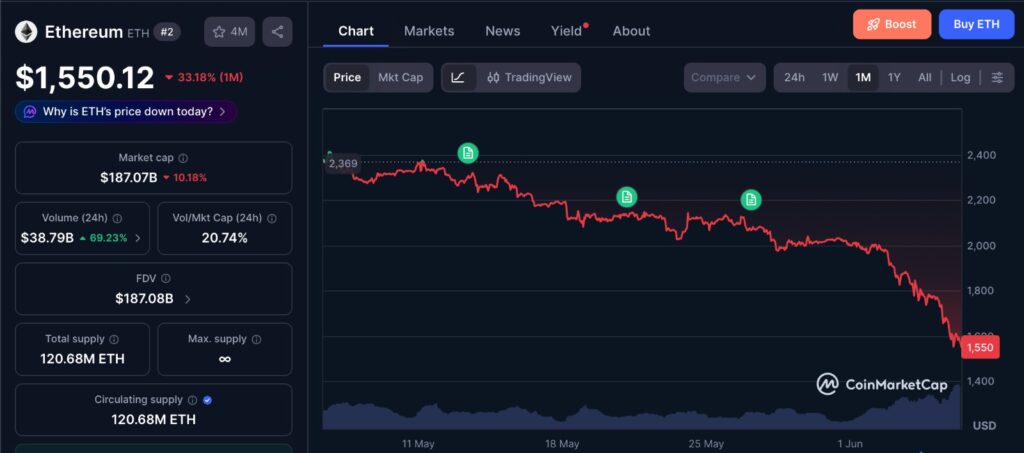
The 1-month ETH chart shows how Ethereum moved into its 13-month low after repeated recovery attempts failed to hold. The focus is not only on the drop toward the $1,540 area, but also on how price reacts around that zone. If rebounds continue to face selling pressure, it would show that confidence remains fragile. If ETH begins to stabilize near the lows, it would suggest buyers are starting to absorb the repricing rather than simply reacting to oversold conditions.
ETH Needs Absorption, Not Just a Bounce
The next important signal for Ethereum is not whether ETH can bounce from oversold levels.
It is whether buyers can absorb supply.
A bounce can happen quickly after aggressive selling. Absorption is different. Absorption means buyers continue stepping in even when sellers return. That makes Ethereum liquidity important, because price stability depends on whether buyers can absorb supply when selling pressure comes back. It means the market can handle fresh pressure without immediately breaking lower. It also means lower prices begin attracting real demand rather than only short-term traders looking for a reaction move.
This matters because sellers do not need to be aggressive forever. If buyers are slow, cautious, or waiting lower, even normal selling can keep pressure on ETH until stronger demand appears.
That is what ETH needs now.
If Ethereum begins to hold above its recent lows and selling pressure starts to fade, the market may begin treating the 13-month low as a reset. That would not instantly restore the bullish structure, but it would show that the most aggressive phase of selling may be slowing.
If ETH fails to hold that area, the market could start repricing Ethereum more aggressively. In that case, the 13-month low would not be remembered as the bottom. It would be remembered as the level where confidence weakened further.
Price can bounce on thin liquidity. Real recovery needs buyers who stay after the bounce.
Ethereum does not need a dramatic headline to recover. It needs proof that buyers are willing to defend price when sentiment is weak.
What This Means for the Broader Crypto Market
Ethereum’s weakness also matters beyond ETH itself.
ETH is not a small altcoin that can fall without affecting the rest of the market. It is one of the largest crypto assets and a core benchmark for risk appetite. When Ethereum breaks to a 13-month low, it sends a message about how investors are treating risk across the digital asset market.
A weak ETH market can reduce confidence in altcoins, decentralized finance tokens, and other smart contract assets. It can also make traders more cautious with leverage and more selective with exposure. That does not mean every crypto asset must follow ETH lower, but Ethereum weakness often affects the tone of the broader market.
This is especially true when ETH’s decline reflects confidence pressure rather than one isolated event.
The market is not only asking whether Ethereum can recover. It is asking whether risk appetite across crypto is strong enough to absorb stress in one of the sector’s most important assets.
Ethereum 13-Month Low Leaves ETH at a Critical Point
Ethereum’s 13-month low has changed the conversation around ETH.
This is no longer just about whether Ethereum can reclaim a short-term price level. The bigger question is whether ETH can rebuild confidence after moving into a deeper repricing phase.
The decline below $1,600 and the move toward $1,540 show that the market has become more cautious, more defensive, and less willing to reward weak rebounds. That does not remove Ethereum’s long-term role in crypto, but it does create a tougher near-term test for ETH as an asset.
For now, the market needs evidence that buyers can absorb pressure near the lows. Without that, each bounce risks becoming another exit point rather than the start of a stronger base.
Ethereum is not only testing a price level. It is testing whether real demand can return before the market accepts a lower range.
Disclaimer: This content is for informational purposes only and does not constitute financial advice.
Keep yourself updated with the latest crypto news with FYI Gazette
Keep yourself updated with the latest Altcoin News with FYI Gazette
 Bitcoin
  Ethereum
  Tether
  BNB
BNB  XRP
XRP  Solana
  TRON
TRON  Dogecoin
  Litecoin
  Pepe
Pepe