

BitMine Ethereum Purchase Tests ETH Demand As Price Falls Below $2K
BitMine Ethereum purchase activity has become one of the clearest signs that corporate treasury demand has not disappeared, even as ETH slipped below the key $2,000 level.
The company reportedly added another 25,000 ETH to its treasury, a purchase valued at roughly $47.98 million. The move came during a weak period for Ethereum, with ETH falling below $2,000 and testing buyer confidence across the market.
That makes the purchase important, but not simple.
On one side, BitMine’s accumulation shows that at least one major corporate buyer is still willing to add Ethereum during weakness. On the other side, ETH’s failure to hold $2,000 shows that corporate demand has not yet become strong enough across the wider market to confirm a recovery.
Recent sessions have shown the same tension clearly: ETH has attracted accumulation headlines, but price action has still struggled to hold important levels.
This is the main signal behind the latest move. BitMine’s ETH purchase shows corporate demand still exists, but Ethereum needs broader buyer absorption before that demand can turn into a real price recovery.
BitMine Adds ETH While Ethereum Loses $2K
BitMine’s latest 25,000 ETH addition extends its aggressive Ethereum treasury strategy. The company had already reported a large ETH treasury position of more than 5.4 million ETH as of May 31, making it one of the largest known corporate Ethereum holders.
That scale matters because corporate treasury buying is different from short-term trading. A company building a large ETH position is usually not reacting to every daily candle. It is positioning around a longer-term view of Ethereum as a treasury asset, staking asset, and blockchain infrastructure play.
Still, markets do not reward conviction automatically.
Ethereum fell below $2,000 despite the purchase, showing that treasury accumulation can support the demand narrative without immediately changing the price trend. A large buyer can absorb part of the selling pressure, but it cannot force the market to reprice ETH higher if broader liquidity remains weak.
That is the key mechanism: treasury demand can remove supply from the market, but price only turns when that demand becomes broad enough to absorb sellers across visible liquidity zones.
Accumulation tells the market that some buyers see value. Recovery begins only when enough buyers overpower sellers across spot markets, derivatives, and key support areas.
A large buyer can slow selling pressure, but it cannot replace broad demand.
Why The Purchase Matters For Ethereum
The BitMine Ethereum purchase matters because it suggests that institutional-style ETH demand has not broken down.
During sharp declines, many traders focus only on price. That can make the market look weaker than the underlying flow of capital suggests. If a large treasury buyer continues to add ETH while the asset is falling, it shows that some demand is willing to absorb panic-driven or forced selling.
This does not mean ETH has bottomed.
It means the sell-off is not happening in a market where every serious buyer has stepped aside. That distinction matters. When price falls and demand disappears, the market becomes fragile. When price falls but deeper-pocketed buyers keep accumulating, the downside structure becomes more balanced, even if the chart still looks weak.
The latest purchase also fits a broader Ethereum treasury narrative. BitMine has tied much of its digital asset strategy to ETH, while also staking a large portion of its holdings. That makes the company’s exposure less like a passive token bet and more like a balance-sheet strategy built around Ethereum’s yield and network utility.
However, investors should not confuse this with instant price support.
Treasury buyers can reduce available supply over time, especially if assets are moved away from exchanges or staked. But short-term price action is still controlled by liquidity, leverage, sentiment, and whether buyers defend key levels when sellers press.
That is where execution matters. A large purchase can look bullish on paper, but if it is absorbed quietly while other sellers keep hitting the market, price may still weaken. For ETH to respond more strongly, demand needs to appear not only as treasury accumulation, but also as visible support during stress.
Ethereum Below $2K Shows The Bigger Problem
Ethereum losing the $2,000 area is the part of the story that cannot be ignored.
The level was not just psychological. It had acted as a visible market reference point for traders watching whether ETH could maintain a stronger recovery structure. Once price fell below it, the market shifted from asking whether Ethereum could extend upside to asking whether buyers could defend the next support area.
That shift changes behavior.
Below $2,000, buyers often become more cautious because they want confirmation before adding exposure. Sellers, meanwhile, can become more confident because the market has failed to defend a level many traders were watching. That makes Ether open interest important to watch, since rising trader exposure can amplify moves when ETH breaks or reclaims a major level.
This matters because broken levels often become decision points. If buyers hesitate and sellers keep pressing, liquidity can concentrate lower, forcing ETH to search for a level where demand is strong enough to absorb supply.
Liquidity is not evenly spread across the chart. Once nearby bids are filled or pulled, price has to move toward the next area where buyers are willing to step in. This is also why Ethereum liquidity zones matter when ETH loses major levels, because buyer reaction around those areas often decides whether selling pressure slows or extends.
A reclaim of $2,000 would not just be a price move. It would show that buyers are willing to absorb supply where the market recently lost confidence.
If ETH cannot reclaim $2,000, the purchase may be seen as long-term conviction but not immediate support. If ETH does reclaim the level with stronger spot demand, the same purchase could be viewed differently, as part of a larger accumulation phase that helped absorb supply near the lows.
The facts are the same. The market interpretation depends on price response.
A treasury buy can strengthen the long-term story, but price still decides whether that story is being accepted by the wider market.
ETH Price Chart
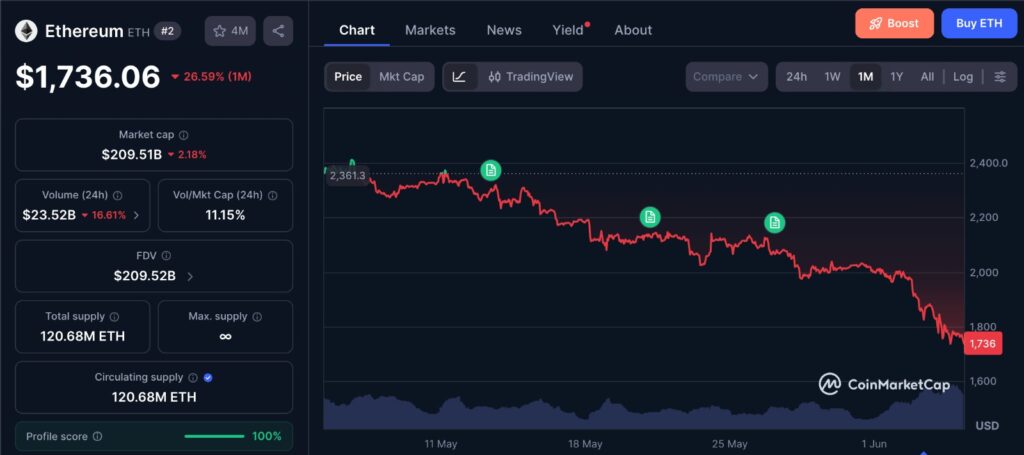
The 1-month ETH chart from CoinMarketCap helps show how Ethereum reacted after losing the $2,000 level despite BitMine’s latest treasury purchase. The key point is not only that one large buyer entered the market, but whether ETH can stabilize and reclaim that level with broader spot demand. If the chart continues to show weakness below $2,000, it would suggest corporate accumulation is being absorbed by selling pressure. A stronger reclaim, however, would show that buyers are beginning to absorb supply where the market recently lost confidence.
Spot Demand Still Needs Confirmation
Reports also pointed to continued spot buying and declining exchange reserves, both of which support the idea that some investors are still accumulating ETH during weakness.
That is constructive, but it needs context.
Spot buying can absorb sell pressure without immediately creating a rally. This usually happens when sellers remain active, liquidity is thin, or the wider market is still risk-off. In that environment, buyers may slow the decline before they reverse it.
That appears to be the current tension around Ethereum.
There are signs of demand beneath the surface, including BitMine’s treasury buying and reduced exchange supply. But ETH price action has not yet confirmed that demand is strong enough to reclaim broken levels. That same demand gap has been visible before, with Ethereum price rallies struggling when network activity and market-wide buying failed to confirm the move.
This is often how weak markets behave. Buyers may be present, but they become selective. Instead of chasing price higher, they wait for sellers to exhaust themselves, which can leave the chart heavy even while accumulation continues in the background.
Markets do not turn because buyers exist. They turn when sellers lose control.
For Ethereum, the next test is not simply whether more corporate buyers accumulate ETH. The more important question is whether ETH can stabilize, reclaim $2,000, and show that spot demand is strong enough to rebuild confidence.
What This Means For The Global Crypto Market
The BitMine Ethereum purchase also matters beyond ETH.
Corporate crypto treasuries became one of the strongest narratives in the Bitcoin market, especially after companies showed that balance-sheet demand could influence long-term supply dynamics. Ethereum is now seeing a similar discussion, but with a different structure.
Bitcoin treasury demand is usually built around scarcity and reserve-asset positioning. Ethereum treasury demand adds another layer because ETH can be staked and tied to network activity.
That makes Ethereum attractive to some institutions, but it also makes the signal harder to price. ETH is not only being judged as a store of value. It is being judged as a productive crypto asset linked to staking, decentralized finance, stablecoins, tokenization, and network use. This is why Ethereum RWA dominance matters in the broader demand discussion, because real-world asset activity can strengthen the network narrative without automatically guaranteeing ETH price strength.
For the wider crypto market, this creates a mixed message.
The positive side is that corporate demand has not vanished despite weak price action. That suggests treasury-focused buyers are still willing to look through volatility.
The negative side is that even a major ETH purchase did not stop Ethereum from falling below $2,000. That shows the market is still driven by broader risk pressure, not isolated accumulation headlines.
In simple terms, the treasury story is alive, but the market still wants proof.
Ethereum Needs More Than One Big Buyer
BitMine’s latest ETH purchase gives Ethereum bulls something to point to, but it does not solve the entire market structure.
The strongest version of the bull case is that corporate accumulation, spot demand, and falling exchange reserves could slowly tighten available supply if the trend continues.
The risk is that this process can take time, while price can still fall quickly when sentiment weakens.
That is why the $2,000 level remains central. A reclaim would suggest that buyers are beginning to regain control. Continued rejection below that zone would show that the market is still treating rallies as exit opportunities.
BitMine’s purchase proves that Ethereum demand has not disappeared.
But Ethereum’s drop below $2,000 proves something just as important: conviction from one large buyer is not the same as market-wide absorption.
The move does not begin when one balance sheet gets larger. It begins when available supply meets enough demand that sellers can no longer push ETH lower.
Disclaimer: This content is for informational purposes only and does not constitute financial advice.
Keep yourself updated with the latest crypto news with FYI Gazette
Keep yourself updated with the latest Altcoin News with FYI Gazette
 Bitcoin
  Ethereum
  Tether
  BNB
BNB  XRP
XRP  Solana
  TRON
TRON  Dogecoin
  Litecoin
  Pepe
Pepe