
Zcash 40% Crash Turns Orchard Bug Fix Into Supply Trust Test
Zcash Orchard bug concerns have turned ZEC’s sharp decline into more than a normal market correction.
ZEC fell around 40% after the Zcash ecosystem disclosed and fixed a critical vulnerability affecting Orchard, its latest shielded pool. On the surface, the timing looked strange. According to official updates, the issue had already been addressed, Orchard functionality had been restored, and the project stated there was no evidence of exploitation or unauthorized value creation.
Yet the market still sold aggressively.
That reaction matters because ZEC did not fall only because of a bug. It fell because a fixed privacy-system vulnerability still forced traders to reprice trust in the parts of Zcash that are hardest to externally verify.
Zcash’s 40% crash was not only a support failure. It was a confidence reset after the Orchard bug fix raised a harder question: can the market fully trust that ZEC’s shielded supply was not compromised?
That question is why the sell-off carried more weight than a typical altcoin pullback.
Why ZEC Fell Even After the Orchard Bug Was Fixed
Markets do not always wait for proof of damage. Sometimes, uncertainty alone is enough to trigger repricing.
In Zcash’s case, the vulnerability affected Orchard, a shielded pool designed to support private transactions. The issue has been described as a soundness bug, meaning the system could potentially accept something it should reject under the protocol’s rules. In simple terms, the concern was not just a broken feature. It was whether the accounting guarantees inside a private transaction system could still be trusted after such a flaw was found.
The official response helped contain the technical risk. Developers coordinated a temporary suspension of Orchard-related actions, followed by a protocol-level upgrade that restored functionality. The project also stated that user funds remained safe, privacy was not affected, and no unauthorized value creation had been detected.
But price did not recover immediately because the market was dealing with a different problem. The fix closed the known attack path, but it did not erase the perception risk around Zcash’s shielded architecture.
When a market cannot easily measure risk, traders often reduce exposure first and wait for confidence to return later. This matters because liquidity usually becomes thinner when buyers step back, and even moderate selling can move price faster when fewer participants are willing to absorb it.
Recent sessions have shown that ZEC buyers were not only reacting to lower prices. They were reacting to a confidence gap that made every rebound harder to trust.
That is the mechanism behind the crash: the fix reduced technical risk, but defensive liquidity kept the market pricing trust risk.
Markets do not sell only because something breaks. They sell when trust becomes harder to price.
The Real Issue Was Supply Confidence
The biggest concern around the Zcash Orchard bug was not simply that a vulnerability existed. Crypto networks have faced serious vulnerabilities before, and strong projects are often judged by how quickly they respond.
The harder issue was confidence in supply integrity.
Zcash has a fixed supply model, and its credibility depends on users believing that ZEC cannot be created outside the rules. The Orchard bug created anxiety because shielded pools are designed to protect privacy. That privacy is one of Zcash’s core strengths, but it also means every internal movement is not publicly visible in the same way as activity on fully transparent ledgers.
This is where the market reaction becomes easier to understand.
Zcash’s turnstile mechanism is designed to help track how much value enters and leaves different pools. That provides important protection around the overall supply structure. However, market participants were still left weighing a more uncomfortable question: if a vulnerability existed inside a shielded pool, could everyone be fully satisfied that nothing improper happened before discovery?
There was no confirmed exploitation. That point is important.
But in markets, “no evidence of exploitation” and “impossible to worry about exploitation” are not the same thing.
That gap between technical assurance and market comfort is where the 40% crash came from.
Why Privacy Became a Double-Edged Sword
Zcash exists because financial privacy matters. Its shielded transaction model is designed to hide transaction values and participant details while still allowing the network to validate activity cryptographically. This same privacy narrative had previously supported stronger interest in Zcash privacy coin demand, but the Orchard issue changed how traders evaluated that strength.
That value proposition is exactly why the Orchard incident hit sentiment so hard.
Privacy is powerful when users trust the cryptography. It becomes harder for markets to process when a vulnerability appears inside the same private system that users depend on for security and confidentiality. The market was not only reacting to a bug. It was reacting to the fact that the most advanced privacy layer on the network had required an emergency response.
That does not mean Zcash failed.
In fact, the response showed that the ecosystem could coordinate under pressure. The vulnerability was discovered through security research, disclosed responsibly, and addressed through network upgrades. Orchard transactions were restored, and the network continued operating.
Still, price action often reflects confidence before it reflects technical detail.
For many traders, the immediate conclusion was simple: if ZEC carries uncertainty around its shielded supply, the asset deserves a lower risk premium until trust is rebuilt.
This is how execution changes after a confidence shock. Buyers become less aggressive, market makers protect themselves with wider spreads, and sellers do not need much pressure to push price lower. Liquidity is not continuous. Once nearby bids are absorbed, price must move lower to find the next group of buyers willing to take the risk.
Once liquidity becomes defensive, even a fixed bug can trade like an unresolved risk.
Why the Fix Did Not Immediately Restore Trust
A protocol fix can happen quickly. Confidence usually takes longer.
The Orchard upgrade addressed the known vulnerability, but markets still had to digest several uncomfortable details at once. The bug may have existed for years. It affected a core shielded component. It required a coordinated emergency upgrade. It also forced the project to explain that no unauthorized value creation had been detected while dealing with the limits of what can be publicly verified inside a privacy-preserving system.
That combination is difficult for traders to ignore.
In a normal support-level correction, buyers usually look for familiar signals: strong bids, exchange outflows, or a reclaim of a key price zone. This decline was different because the market was not only asking where ZEC support sits. It was asking whether the asset’s credibility had been weakened. That separates this move from a standard ZEC key support correction, where the main focus is price structure rather than supply confidence.
That is why the crash should not be viewed only through the chart.
A support break can reverse quickly if buyers return. A confidence reset requires evidence, time, communication, and repeated proof that the system remains reliable under stress.
The market was not punishing Zcash because the fix failed. It was repricing the time needed for trust to catch up with the fix.
ZEC Price Reaction Shows How Crypto Reprices Uncertainty
The 40% ZEC drop shows how quickly crypto markets punish uncertainty around security.
This does not mean the market concluded that Zcash was compromised. It means traders treated the uncertainty itself as a reason to reduce risk. That distinction matters. Selling pressure can accelerate even when no loss has been confirmed if the unresolved question is large enough. That kind of reaction often appears when crypto market confidence becomes fragile and traders prefer to reduce exposure before clarity improves.
For privacy coins, that sensitivity is even stronger. These assets already sit in a more complex category because they combine cryptography, regulatory pressure, exchange access concerns, and public trust challenges. A bug involving shielded transactions adds another layer to that risk profile.
Crypto markets do not need certainty to sell. They only need uncertainty to become expensive to hold.
That is what happened with ZEC.
The fix was necessary, but it was not enough to restore the market’s willingness to pay the same valuation for Zcash. Traders needed more than a patched vulnerability. They needed renewed confidence that the network’s shielded supply assumptions remained intact.
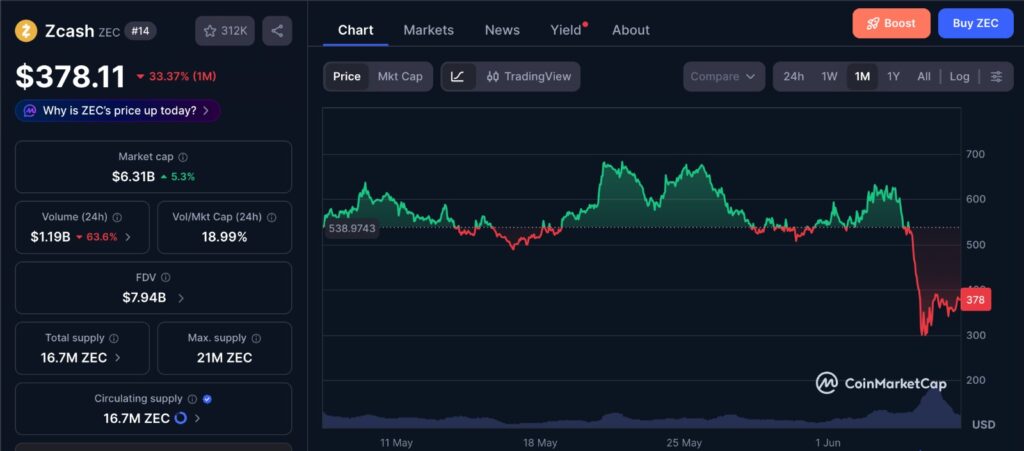
The 1-month ZEC chart shows how sharply price repriced after the Orchard bug disclosure and fix. The key point is not only the size of the decline, but how the market behaves after the first confidence shock. If ZEC struggles to build a stable base, it would suggest buyers are still cautious about supply-trust risk. A stronger stabilization phase, however, would show that the market is beginning to absorb the uncertainty rather than simply reacting to the initial sell-off.
What Zcash Needs Next
For Zcash, the path forward is not only technical. It is reputational.
The project has already taken the most important first step by fixing the vulnerability and communicating that no unauthorized value creation was detected. But rebuilding confidence will likely depend on continued transparency, further security reviews, stronger verification processes, and clear explanations that ordinary users and investors can understand.
The market will also watch whether ZEC can stabilize without relying only on short-term dip buying. If buyers return because they believe the incident is contained, ZEC may begin to rebuild trust. If rallies keep fading, the market may continue treating the Orchard bug as a deeper confidence scar.
The important point is that Zcash is now being judged on two levels.
The first is whether the technical vulnerability has been fixed. Based on official updates, that part has been addressed.
The second is whether the market believes the fix fully restores confidence in ZEC’s shielded supply model. That part may take longer.
Final Takeaway
ZEC’s 40% crash was not just a reaction to weak support or broader market pressure. It was a repricing of trust.
The Orchard bug fix removed the known vulnerability, but it also forced the market to confront a deeper issue: privacy systems require confidence that users cannot always verify in a simple, public way. That is not a flaw unique to Zcash, but it became the center of the market’s concern once the vulnerability was disclosed.
For Zcash, the incident may eventually be remembered as a successful emergency response. For ZEC traders, it was a reminder that security perception can move price as sharply as liquidity or leverage.
The chart showed the crash, but the structure showed the real stress. Price does not stabilize because uncertainty is explained. It stabilizes when enough buyers believe the risk has been absorbed.
Disclaimer: This content is for informational purposes only and does not constitute financial advice.
Keep yourself updated with the latest Altcoin News with FYI Gazette
 Bitcoin
  Ethereum
  Tether
  BNB
BNB  XRP
XRP  Solana
  TRON
TRON  Dogecoin
  Litecoin
  Pepe
Pepe