

Bitcoin Realized Losses Keep Capitulation Risk in Focus
Bitcoin realized losses are becoming one of the clearest signals that the current market reset may not be finished yet.
BTC has already suffered a major drawdown, sentiment has weakened, and many traders are treating the recent decline as a late-stage bear-market move. However, on-chain loss data suggests full capitulation is still unproven.
That matters because major Bitcoin bottoms are rarely built on price decline alone. They are usually built when weak holders stop defending losing positions, sell into fear, and allow stronger buyers to absorb supply at lower levels.
According to recent on-chain analysis, Bitcoin’s realized losses since the October top have reportedly reached roughly $174 billion, still below the $211 billion recorded during the 2022 bear market. The gap matters, but it should not be treated as a required target. Bitcoin does not need to repeat the 2022 path exactly.
It does show that the market has not yet produced the same scale of accepted loss-taking seen during the last major bear-market capitulation.
Why Bitcoin Realized Losses Matter
Realized losses measure coins that move on-chain at a lower price than their previous transaction price. In simple terms, they show when investors are no longer just holding paper losses. They are selling at a loss.
That distinction matters.
A market can look weak when price falls, but unrealized losses do not always create a bottom. Many holders can stay underwater for weeks or months without selling. Capitulation becomes more meaningful when those losses are realized, because it shows that sellers have accepted the pain and exited.
This is why Bitcoin realized losses can reveal something price charts alone often miss.
Bitcoin can fall sharply and still not reach full capitulation if enough holders continue to believe every dip is a buying opportunity. In that case, price may be lower, but psychology has not fully reset. The market remains crowded with participants still expecting a quick recovery.
Recent sessions have shown this tension clearly: BTC has struggled to rebuild momentum, yet dip-buying confidence has not disappeared in the same way it usually does near deeper loss-taking phases.
The realized-loss total is already severe, but it has not yet exceeded the 2022 bear-market benchmark. If this cycle follows a similar emotional pattern, another wave of loss realization could still occur before the market forms a cleaner long-term base.
Markets do not bottom because price looks cheap. They bottom when forced sellers run out of supply.
Retail Conviction Is Still Unusually High
The other important signal is retail behavior.
A healthy late-stage capitulation usually comes with exhaustion. Traders stop calling every dip a gift. Weak holders stop averaging down aggressively. Social confidence fades. Instead of trying to catch the bottom, participants become cautious, quiet, or completely disengaged.
This cycle does not appear to have fully reached that point yet.
Recent market commentary has pointed to retail traders continuing to buy dips even as Bitcoin keeps printing lower levels. At the same time, larger and more experienced participants have reportedly used relief bounces to reduce exposure. This same tension between Bitcoin retail demand and futures selling has already shown how retail conviction can keep price supported temporarily without confirming a stronger market structure.
That is not usually the cleanest foundation for a durable bottom.
When retail buyers keep absorbing coins from larger sellers during a decline, price can hold temporarily, but risk transfers to participants with less patience and weaker balance sheets. That support can look stable until conviction weakens and the same buyers become sellers.
The reason this happens is simple: retail buyers often add gradually into weakness, while larger holders can use liquid bounce periods to sell without forcing an immediate breakdown. Once nearby demand is absorbed, price has to move lower to find the next group of buyers willing to take the other side.
This is why high conviction during a decline can be a warning rather than a bullish signal.
Confidence is useful when it is supported by strong demand and improving structure. It becomes risky when it only delays capitulation.
Why This Is Different From a Normal Bitcoin Pullback
Not every Bitcoin correction becomes a capitulation event. Some declines are liquidity resets. Others come from leverage being flushed out of the system. Realized losses show a deeper kind of damage because they reflect actual holder exits. This is also why Bitcoin funding rates matter in the current setup, since cautious leverage can show whether traders are reducing risk or still leaning too heavily into a rebound.
That makes the current setup more important than a normal price pullback.
Bitcoin is not only testing support levels. It is testing whether investors are ready to accept lower valuations after months of failed recovery attempts. If realized losses continue to rise, it would suggest that more holders are abandoning underwater positions rather than waiting for a rebound.
That shift can be painful in the short term, but it often helps reset the market.
A bottom built on hope is fragile. A bottom built after forced sellers are exhausted is stronger because fewer trapped holders remain above price waiting to exit on every bounce.
If BTC rebounds before loss realization becomes more complete, the move may still face heavy selling pressure from investors trying to escape near breakeven. If losses deepen and weaker holders are cleared out first, the next recovery attempt could have a cleaner structure.
Price can bounce before confidence returns. But without seller exhaustion, that bounce often becomes a liquidity window for trapped holders.
The $35 Billion Gap Keeps Capitulation Risk Alive
The gap between the current realized-loss total and the 2022 bear-market total is roughly $35 billion.
That number should not be treated as a precise target. Markets do not follow old cycles perfectly, and on-chain data should never be used in isolation. However, the gap gives traders a useful framework for judging whether the current reset has reached a comparable level of stress.
Bitcoin has already absorbed major losses, but not enough to clearly exceed the last major capitulation benchmark. Another wave of loss realization could still occur before the market forms a cleaner long-term base.
That would not necessarily mean Bitcoin is broken. It would mean the market is still moving through the emotional phase that often comes before stronger long-term accumulation.
The risk is that some traders may be treating the current decline as late-stage capitulation even though the data still points to an unfinished reset.
That is why this moment matters.
Bitcoin Price Chart Shows the Capitulation Test
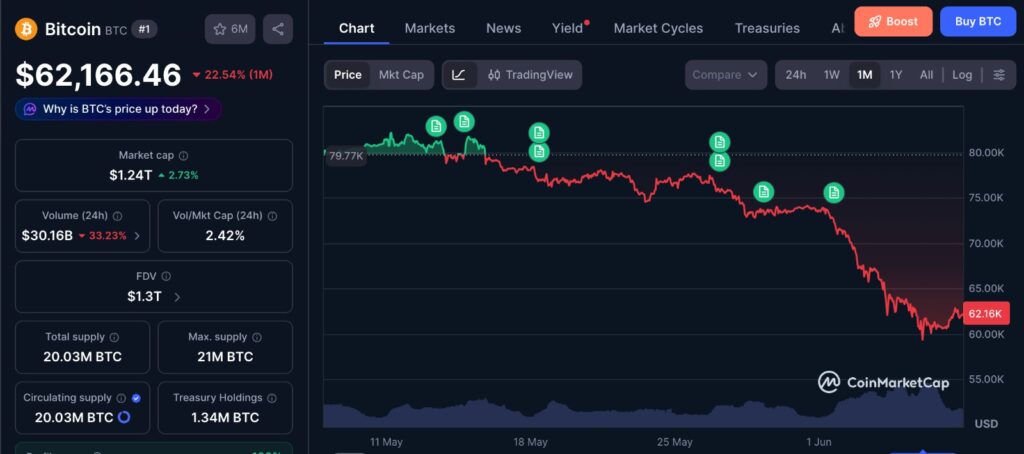
The 1-month BTC chart from CoinMarketCap shows why Bitcoin realized losses remain important in the current market structure. Price has struggled to rebuild strong momentum, and recent movement suggests traders are still testing whether lower levels can attract steady demand or whether each rebound is being used by sellers to reduce exposure. The key signal is not only whether BTC bounces, but whether it can hold those rebounds while realized losses begin to slow. If price stabilizes as loss-taking eases, it would suggest seller exhaustion is improving. If BTC keeps weakening while realized losses climb, the market reset may still be unfinished.
If BTC rebounds while loss realization slows, the market may be moving closer to seller exhaustion. If price keeps weakening while realized losses climb, the reset may still be unfinished.
What Would Confirm a Stronger Bitcoin Bottom?
For Bitcoin to build a more convincing bottom, the market likely needs more than a short-term bounce.
The first sign would be a slowdown in realized losses after a major flush. That would suggest fewer holders are selling at a loss and forced exits are beginning to fade.
The second sign would be stronger absorption from larger buyers. If institutional or mid-sized participants stop selling into bounces and begin absorbing supply near lower levels, the structure would become healthier. That is why earlier signs of Bitcoin demand weakness remain important, because a bottom needs more than lower prices. It needs enough real demand to absorb supply.
The third sign would be a shift in retail psychology. A true reset often comes when dip-buying confidence fades and the market stops assuming every decline must be immediately reversed.
Until those signals improve, Bitcoin’s bottom case remains incomplete.
Price can bounce before the loss-taking phase is finished. But without a deeper reset in holder behavior, those bounces can become exit liquidity for sellers still waiting to reduce exposure.
Editor’s View: Capitulation Is About Behavior, Not Just Price
The market is not only asking how far Bitcoin has fallen. It is asking whether enough holders have accepted losses for the next recovery attempt to start from a cleaner base.
High realized losses show real damage. They show that some investors have stopped waiting for a rebound and have chosen to exit at a loss. That is a painful process, but it is also how excess supply begins to clear.
The concern is that continued retail dip-buying suggests the emotional reset may not be complete. If buyers are still treating every decline as temporary while larger participants sell into strength, the market may need more time before supply and demand are balanced again.
The key signal now is not a single price level. It is whether sellers lose urgency and stronger buyers absorb supply without needing constant relief rallies to hold the structure together.
Bitcoin’s Next Move Depends on Who Absorbs the Pain
The current Bitcoin market is not only about whether BTC can hold a specific level. It is about who is carrying the losses and whether those losses have been fully processed.
If retail buyers continue absorbing supply while larger participants sell into strength, the market may remain vulnerable to another downside purge. If weaker holders capitulate and stronger buyers step in with sustained demand, the foundation for a stronger recovery becomes more credible.
That is why Bitcoin realized losses deserve close attention now.
They show that the market has already taken significant damage, but the process may not be complete. With 2026 realized losses still below the 2022 bear-market benchmark, the case for full capitulation remains unproven.
Bitcoin does not need to copy 2022. But it still needs proof that seller urgency is fading, realized losses are slowing, and stronger buyers are absorbing available supply.
The stronger move begins when the market stops relying on dip-buying belief and starts proving that available supply has been fully absorbed.
Disclaimer: This content is for informational purposes only and does not constitute financial advice.
Keep yourself updated with the latest crypto news with FYI Gazette
 Bitcoin
  Ethereum
  Tether
  BNB
BNB  XRP
XRP  Solana
  TRON
TRON  Dogecoin
  Litecoin
  Pepe
Pepe