
HYPE Drops 22% From Record Highs as Spot Demand Faces Key Test
HYPE’s 22% drop from record highs has turned into a key test for Hyperliquid’s uptrend as spot demand tries to prove that the latest rally was not only driven by momentum traders.
The token recently fell from its record high near $75, pulling back toward an important support area after one of the strongest rallies among major altcoins this year. On the surface, the move looks like a normal cooling-off phase after a sharp advance. Markets rarely move in one direction without forcing late buyers to rethink their exposure.
But for HYPE, the timing matters.
The correction is not only testing price levels. It is testing whether real demand remains strong enough after leveraged traders reduce exposure and short-term momentum fades. Strong uptrends survive pullbacks when spot buyers absorb supply. Weaker ones rely more heavily on leverage, excitement, and fast price movement.
HYPE is now caught between those two possibilities.
HYPE Pullback Tests The Strength Behind The Rally
The main question after HYPE’s drop is simple: did buyers step back because the trend is weakening, or is the market only resetting after an overheated move?
Recent market data showed a more balanced picture. Spot selling pressure started to ease after the earlier decline, but that does not automatically mean aggressive accumulation has returned. Spot cumulative volume delta has improved from recent lows, yet it remains deeply negative near $95 million.
That suggests sellers are no longer pressing with the same intensity, but buyers have not taken control.
This is where the current setup becomes more important than the headline percentage decline. A 22% drop from record highs can be healthy if it clears excess positioning and gives stronger buyers room to enter. It becomes more fragile if price stabilizes only because selling slows, while fresh demand remains too weak to push the market higher again.
Markets do not recover because selling stops. They recover when buyers are willing to absorb supply at important levels.
For HYPE, that demand test is now happening near one of the most important support zones of the trend.
Spot Demand Has Improved, But Not Enough To Confirm A Reversal
The early June decline reportedly produced a sharp imbalance in spot flows, with selling pressure near $110 million during the move down from the record high area. Since then, the imbalance has improved, showing that the market is no longer under the same immediate pressure.
Still, there is a difference between reduced selling and renewed demand.
Reduced selling can help price stop falling. Renewed demand is what allows price to reclaim higher levels, rebuild confidence, and bring sidelined traders back into the market. That second step has not been fully confirmed yet.
This matters because HYPE’s rally attracted both spot participants and derivatives traders. When price moves quickly, momentum can make demand look stronger than it is. Some traders buy because the chart is rising, not because they have deeper conviction in the asset.
Once price pulls back, that behavior changes. Momentum traders become cautious. Leveraged longs reduce exposure. Short-term buyers wait for confirmation. The market then has to rely more on spot demand and less on excitement.
This is also where liquidity becomes more selective. Buyers who were willing to chase higher prices often become patient after a sharp pullback, which means sell orders can have a bigger impact unless stronger spot bids appear near support. Liquidity is not always continuous. Once nearby bids are absorbed, price has to move lower to find the next area where buyers are willing to act. Ethereum showed a similar liquidity test recently, where taker volume became important because price needed active buyers to absorb pressure near a key level.
Recent sessions have shown that HYPE is no longer being carried by clean breakout momentum alone. The market is now testing whether buyers still want exposure when the easy part of the move has paused.
If spot buyers continue absorbing supply near support, the correction could remain a normal pause inside the broader uptrend. If demand fades, the decline would show how much of the previous move depended on momentum rather than conviction.
A strong market does not need every buyer to chase. It needs enough buyers to stay active when the chase slows.
Futures Traders Are Reducing Exposure
The derivatives market is already showing that participation has cooled.
Open interest has reportedly fallen from about $2.2 billion to $1.73 billion, showing that traders are reducing exposure rather than adding aggressively to new positions. At the same time, derivatives CVD remains weak, sitting near negative $389 million.
That does not automatically mean HYPE is entering a bearish trend. In some cases, falling open interest can be healthy because it removes crowded leverage and reduces the risk of forced selling. A market with less leverage can become more stable if spot buyers remain active. A similar pattern appeared in Ether recently, where a major leverage reset showed how quickly crowded long exposure can unwind when market momentum weakens.
However, it also means the next upside move may need stronger organic demand.
When leverage is expanding, price can move quickly because traders are using borrowed exposure to chase direction. When leverage contracts, the market has to work harder. Buyers need to show up with real capital, not only short-term positioning. Solana faced a similar open interest reset earlier, where falling futures exposure made support defense more dependent on real buyer demand.
That is the mechanism behind the test: once leveraged demand fades, price can only hold if spot buyers keep absorbing supply near support.
HYPE’s uptrend can survive lower open interest if spot demand strengthens. But if open interest falls while spot demand remains modest, the market may struggle to regain the same momentum that carried it to record highs.
The $50-$54 Zone Is Now The Main Line For HYPE
The $50-$54 area has become the most important support zone for HYPE because it lines up with key trend structure from the recent rally.
This zone matters for two reasons. First, it sits near the rising 50-day exponential moving average, which has helped define the broader uptrend. Second, it marks the area where buyers need to defend price if they want to keep the sequence of higher highs and higher lows intact.
As long as HYPE holds this region, the correction can still be viewed as a pullback inside a larger trend. That would keep the market structure constructive, even if short-term momentum has weakened.
A daily close below $53 would change the tone. It would mark the first meaningful bearish shift on the daily chart this year and could open the door to a deeper retest. The 100-day EMA near $51.6 would then become the next support reference.
That does not mean HYPE must fall there. It means the market has a clear structure now. The $50-$54 zone is where buyers need to show that the trend still has demand behind it.
Support is not just a price level. It is where the market proves whether buyers are willing to absorb pressure when momentum is no longer doing the work.
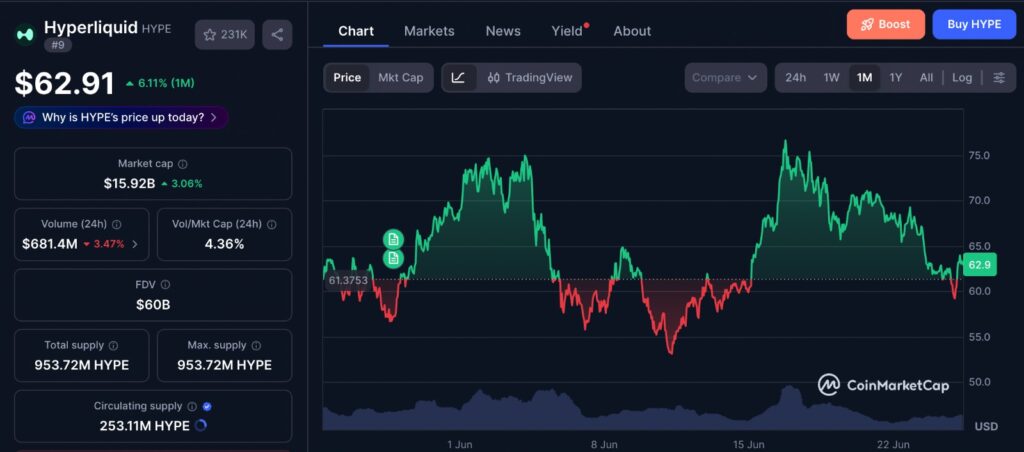
The 1-month HYPE chart shows how quickly the token’s rally cooled after reaching record highs, with price now trying to stabilize near the $50-$54 support zone. The key point is not only the 22% pullback, but whether HYPE can hold structure after leverage cooled and spot demand weakened. A stronger hold near this area would suggest buyers are still absorbing supply, while a weak reaction would show that the rally needs firmer demand confirmation before momentum can rebuild.
Why This Pullback Matters More Than A Normal Dip
Not every correction deserves attention. Many altcoins pull back sharply after rallies, especially when the broader crypto market is volatile.
HYPE is different because its rally has been tied to a stronger market narrative around Hyperliquid, trading activity, and demand for exchange-linked tokens. That has made the token one of the more closely watched assets among active traders.
The risk is that strong narratives can become crowded quickly.
When too many traders chase the same trend, price can rise faster than underlying demand. The first pullback then becomes a test of whether new buyers are still willing to enter after the easy momentum has passed.
Over the past week, HYPE’s price action has shifted from breakout strength to support testing, while positioning data shows traders becoming more cautious. That combination makes the current zone more important than a routine dip.
The market is now in a more selective phase, where demand quality matters more than speed. Weaker rallies often rely on the memory of the previous high. Stronger rallies compress, absorb supply, and rebuild before attempting another push.
HYPE is now trying to prove it belongs in the second group.
HYPE Needs Absorption, Not Just Optimism
The most important signal from here is not whether traders are still bullish on HYPE. It is whether the market can absorb supply near support without needing aggressive leverage to do the work.
If spot buyers continue stepping in while derivatives exposure resets, HYPE could build a healthier base. That would make the recent decline look more like a trend reset than a breakdown.
If spot demand stays weak, the support zone could become fragile. In that case, the pullback would no longer be about cooling momentum. It would become a warning that the rally moved ahead of sustainable demand.
The reason this matters is simple: when leverage fades, price has fewer forced buyers behind it. The market then depends on real buyers showing up where sellers are still active.
That is the real test for HYPE now.
HYPE Outlook: Support Must Prove Demand Is Still There
HYPE’s 22% drop from record highs has not destroyed the broader uptrend, but it has made the next support test more important.
The $50-$54 area is now the line that separates a normal correction from a deeper structure shift. Holding that zone would keep the uptrend alive and suggest that spot buyers are still willing to defend the market after momentum cooled.
Losing it would send a different message. It would show that the market needs more time to reset and that demand was not strong enough to absorb supply near the first major support area.
For now, HYPE remains in a transition phase. The rally has already shown that momentum can carry the token to record highs. The next move depends on whether spot demand can replace fading leverage near support.
Price does not move higher because traders remember the last high. It moves when fresh demand becomes strong enough that sellers can no longer control the structure.
Disclaimer: This content is for informational purposes only and does not constitute financial advice.
Keep yourself updated with the latest crypto news with FYI Gazette
Keep yourself updated with the latest Altcoin News with FYI Gazette
 Bitcoin
  Ethereum
  Tether
  BNB
BNB  XRP
XRP  Solana
  TRON
TRON  Dogecoin
  Litecoin
  Pepe
Pepe