Revolut USDT Delisting Shows Stablecoin Access Risk Under MiCA
Revolut’s decision to delist USDT is not just another stablecoin compliance update. It shows a deeper risk forming around crypto access in regulated markets.
The issue is not whether Tether remains dominant. USDT is still one of the largest and most widely used stablecoins in crypto. The issue is whether users can keep reaching that liquidity through major regulated fintech platforms when compliance pressure changes what those platforms are willing to support.
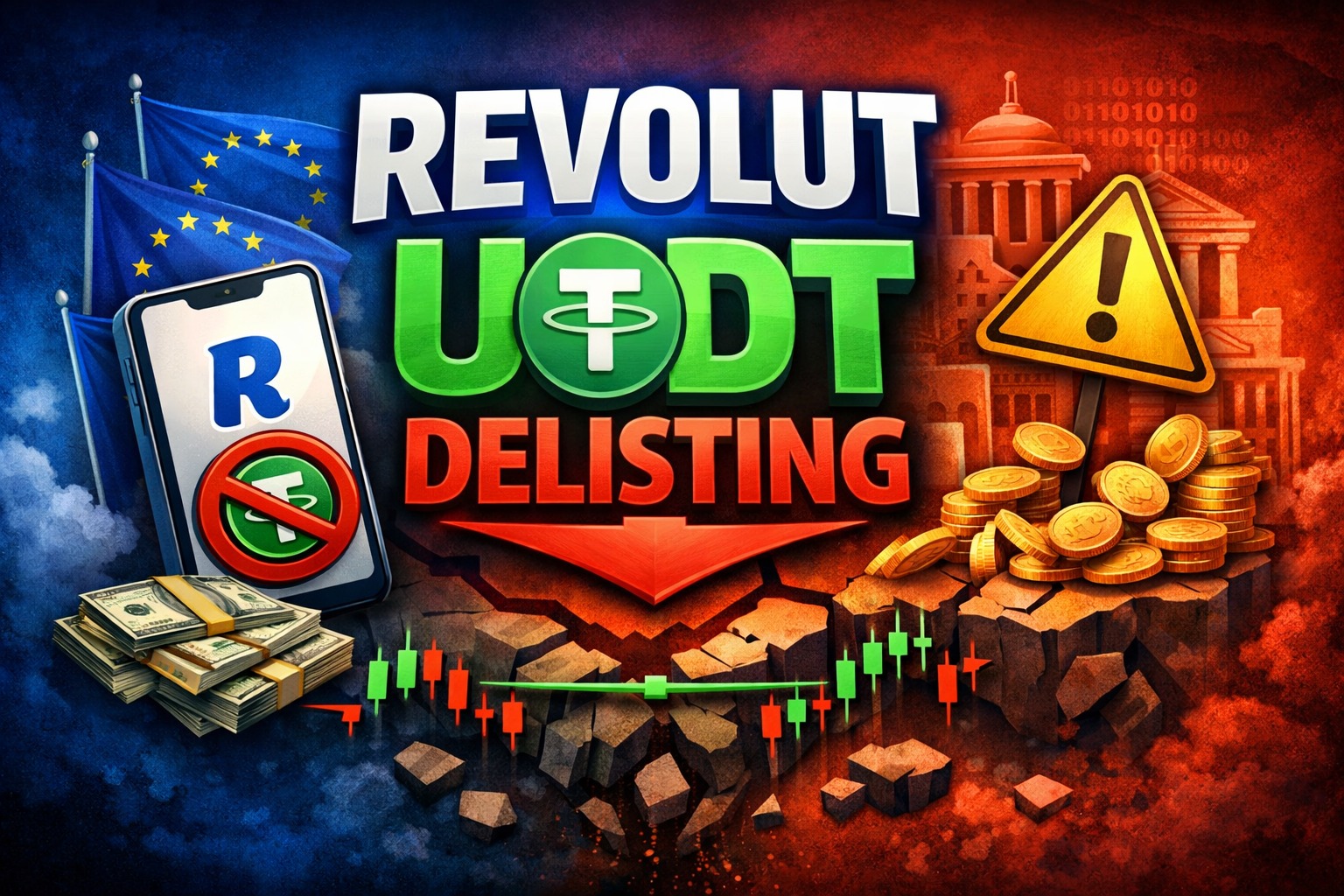
Revolut has reportedly notified some users that it will delist Tether’s USDT stablecoin in August, citing regulatory and risk considerations. According to the notice, users will no longer be able to buy USDT from July 6. Deposits will stop being supported after July 30, and full delisting is scheduled for August 31, 2026.
If users still hold USDT after the deadline, the notice said the remaining balance will be automatically converted into the user’s base currency at the exchange rate available that day.
That final detail matters most.
This is not only a delisting. It is an access decision. Users are being given a limited window to sell, withdraw, or accept conversion into local currency. For a stablecoin that many traders treat as digital dollar liquidity, that creates a different kind of risk from the usual market concerns.
Revolut USDT Delisting Puts Access Above Market Dominance
USDT’s position in the market has rarely been questioned in terms of usage. It remains central to crypto trading, offshore liquidity, exchange pairs, and dollar-based settlement across digital asset markets. Its size gives it influence, but size does not guarantee availability on every platform.
That is the key lesson from Revolut’s move.
A stablecoin can remain dominant globally while becoming harder to access through regulated platforms in specific regions. This creates a split between market liquidity and platform access. Traders may still see USDT as the deepest stablecoin in global crypto markets, but users on some fintech apps may no longer be able to buy, deposit, or hold it in the same way. That split is visible across the wider market too, where TRON stablecoin activity shows how global stablecoin usage can remain strong even as access conditions differ by platform and region.
Markets do not move only because liquidity exists. They move when users can actually reach it.
For retail users, this can matter more than market capitalization. A holder does not need USDT to lose its peg to face disruption. They only need their platform to stop supporting it.
That is why the Revolut USDT delisting matters beyond one company’s product list. It shows how liquidity can look deep at the market level while becoming less usable at the user level.
That is the mechanism behind the access risk: liquidity can remain deep globally, but users still face friction if their regulated platform removes the route they rely on to reach it.
CMC Chart Analysis
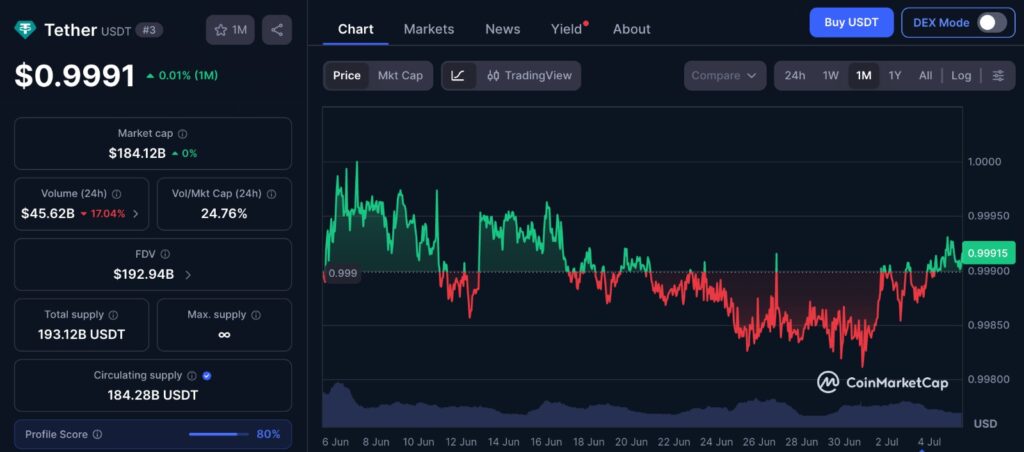
The 1-month USDT chart from CoinMarketCap shows why the Revolut delisting story is not mainly about a price breakdown or peg instability. USDT continues to trade close to its $1 target, which keeps the focus on access rather than price stress. The more important question is whether users can still reach that liquidity through regulated platforms when regional rules and compliance pressure change what those platforms are willing to support. In this case, the chart helps separate market stability from platform availability, showing that a stablecoin can remain steady in price while still becoming harder for some users to access.
Why MiCA Changes The Stablecoin Risk Equation
The pressure around USDT in Europe has increased under the European Union’s Markets in Crypto-Assets framework, known as MiCA. The regulation has created a stricter environment for crypto platforms, stablecoin issuers, and service providers operating in the region.
Under MiCA, stablecoin access is no longer only a product decision. It is also a licensing, reserve, supervision, and compliance decision.
That changes how platforms behave.
Instead of waiting for a stablecoin to show market weakness, regulated companies may reduce support if the legal or compliance risk becomes too high. This is especially important for fintech firms such as Revolut, which sit closer to mainstream banking and payments than many crypto-native exchanges.
The reason this happens is simple. A regulated platform does not only measure user demand. It also measures whether carrying an asset creates legal, operational, or reputational risk that outweighs the benefit of offering it.
Revolut did not give a detailed public explanation of the specific regulatory framework behind the delisting notice. However, the timing fits a broader shift in Europe, where several crypto platforms have already reduced or removed USDT support as MiCA rules reshape stablecoin offerings.
The important point is not that USDT has suddenly become unusable everywhere. It has not. The point is that regulated access can narrow even while the token remains liquid elsewhere.
That is a very different kind of stablecoin risk.
Users Face A Sell, Withdraw, Or Convert Decision
The Revolut notice gives users three practical options before the delisting deadline.
They can sell USDT. They can withdraw it before support ends. Or they can leave it on the platform and have it converted automatically into their base currency after the deadline.
Each option carries a different consequence.
Selling is simple, but it removes the user from USDT exposure immediately. Withdrawing keeps the user in USDT, but only if they have another wallet or platform ready to receive it. Automatic conversion is the most passive option, but it gives the user less control over timing and leaves the final exchange rate dependent on the day of conversion.
That is why this delisting should not be seen as a small technical adjustment.
For active traders, stablecoins are often used as dry powder. They allow users to stay outside volatile crypto assets without returning fully to bank money. If access is removed, that dry powder has to move somewhere else.
It may rotate into another stablecoin. It may return to fiat. Or it may leave the platform entirely.
This is where platform decisions affect participant behavior. Some users may choose speed and sell. Others may choose control and withdraw. Others may do nothing and accept conversion. The result is not necessarily a market shock, but it does create forced movement around a deadline.
Liquidity is not just present or absent. Once a platform removes support, users must route through fewer available exits, and that changes how easily they can act.
Recent sessions have shown that the key issue is not USDT’s price behavior, but how users on affected platforms must prepare for reduced access before the deadline arrives.
Access risk does not always appear as panic. Sometimes it appears as users quietly changing where they hold liquidity.
Stablecoin Risk Is No Longer Only About The Peg
Most stablecoin debates focus on peg stability, reserves, transparency, and redemption strength. Those questions remain important, especially for large dollar-backed tokens. Stablecoin risk has already been tested in other forms, including cases where stablecoin depeg risk showed how quickly confidence can weaken when users question stability.
However, Revolut’s USDT delisting highlights another layer of risk: platform availability.
A stablecoin can hold its price near $1 and still become less useful if a major platform stops supporting it. In that case, the risk is not a price break. It is an access break.
That distinction matters because many users treat stablecoins like neutral infrastructure. They assume that a dollar stablecoin will be available wherever crypto is available. MiCA is challenging that assumption in Europe.
Stablecoins are becoming more dependent on where they are issued, where they are offered, and whether the platform serving the user is willing to carry the compliance burden.
The next phase of stablecoin competition may not be decided only by liquidity depth or brand trust. It may also be decided by regulatory compatibility.
What This Means For USDT And Rivals
USDT’s global role is still significant. The delisting by one platform does not remove its importance from crypto markets. It also does not prove weakness in its peg or immediate demand.
However, it does show that dominance does not automatically protect a stablecoin from regional restrictions.
If more regulated platforms reduce USDT access, users in those markets may shift toward stablecoins that are easier for platforms to support under local rules. That could benefit compliant alternatives, especially where users want stablecoin exposure without leaving regulated apps. This is why the PYUSD market cap drop and USDC liquidity gap matters, because stablecoin competition is often shaped by usable liquidity, not just brand recognition.
This does not mean USDT loses its global lead overnight. Stablecoin liquidity is sticky, and traders often prefer the asset with the deepest exchange pairs and broadest offshore use.
Still, access friction can build slowly. USDT may keep its global lead, but regional platform restrictions can make compliant alternatives more convenient for users who want to stay inside regulated apps.
Liquidity is not just about how much of an asset exists. It is about whether users can reach it when they need it.
Revolut’s Move Shows The Direction Of Travel
Revolut’s USDT delisting is important because it connects stablecoin regulation with everyday user access. This is not an abstract policy debate anymore. It affects what users can buy, deposit, hold, and move inside a mainstream fintech app.
For crypto markets, the lesson is clear. Stablecoin risk is expanding beyond reserves and price stability. It now includes platform rules, jurisdictional limits, and forced conversion timelines.
USDT may remain dominant globally, but Revolut’s decision shows that dominance does not remove access risk under MiCA.
The stablecoin market is no longer only asking which token holds $1. It is asking which token users can still reach when platform rules, regional regulation, and compliance pressure decide where liquidity is actually usable.
Disclaimer: This content is for informational purposes only and does not constitute financial advice.
Keep yourself updated with the latest crypto news with FYI Gazette
Keep yourself updated with the latest Altcoin News with FYI Gazette
 Bitcoin
  Ethereum
  Tether
  BNB
BNB  XRP
XRP  Solana
  TRON
TRON  Dogecoin
  Litecoin
  Pepe
Pepe