TRON Stablecoin Boom Hits $1.96T as DeFi Growth Remains Key Test
TRON stablecoin settlement volume has become one of the clearest signs of how the network is being used in the current crypto market.
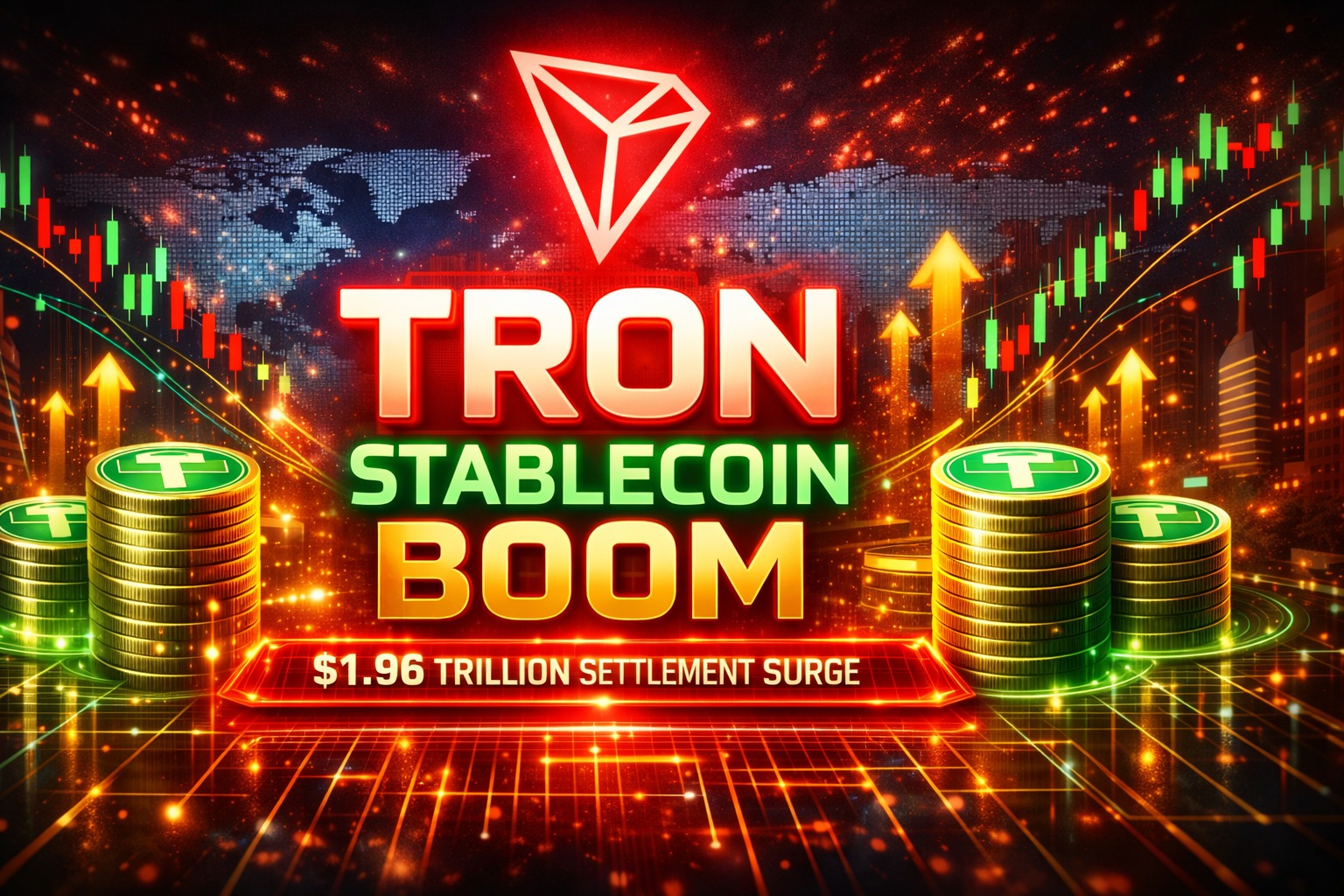
The network reportedly processed $1.96 trillion in stablecoin settlements during the first quarter of 2026, showing that TRON has moved beyond being just another smart contract chain. Its main role today is tied to dollar-based transfers, especially USDT activity.
That matters because stablecoins are no longer used only by traders moving funds between exchanges. They are also used for cross-border payments, peer-to-peer transfers, remittances, and recurring transactions where speed, liquidity, and low fees matter more than complex on-chain products.
However, TRON’s growth also comes with a clear test.
The network has built a strong position as a stablecoin payment rail, but the next stage depends on whether those flows can become sticky enough to support deeper DeFi usage, new user growth, and broader on-chain utility. Without that, TRON may remain highly important for payments while still needing to prove that stablecoin settlement can support a more complete ecosystem.
TRON Stablecoin Settlement Shows Real Payment Demand
TRON’s stablecoin growth is important because it reflects actual network usage rather than only speculative activity around TRX.
The chain reportedly hosts around $85 billion to $86 billion in USDT, giving it one of the strongest stablecoin liquidity bases in the market. That liquidity makes TRON useful for users who want to move digital dollars quickly and cheaply.
For many users, this is the main point. They are not necessarily looking for lending markets, NFT activity, or advanced DeFi strategies. They want a network that can move USDT with low friction.
That is where TRON has found a durable use case.
Recurring payments, peer-to-peer transfers, and cross-border settlement can create steady transaction demand because users return to the same rail when it works. This kind of usage depends less on price excitement and more on reliability. Stablecoin payment rails depend on trust as much as speed, which is why a stablecoin depeg key risk can quickly change how users think about liquidity, settlement, and where they route digital dollars.
Markets do not reward activity when it is large. They reward activity when it becomes difficult to replace.
This is why TRON’s stablecoin position matters. Stablecoin users usually follow liquidity, cost, and habit. Once a network becomes the default route for moving USDT, that behavior can become self-reinforcing because wallets, exchanges, and users keep returning to the same settlement path. The same pattern can be seen across the wider stablecoin market, where the PYUSD market cap drop and USDC liquidity gap showed how users often concentrate around deeper, more established liquidity rails.
That is the mechanism behind TRON’s advantage: stablecoin users follow liquidity, cost, and habit, but ecosystem value grows only when those flows create reasons for users to stay.
CMC Chart Analysis
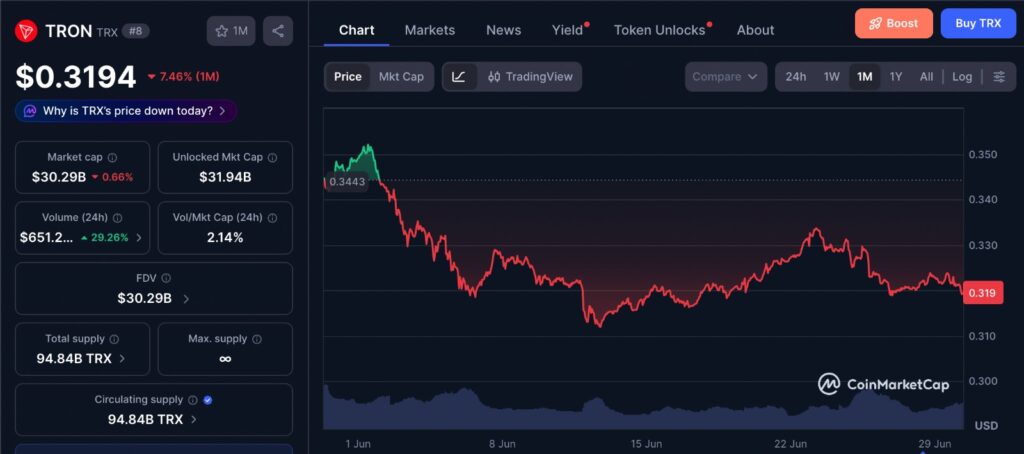
The 1-month TRX chart helps show how TRON’s token has traded while the network’s stablecoin settlement volume reached $1.96 trillion and DeFi growth remained the key test. The chart matters because headline payment volume does not always translate directly into token strength. A stronger hold in TRX would suggest that investors are giving more value to TRON’s stablecoin payment role, while a weaker reaction would show that the market still wants confirmation from DeFi activity, new user growth, and broader on-chain utility.
User Activity Is Strong, But Growth Is Not One-Sided
TRON’s user data shows both strength and caution.
Daily active users reportedly rose 16% over the past 30 days to about 4.4 million, above the first-quarter average of around 3.2 million. That suggests the network continues to see strong engagement from existing participants.
At the same time, quarterly active addresses have reportedly eased from their Q4 2025 peak, while new address creation has also declined. This creates an important difference between activity and expansion.
A network can process more transactions because existing users are more active. But long-term growth usually needs current users returning often and new users entering the ecosystem.
That is the part TRON still needs to prove.
If stablecoin users keep sending payments through the network, activity can remain elevated. But if new user growth slows, the market may question whether TRON is expanding its reach or simply getting more volume from an existing base.
Recent sessions have shown that investors are becoming more selective about network activity, especially when headline volume is not matched by clear growth in new users or broader application demand.
The distinction matters for TRX because payment activity alone does not automatically create a stronger investment case. Investors will likely want evidence that stablecoin settlement is pulling more users, more applications, and more capital into the network over time.
High activity shows that the rail is working. New user growth shows whether the rail is still expanding.
DeFi Growth Remains The Bigger Test For TRON
TRON’s payment strength has not yet fully translated into broader DeFi adoption.
The network’s DeFi TVL has been reported near $4.4 billion to $4.5 billion, depending on the data source and methodology. That shows some capital is staying on-chain, rather than only passing through the network and leaving immediately.
Still, the bigger question is where that capital goes after settlement.
Settlement volume shows that TRON moves capital efficiently. DeFi growth would show that the network can keep more of that capital engaged. That same gap between network utility and token demand has appeared elsewhere in crypto, including Ethereum RWA dominance and the ETH demand gap, where real usage still needed to translate into stronger asset-level demand.
If stablecoin liquidity remains mostly tied to transfers, TRON can continue to dominate a specific payment use case. That is valuable, but it may limit the network’s broader growth story. DeFi activity such as lending, decentralized exchange trading, yield markets, and smart contract usage can create deeper demand than transfers alone.
A strong payment rail becomes more powerful when users do more than send USDT from one wallet to another. If stablecoin users begin borrowing, lending, swapping, saving, or interacting with applications on TRON, the network’s activity becomes stickier.
Payment volume brings users to the chain. DeFi determines whether those users stay inside the ecosystem.
That is why TRON’s $1.96 trillion settlement figure should not be viewed as the final answer. It is better understood as the base layer of the story. The next question is whether that base can support more financial activity.
The real test is not whether money can move through TRON. It is whether more of that money finds a reason to remain active on TRON.
Why TRX Still Faces A Market Confidence Test
For TRX, the challenge is not whether TRON has usage. The network clearly has a strong role in stablecoin settlement.
The challenge is whether that usage creates enough demand around the wider ecosystem to support a stronger long-term narrative.
Stablecoin transactions can support fees, network activity, and recurring usage. They can also strengthen TRON’s position as a practical chain for digital dollar movement. But crypto markets often look for growth beyond one dominant use case.
If TRON remains mostly a USDT transfer network, its value proposition stays clear but narrow. If it can convert payment users into DeFi users, its growth story becomes much broader.
This is the main difference between being a high-volume settlement rail and becoming a deeper on-chain economy.
That puts TRON in a strong but unfinished position.
The network has already proven that users trust it for moving stablecoins. Now it needs to show that stablecoin flows can support more than payments.
TRON’s Stablecoin Lead Is Strong, But The Next Phase Matters
TRON’s $1.96 trillion stablecoin settlement volume confirms that the network has become a major part of the digital dollar economy.
Low fees, fast transfers, deep USDT liquidity, and user habit have helped TRON build a practical use case at a time when many chains are still trying to prove durable demand. That gives the network a clear advantage.
However, the next phase will be harder.
Sustained growth will depend on whether TRON can attract new users, expand DeFi activity, and turn stablecoin liquidity into broader on-chain utility. Payment volume can keep a network busy, but broader utility is what makes that activity harder to leave.
If that happens, the network’s payment dominance could become the foundation for a larger ecosystem.
If not, TRON may remain one of crypto’s most important stablecoin rails, but with a growth story still heavily dependent on transfers.
For now, TRON has payment demand. The stronger story begins when stablecoin liquidity stops only passing through the network and starts creating deeper, repeatable activity inside it.
Disclaimer: This content is for informational purposes only and does not constitute financial advice.
Keep yourself updated with the latest crypto news with FYI Gazette
Keep yourself updated with the latest Altcoin News with FYI Gazette
 Bitcoin
  Ethereum
  Tether
  BNB
BNB  XRP
XRP  Solana
  TRON
TRON  Dogecoin
  Litecoin
  Pepe
Pepe