

Bitcoin Hits 11-Week High Near $70K as Treasury Buybacks Ease Yield Pressure
Bitcoin climbed to an 11-week high near $70,000 as a shift in the US bond-market backdrop gave risk assets more room to recover.
BTC reached approximately $69,749 on Wednesday, its strongest level since June 2, after the US Treasury announced plans to significantly expand buybacks of longer-dated government debt. Bitcoin was up around 6% during the move as long-term Treasury yields fell and broader risk assets strengthened.
The immediate Bitcoin rally was significant, but the more important development happened outside the crypto market.
Treasury is increasing the maximum size of liquidity-support buybacks in the 10-to-20-year and 20-to-30-year maturity sectors from $2 billion to at least $4 billion per operation. The change takes effect September 9 and is scheduled to remain in place through November 4.
That does not automatically create lasting Bitcoin demand.
What it can do is ease pressure in the long end of the bond market, where rising yields had been increasing borrowing costs and making risk assets less attractive.
For Bitcoin, that distinction matters.
Treasury Buybacks Relieve Pressure From Rising Yields
Long-term US government bonds had been under growing pressure before the Treasury announcement.
The 30-year Treasury yield had reached its highest level since 2007 before falling sharply following the announcement. It dropped roughly nine to 10 basis points toward 5.19% as investors responded to the prospect of a larger Treasury presence in the long-end market.
Treasury says the expanded operations are intended to provide greater liquidity support in longer-dated securities, where it has continued to receive substantial offers from market participants.
The mechanism matters more than the headline number.
Older Treasury securities can become less liquid than newly issued benchmark bonds. Dealers and other investors may still hold them, but selling large positions becomes harder when fewer buyers are willing to take the other side without demanding a lower price.
Regular buybacks provide another opportunity for market participants to sell those less-liquid securities. Treasury itself describes liquidity-support buybacks as a way to bolster market liquidity by creating a regular and predictable buyer for older Treasury debt.
That can help dealers reduce inventory and free balance-sheet capacity. Sellers also face less execution pressure because they do not need to move prices as aggressively to find buyers.
Dealers cannot absorb unlimited amounts of debt. When their balance sheets become crowded, their willingness to take additional bonds falls, which can leave sellers competing for fewer buyers and place further pressure on prices.
Buybacks can reduce some of that friction.
They do not solve the government’s broader fiscal challenges, but they can improve how smoothly existing debt trades.
That is where the Bitcoin connection begins.
Why Lower Long-Term Yields Can Help Bitcoin
Bitcoin does not receive any of the Treasury’s buyback money directly.
Instead, the effect travels through financial conditions.
When long-term government bond yields rise sharply, investors can earn stronger returns from assets that carry far less risk than Bitcoin. Higher yields also raise borrowing costs across the economy and tighten conditions for businesses, consumers and leveraged investors.
That raises the hurdle for holding speculative assets.
When yields retreat, that hurdle becomes lower.
The relative cost of holding Bitcoin becomes less restrictive, while lower bond-market stress can improve risk appetite across portfolios.
The dollar also weakened after the Treasury announcement, while stocks, gold and Bitcoin advanced. That broader reaction suggests BTC was participating in a macro repricing rather than responding to a crypto-specific catalyst alone.
Bitcoin did not suddenly become more attractive on its own. The financial environment became less restrictive around it.
That is the mechanism behind the Bitcoin move: yield relief lowers the pressure on risk assets, but BTC only confirms the rally if voluntary buyers remain after the macro repricing and short liquidations fade.
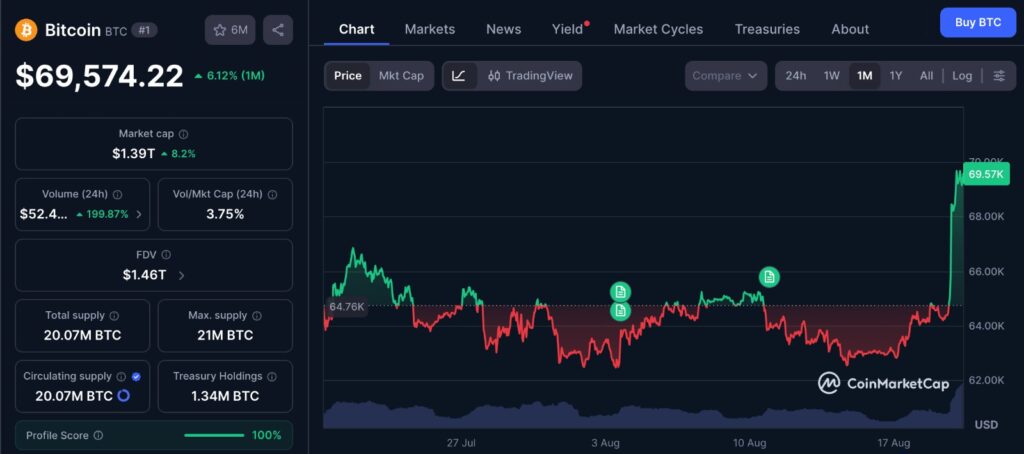
The one-month Bitcoin price chart shows how sharply the market backdrop has shifted after a period of weaker momentum. BTC’s move toward $70,000 pushed price to its highest level in 11 weeks, but the speed of the advance also reflects the combination of improving macro conditions and forced short covering. The chart therefore provides useful context for the breakout: price has strengthened quickly, while the next test is whether voluntary buying and deeper crypto liquidity can support the move once liquidation-driven demand fades.
Bitcoin’s Rally Was Also Amplified by Positioning
Changing macro conditions were not the only force behind the speed of Bitcoin’s move.
As BTC accelerated higher, a large wave of bearish leverage was forced out across crypto markets. Market data showed substantial short liquidations during the advance, reinforcing the speed of the repricing.
Short liquidations create forced buying. A similar dynamic has appeared during previous periods of heavy crypto liquidations, when forced position closures amplified Bitcoin moves beyond what spot demand alone would have produced.
When a leveraged trader bets on falling prices and the market moves sharply higher, the position may be automatically closed. That requires bearish exposure to be bought back while price is already rising.
A modest increase in genuine demand can therefore produce a much larger move when positioning is heavily tilted in the opposite direction.
Liquidity is not evenly distributed across every price. Once nearby sell orders are absorbed and shorts begin closing, price has to move higher to find the next group of participants willing to sell.
Positioning can turn ordinary buying pressure into forced execution.
That means the size of the price move should not be treated as equal to the improvement in underlying demand.
Some of Wednesday’s buying was voluntary. Some was forced.
Recent sessions have shown how quickly that difference can matter. Once bearish positions began unwinding, the move accelerated, leaving the next phase more dependent on buyers who are choosing to remain involved.
Crypto Liquidity Has Not Fully Confirmed the Move
That leads to a second question: whether enough crypto-native liquidity is available to support Bitcoin after forced buying fades.
One market assessment noted that stablecoin supplies on exchanges had fallen by approximately $14 billion since May. The Stablecoin Supply Ratio, which compares Bitcoin’s market capitalization with aggregate stablecoin market capitalization, also rose from 9.82 on June 30 to 11.69, indicating tighter liquidity relative to Bitcoin’s valuation.
Stablecoins matter because they represent one of the most immediate pools of deployable capital inside crypto markets.
When those balances expand, more capital is available to absorb Bitcoin offered for sale. When they contract, fewer immediately available dollars may be competing for the same supply. This also makes Bitcoin’s $70K order book test important, because visible support only becomes meaningful when buyers continue absorbing supply as price moves higher.
Bitcoin can rally on short covering and improving macro conditions even while internal liquidity remains constrained. This fits the broader pattern of weaker crypto liquidity absorption, where lower leverage can reduce liquidation pressure without necessarily creating enough fresh demand to absorb available supply.
But once forced buying fades, extending the move becomes more dependent on fresh capital stepping in voluntarily.
That does not invalidate the rally.
It simply means price strength and liquidity strength are not yet sending exactly the same message.
Treasury Buybacks Are Not the Same as QE
The distinction between the Treasury’s decision and Federal Reserve quantitative easing is important.
Treasury buybacks are debt-management operations. Treasury purchases eligible outstanding securities, and those securities are retired after settlement. Liquidity-support operations are designed primarily to improve trading conditions in older, less-liquid Treasury securities.
QE operates differently.
Under quantitative easing, the Federal Reserve purchases securities and expands its balance sheet, increasing reserves in the banking system as part of monetary policy designed to influence broader financial conditions and long-term interest rates.
Treasury buybacks can still affect market liquidity, yields and investor positioning, but they should not automatically be interpreted as monetary expansion.
Describing the announcement as a flood of new liquidity entering Bitcoin would therefore overstate what happened.
The more precise interpretation is that Treasury improved the expected trading environment for part of the bond market, helping ease pressure on yields.
Bitcoin benefited from the change in financial conditions, not from Treasury money flowing directly into crypto.
The Bigger Question Is Whether Yield Relief Lasts
The Treasury’s intervention also has limits.
Treasury estimated on August 3 that it would borrow $739 billion in privately held net marketable debt during the July-to-September quarter and $628 billion during October through December. Treasury also notes that buybacks are not expected to significantly reduce privately held borrowing because new issuance replaces securities that are repurchased.
The broader point is simple.
Buybacks can improve secondary-market liquidity, but they do not remove the broader Treasury supply challenge.
That keeps the direction of long-term yields important for Bitcoin.
If yields remain contained, one source of macro pressure on risk assets becomes less restrictive. If yields climb again, some of that relief disappears.
Over the past week, Bitcoin had traded without the sustained momentum seen in Wednesday’s move. The sharp reversal in long-end yields changed that backdrop quickly and gave buyers more room to push price toward $70,000.
The next test is whether demand remains after that initial repricing is complete.
What Bitcoin Needs for Stronger Confirmation
Bitcoin reaching approximately $69,749 marks a meaningful recovery in price, but it does not by itself establish a sustained shift in demand.
Three conditions now matter.
First, Bitcoin needs to retain a meaningful portion of the breakout after short covering fades. A move supported by investors willingly adding exposure has a stronger foundation than one driven mainly by liquidations. Then add:
That makes US spot Bitcoin demand an important confirmation signal, because stronger participation from spot buyers would show that the move is relying less on forced execution.
Second, crypto-native liquidity needs to stabilize or improve. Stronger stablecoin liquidity would indicate that more deployable capital is available to absorb Bitcoin offered for sale.
Third, long-term Treasury yields need to remain contained enough that the macro environment does not quickly become restrictive again.
These conditions are connected.
Lower yields can create a better backdrop. Liquidations can accelerate price. Stablecoin liquidity and voluntary buying help determine whether the market can continue absorbing supply after those initial forces weaken.
The combination matters more than any single price level.
Editor’s View
Bitcoin’s move toward $70,000 matters because it shows how sensitive the market remains to changes in the wider financial system.
The Treasury buyback expansion did not change Bitcoin’s supply, adoption or network fundamentals. It changed the environment surrounding risk.
Lower long-term yields reduced pressure on portfolios. A weaker dollar improved the backdrop. Short liquidations then accelerated the adjustment.
That explains how Bitcoin could rise quickly even while crypto-native liquidity remained comparatively constrained.
The next phase is therefore less about the original Treasury headline and more about who remains willing to buy once forced activity fades.
If voluntary demand continues absorbing available supply while stablecoin liquidity stabilizes, the rally has a stronger structural base. If that demand remains weak, the speed of the initial move will say more about yield relief and positioning than about a lasting change in Bitcoin demand.
The rally becomes more meaningful when yield relief opens the door, shorts stop doing the buying, and real demand is still there to absorb the supply.
Disclaimer: This content is for informational purposes only and does not constitute financial advice.
 Bitcoin
  Ethereum
  Tether
  BNB
BNB  XRP
XRP  Solana
  TRON
TRON  Dogecoin
  Litecoin
  Pepe
Pepe