
Stellar XLM Rally Tests Real Demand After DTCC Tokenization Boost
Stellar XLM rally has become one of the strongest moves in the crypto market this week, but the bigger story is not just that XLM moved higher. It is why the move happened, who may be chasing it, and whether real demand can support the price after the first wave of excitement fades.
XLM jumped sharply after DTCC and the Stellar Development Foundation announced plans to connect DTC’s tokenization service with the Stellar network. The announcement gave traders a clear institutional narrative at a time when much of the broader crypto market was still dealing with weak momentum, cautious liquidity, and selective capital rotation.
That contrast matters.
In a market where many altcoins are moving only when leverage forces them to move, Stellar received a catalyst tied to real-world asset tokenization and traditional financial infrastructure. That does not automatically mean XLM has entered a long-term uptrend. But it does explain why traders reacted quickly.
The market did not just buy a chart. It bought a reason to pay attention.
Stellar XLM Rally Gains From Institutional Tokenization Narrative
The DTCC announcement is important because it connects Stellar to one of the most serious themes in digital assets: regulated tokenization of traditional financial instruments.
DTCC said the planned integration would allow DTC-custodied assets to be tokenized on the Stellar network, with the firms expecting DTC-tokenized assets to become available on Stellar in the first half of 2027. The announcement also highlighted that the tokenized assets would retain the same investor protections, entitlements, and safeguards as traditionally held securities.
That is the part of the story the market is trying to price in.
For years, crypto has argued that public blockchains could become rails for financial markets. But many investors have treated that idea as distant or speculative. A connection involving DTCC changes the conversation because it places Stellar closer to regulated market infrastructure rather than only retail trading excitement.
This is why the Stellar XLM rally is different from a typical altcoin move. It is being supported by a larger market theme around tokenized securities, settlement efficiency, collateral movement, and the possibility of traditional assets moving across blockchain rails.
Still, there is a clear gap between strategic relevance and immediate network demand. The timeline points to future usage, not activity that is already flowing through the network today.
That gap is where the rally now has to prove itself.
Why XLM Moved So Fast
XLM’s move was not only about spot buyers responding to the DTCC news. Derivatives also appear to have played a major role.
When a token rallies strongly while short positioning is crowded, the move can accelerate because bearish traders are forced to close positions. That forced buying creates extra upward pressure, especially when liquidity is thin or traders are positioned too aggressively against the move. This is the same kind of forced-positioning pressure seen during broader market liquidation events, where crypto liquidations can quickly amplify price moves when leverage is crowded on one side.
Recent market data showed short liquidations rising more sharply than long liquidations as XLM moved higher. At the same time, open interest increased significantly, showing that traders were not simply closing old positions. New leverage was also entering the market. A similar positioning dynamic appeared in Solana recently, where rising open interest showed how traders were building exposure around a key price zone.
Recent sessions have shown how quickly XLM can move when a strong headline meets crowded positioning and limited liquidity.
That distinction matters.
Short liquidations can fuel the first part of a rally, but they are not the same as lasting demand. A leverage-heavy rally can still move price sharply, but it is often more fragile because it depends on traders continuing to add exposure. Once momentum slows, that same leverage can become a source of selling pressure. That is why funding rates can help show whether leverage is supporting a move or making it more fragile, especially when price action starts depending more on derivatives than spot demand.
Liquidity is not continuous. Once nearby orders are absorbed, price has to move to find the next layer of buyers or sellers, which is why crowded positioning can turn a normal reaction into a much sharper move.
This is why the Stellar XLM rally should not be judged only by the percentage gain. The quality of the rally matters more than the size of the candle.
Markets do not hold higher because shorts were squeezed. They hold higher when real buyers keep absorbing supply after the squeeze is over.
If buyers keep absorbing profit-taking while leverage cools, the rally starts building structure. If they do not, the same leverage that helped the move can turn into exit pressure.
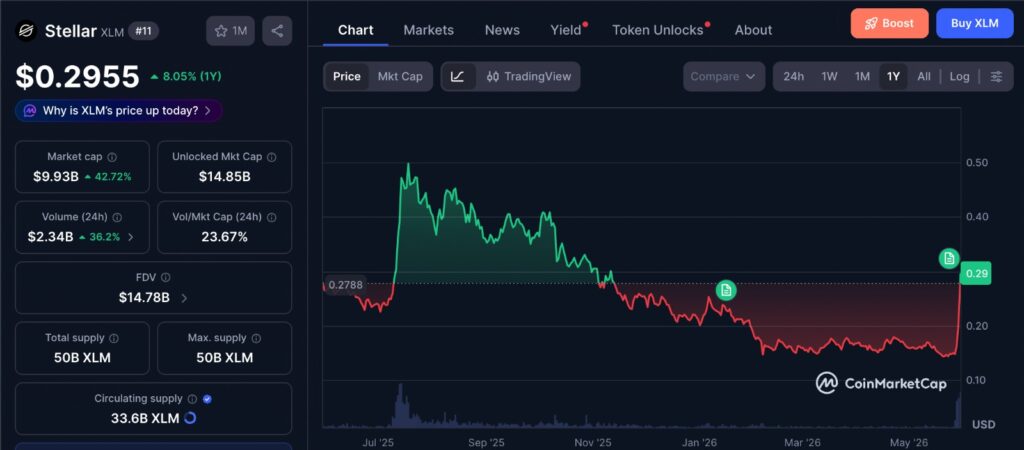
The one-month Stellar price chart shows how quickly the XLM move developed after the DTCC-related catalyst brought fresh attention back to the asset. The sharp rise reflects strong momentum, but the chart also makes the next test clear: whether buyers can keep defending higher levels after the first wave of excitement slows. If the rally continues to hold above its recent breakout area while leverage cools, it would suggest that demand is becoming more stable rather than being driven only by short covering.
Resistance Is Now the Real Test for XLM
The biggest mistake traders can make after a strong rally is assuming that a catalyst removes resistance. It does not.
Resistance is where the DTCC narrative meets real selling pressure.
A major announcement can bring attention. It can force short covering. It can trigger volume. But after the first move, buyers still have to absorb profit-taking and overhead supply from traders who were waiting for a stronger exit.
XLM is now trading near an area where previous rallies have struggled. This matters because early buyers may use the move to take profit, while late buyers may hesitate if price starts moving sideways. At the same time, short sellers may return if the market fails to break above key resistance with strength.
That creates a more demanding setup.
For XLM to keep its bullish structure, the market needs more than headlines. It needs sustained demand, controlled leverage, and enough volume to absorb selling without giving back too much of the move. If buyers cannot hold higher levels, the rally could turn into another sharp altcoin rotation where attention arrives quickly and leaves just as fast.
Strong news can open the door, but buyers still have to walk through it with real capital.
The key signal now is not whether XLM can spike again. The key signal is whether it can stop giving back gains when the initial excitement slows.
Stellar’s Tokenization Story Has Real Value, But Timing Matters
Stellar has long positioned itself around payments, asset movement, and financial connectivity. The DTCC announcement strengthens that positioning because it links Stellar to a more institutional use case than simple speculative trading.
But investors should be careful not to confuse strategic relevance with immediate token demand.
The planned tokenization service is expected in the first half of 2027. That gives the market a long runway, but it also means the current XLM move is mostly being driven by expectation. Until actual activity begins to show up onchain, the price is still trading around future possibility rather than present usage.
That does not make the move meaningless. It simply means the market is front-running a potential adoption story.
This is common in crypto. Tokens often move first on the narrative, then spend weeks or months trying to justify the valuation through data. The strongest moves survive that process. The weaker ones fade once traders realize the catalyst is important but not immediately demand-producing.
For Stellar, the next phase is validation. Traders will watch whether XLM can hold a higher range, whether volume remains active, and whether the broader real-world asset tokenization theme continues to attract capital.
Editor’s View: This Is a Demand Test, Not Just a News Rally
The most important part of the Stellar XLM rally is not the 50% move. It is the market’s reaction to a credible institutional catalyst during a period when many altcoins are still struggling to attract committed capital.
That says something about the current market structure. Capital is still willing to rotate into altcoins, but only when the story is strong enough and positioning is crowded enough to force movement.
XLM had both.
The DTCC news gave the market a serious narrative. Short positioning gave the rally fuel. The resistance zone now decides whether the move matures into a stronger trend or becomes another short-lived breakout.
This is where traders should stay objective. A strong catalyst can improve sentiment, but it cannot remove the need for confirmation. If XLM holds higher levels while leverage cools, the rally becomes more credible. If the move depends mainly on forced buying and late entries, the risk of a pullback increases.
What makes this setup interesting is that Stellar is not only reacting to a price chart. It is reacting to a shift in how the market views blockchain infrastructure. The question is whether that shift becomes a durable demand story or remains a short-term trading event.
In simple terms, Stellar now has attention. The harder part is keeping it.
What Comes Next for XLM?
The next few sessions could be important for XLM because the market has to decide whether the rally was the start of a repricing or a fast reaction to news.
A healthier continuation would require XLM to hold above its breakout area, avoid a liquidation-driven reversal, and show that buyers are willing to step in on pullbacks. That would suggest the market is not only chasing the DTCC headline but also building a stronger base around Stellar’s tokenization narrative.
A weaker outcome would look different. If volume fades, open interest remains elevated, and price starts losing key levels, the rally could unwind quickly. In that case, the move would look more like a leverage squeeze than a sustainable demand shift.
For now, the Stellar XLM rally deserves attention because it combines institutional tokenization, derivatives pressure, and altcoin rotation. But the real signal comes after the headline effect cools.
Price does not hold because attention arrives. It holds when demand keeps absorbing supply after the easiest part of the move has passed.
Keep yourself updated with the latest crypto news with FYI Gazette
 Bitcoin
  Ethereum
  Tether
  BNB
BNB  XRP
XRP  Solana
  TRON
TRON  Dogecoin
  Litecoin
  Pepe
Pepe