

Ethereum Whale Opens $90M Long What This Bet Really Signals for ETH
A single trade does not move the market, but it can reveal how someone with size is positioning inside it. An Ethereum whale has opened a $90 million leveraged long position, signaling a directional bet on ETH as price action builds toward the $3,200 region.
But the trade itself is not the story. What matters more is the structure behind it.
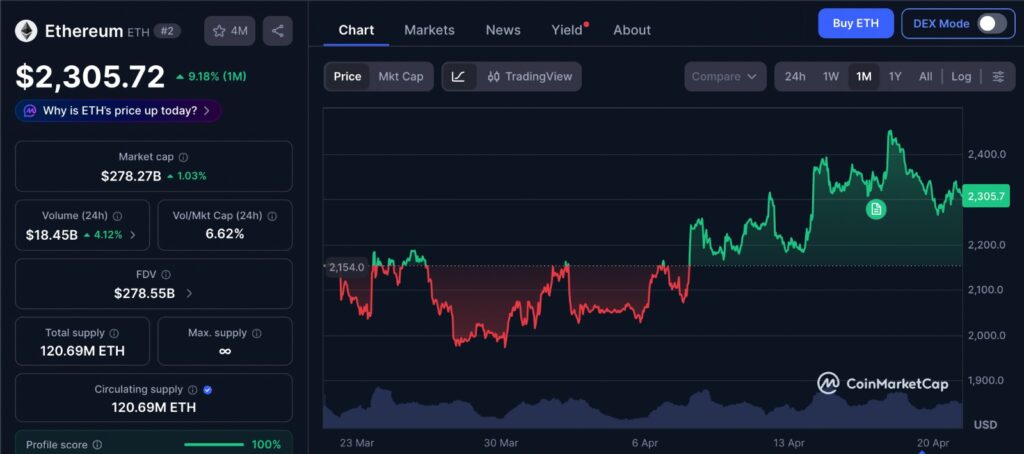
Ethereum’s price action over the past month reflects a period of controlled movement rather than strong directional expansion. The chart shows multiple attempts to push higher, but instead of sharp rejection, price has been absorbed and stabilized. This type of behavior often indicates that liquidity is being built beneath the surface, as positioning develops without forcing immediate movement, creating the conditions for a larger shift once that balance changes.
Why a $90M Long Position Matters
Large leveraged positions are not just expressions of confidence, they are expressions of timing. Opening a position of this size suggests that downside is perceived as limited relative to entry, and that liquidity is sufficient to absorb size without disrupting price.
Whale positioning is rarely random. It tends to appear when volatility is compressed, liquidity is building beneath price, and market participants remain uncertain or underexposed. Recent sessions have shown Ethereum stabilizing above key levels, with price holding steady even as momentum slows. That kind of behavior often signals that selling pressure is being absorbed rather than expanding, creating the kind of environment where larger players begin to act.
This Is Not Just a Bullish Bet It Is a Liquidity Bet
Most retail interpretation stops at a simple conclusion that a whale opening a long position must mean price is going higher. That misses the more important layer.
Large leveraged longs depend on one thing: the ability to exit without moving the market against yourself. That only exists when liquidity is thick enough to absorb size, order books are stable, and market makers are willing to provide counterparties. In practice, large traders build positions gradually, using available liquidity so execution does not push price against them.
This means the trade depends less on direction and more on whether the market can continue absorbing size without disruption. Large positions change how liquidity behaves because they introduce size that cannot be matched instantly, forcing the market to either absorb gradually or reprice quickly. Markets do not move when buying appears. They move when that buying cannot be easily absorbed.
The $3.2K Level Why It Is Being Watched
The $3,200 region is not arbitrary. It represents a zone where previous selling pressure has appeared, breakout attempts have stalled, and traders are positioned on both sides. This creates a tension point where the market is balanced but fragile.
If price pushes through this level, short positions begin to unwind while breakout traders enter, and liquidity above becomes thinner. That combination often leads to faster movement rather than gradual continuation. Large traders position ahead of these moments, where imbalance is likely to develop rather than waiting for confirmation.
Leveraged Positions Are Conviction But Also Risk
A $90M leveraged long is not passive exposure. It comes with liquidation levels, funding costs, and timing pressure, which means the trade depends on conditions remaining stable long enough to work.
Leverage increases sensitivity to price changes. When liquidity tightens or volatility rises, positions like this can be forced to adjust quickly, amplifying moves in either direction. This dynamic becomes more visible during large liquidation events, as seen in recent cases of crypto liquidations wiping out leveraged positions across the market.Markets tend to shift not when positions are opened, but when they are forced to close.
What This Signals About Market Sentiment
This move fits into a broader pattern of changing behavior among large participants. Recent activity suggests that traders with significant capital are beginning to take directional exposure again, engaging at key levels rather than remaining passive. This shift is also reflected in rising derivatives activity, with Ether open interest signaling increased trader exposure in recent sessions.
That does not confirm upside, but it does indicate that high-capital participants are no longer fully defensive. Risk is being deployed in a controlled way, and that shift often precedes changes in volatility and participation across the market.
The Real Insight Timing Over Direction
The biggest mistake is assuming this trade is about predicting price. It is not. It is about when conditions allow price to move.
Large traders do not chase momentum. They enter when liquidity is available, risk is manageable, and execution can be controlled. This trade reflects a moment where those conditions may be aligning. Not certainty, but structure.
Editor’s View:
This move stands out less because of its size and more because of its timing. When large players begin using leverage, it often reflects confidence in execution conditions rather than direction alone. If liquidity remains stable, positions like this can hold without pressure and allow price to expand gradually. If conditions shift, the same positioning can unwind quickly, bringing volatility back into focus.
How This Impacts the Broader Crypto Market
This matters beyond Ethereum because positioning at this scale rarely stays isolated. Similar positioning trends have also appeared across other assets, with open interest rising in Solana as traders increase exposure, suggesting broader participation. Ethereum often acts as a bridge between Bitcoin stability and broader market risk, meaning changes in ETH positioning tend to influence how capital behaves elsewhere.
If ETH holds its structure, confidence can extend into altcoins. If it moves higher, participation tends to increase. If it fails at resistance, positioning becomes more cautious. Whale positioning like this often precedes increased derivatives activity, shifts in short-term sentiment, and changes in volatility behavior.
In that sense, this is not just an ETH story. It reflects how capital is choosing to engage with the market.
Conclusion
A $90M Ethereum long is not important because of its size. It is important because of when it appears. The market is in a phase where liquidity is holding, price is stabilizing, and large players are beginning to step in.
Markets do not move because large players enter. They move when the market can no longer absorb how they are positioned. Right now, that balance is beginning to tighten.
Disclaimer: This content is for informational purposes only and does not constitute financial advice.
Keep yourself updated with the latest Altcoin News with FYI Gazette
 Bitcoin
  Ethereum
  Tether
  BNB
BNB  XRP
XRP  Solana
  TRON
TRON  Dogecoin
  Litecoin
  Pepe
Pepe