

Ethereum Price Rallies Keep Fading Near $2.4K as Network Demand Weakens
Ethereum price rallies are still struggling to hold above the $2,400 area, even as parts of the broader crypto market show signs of recovery.
That weakness is not only about short-term price action. It reflects a deeper issue: Ether is still waiting for stronger network demand, clearer institutional confidence, and a stronger reason for buyers to defend higher levels.
ETH has failed to sustain moves above $2,400 for the past three months and remains down 21% in 2026. That makes Ether’s underperformance stand out because the wider crypto market has fallen less sharply, with total crypto market capitalization down 11% year-to-date.
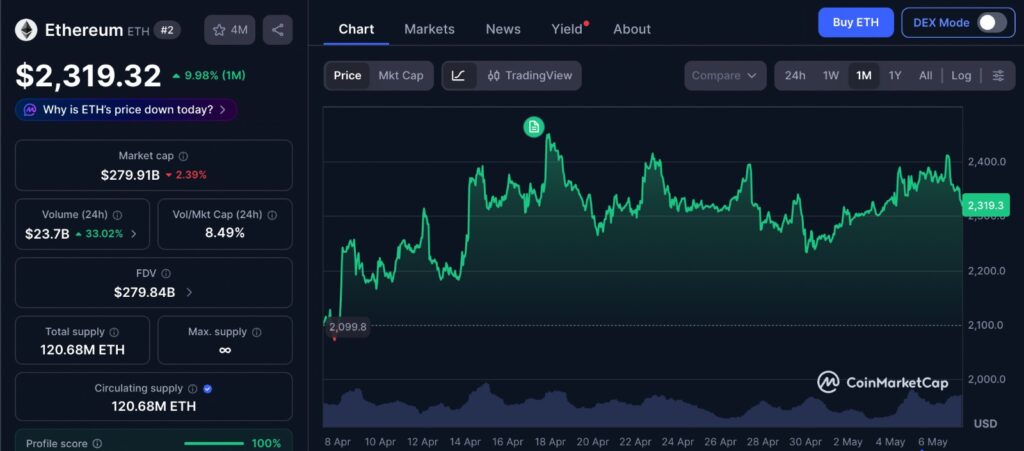
The one-month ETH chart from CoinMarketCap shows why the $2,400 area has become important for this article. Price has managed to recover at different points, but each move has struggled to build lasting momentum once ETH moves back toward the same upper range. That pattern supports the broader issue facing Ethereum price rallies: buyers are still active, but the market has not yet shown enough sustained demand to turn short-term recoveries into stronger continuation. In simple terms, the chart reflects hesitation rather than full rejection, with ETH still needing stronger activity and conviction to hold higher levels.
This gap matters.
When the broader market recovers faster than ETH, investors are not only reacting to price. They are questioning whether Ethereum’s network activity, fee generation, competitive position, and institutional demand are strong enough to support a larger move.
Recent sessions have shown ETH recovering at times, but losing momentum once price returns to the same resistance zone, which keeps the focus on whether Ethereum buyers can support a move toward $3K with stronger conviction. That behavior suggests buyers are present, but not strong enough yet to absorb supply consistently.
Why Ethereum Price Rallies Are Losing Strength
The main issue is not that Ethereum lacks relevance. Ethereum remains one of the most important networks in crypto, with deep liquidity, major developer activity, and a large ecosystem built around DeFi, stablecoins, staking, and layer-2 scaling.
But reputation alone does not sustain price.
For ETH to hold rallies, the market needs real demand flowing through the network. That demand can show up through decentralized exchange activity, DApp revenue, transaction fees, staking demand, or stronger institutional positioning.
Right now, several of those signals remain weak.
Ethereum DEX monthly volumes fell 53% over six months, while DApp revenue declined 49% over the same period. That matters because DEX activity has historically been one of Ethereum’s strongest demand engines.
When trading activity falls, fewer users pay fees, fewer protocols generate revenue, and fewer participants treat the network as the center of risk-taking activity.
That does not mean Ethereum is broken.
It means ETH price rallies are facing a demand problem. Buyers may still step in during recoveries, but without stronger on-chain activity behind them, rallies can lose momentum quickly near resistance, a dynamic also visible when Ethereum taker volume surges but price still needs deeper liquidity to continue higher.
Markets do not hold higher levels because price bounced. They hold higher levels when buyers keep absorbing supply.
Weak DApp Revenue Changes How Investors View ETH
Ethereum’s value story has always been tied to usage.
If applications generate revenue, users compete for blockspace, fees rise, staking economics improve, and ETH becomes more attractive as a productive crypto asset. But when DApp revenue declines, investors start asking harder questions.
Is Ethereum still capturing enough economic activity?
Are users moving elsewhere?
Can layer-2 scaling help Ethereum without weakening base-layer fee demand?
These questions matter because Ethereum is no longer competing only with itself. Other networks are trying to capture the same users, traders, and developers by offering cheaper and faster experiences.
Solana and Hyperliquid together account for a combined 42% share of DApp revenue, while Ethereum’s total value locked remains much larger. That creates an uncomfortable contrast: Ethereum still controls massive capital, but competitors are capturing meaningful revenue share.
This is one reason ETH rallies can fade even when the chart looks ready for continuation.
The market may respect Ethereum’s size, but it still wants evidence that activity is translating into stronger value capture for ETH holders. Large total value locked shows capital is present. Revenue shows whether that capital is actively producing demand.
This matters because capital sitting inside a network is not the same as capital moving through it. Price responds more strongly when users, traders, and protocols create repeated demand rather than passive value locked in place.
Hacks Have Also Hurt Confidence Across DApps
Another pressure point is security risk.
The crypto industry suffered $630 million in hacks in April, with KelpDAO and Drift Protocol accounting for most of those losses. Security incidents do not only affect the protocols involved. They can also reduce confidence across decentralized finance more broadly.
When users feel less confident interacting with DeFi platforms, activity slows. When activity slows, revenue weakens. When revenue weakens, ETH’s investment case becomes harder to defend in the short term.
This is why price resistance near $2,400 is not just a technical level. It has become a reflection of market hesitation.
Recent sessions have shown ETH buyers willing to defend recoveries, but not yet strong enough to create sustained follow-through. That often happens when short-term interest returns before deeper conviction has fully recovered.
A rally can start with relief, but it needs participation to survive.
Ethereum’s Scaling Story Is Still Complicated
Ethereum’s long-term scaling roadmap remains one of its biggest strengths, but it also creates confusion for investors.
Layer-2 networks help reduce friction for users by making transactions faster and cheaper. But they also raise a difficult market question: if more activity moves away from Ethereum’s base layer, how much value flows back to ETH itself?
Ethereum’s upcoming Glamsterdam upgrade is expected to improve base-layer capacity and allow clients to pre-fetch block data, supporting more efficient transaction execution.
That sounds positive for the network.
But for investors, the key question is simpler: will these upgrades increase ETH demand, improve fee capture, or strengthen staking yields?
Until that becomes clearer, some buyers may hesitate to assign a higher valuation to ETH. Technology can improve, but the market still wants to see whether that improvement turns into measurable economic demand.
This is one of Ethereum’s biggest challenges right now. The network can be fundamentally important while the token still struggles to outperform.
Institutional Demand Has Not Fully Recovered
Another reason Ethereum price rallies keep fading is institutional caution.
Bitmine, described as the largest publicly listed holder of ETH, remains underwater on its corporate reserves. The company spent $12.2 billion to acquire ETH, while the position is currently valued at $10.8 billion.
This does not automatically mean selling pressure is coming.
But it does affect perception.
When large public ETH holders are sitting on unrealized losses, institutions may become slower to add exposure. New buyers may wait for clearer price strength, while existing holders may avoid increasing risk until the market proves that ETH can reclaim higher levels, especially when Ether open interest surges without clear follow-through from spot demand.
That creates a feedback loop.
ETH needs stronger institutional confidence to sustain rallies, but institutional confidence may not fully return until ETH shows stronger performance.
This is where execution matters. Larger buyers usually do not chase uncertain moves aggressively unless liquidity, momentum, and confidence are aligned. If those conditions are not present, bids can become thinner near resistance and rallies can stall before they turn into a broader trend.
For larger participants, buying is not only about direction. It is also about whether there is enough demand behind them to exit or rebalance without moving the market against themselves, which is why Ethereum whale long positioning matters only when broader market support follows.
Liquidity is not continuous. Once nearby orders are absorbed, price has to move toward the next area where buyers or sellers are actually willing to trade.
What This Means for the Global Crypto Market
Ethereum’s weakness matters beyond ETH itself.
When Bitcoin leads but Ethereum lags, the market often becomes more selective. Capital may stay concentrated in stronger assets instead of spreading across the broader altcoin market. That can delay full risk appetite and reduce the strength of altcoin rotations.
Ethereum usually plays a major role in crypto market expansion because it sits between Bitcoin and higher-risk altcoins. If ETH starts performing strongly, it can signal that investors are becoming more comfortable moving further out on the risk curve.
But when ETH rallies fade near resistance, it sends a different message.
It suggests that liquidity is still cautious, demand is still selective, and traders are not yet fully convinced that the broader market recovery has enough depth.
This does not mean the market is weak everywhere. It means capital is being more selective. In that kind of environment, assets need a stronger reason to attract sustained demand.
Editor’s View: The Market Is Asking for Proof
Editor’s View: Ethereum’s issue is not visibility. Everyone already knows ETH matters. The problem is that markets do not reward importance forever unless it converts into demand, revenue, and stronger positioning.
Right now, ETH is being treated like an asset with long-term relevance but short-term hesitation. That is a difficult position because the market is not rejecting Ethereum, but it is also not giving ETH the same confidence premium it once did.
The $2,400 area matters because it keeps showing where interest slows down. It is not just a price ceiling. It is where the market keeps asking the same question: is this rally backed by real demand, or is it only another temporary recovery?
Final Thoughts
Ethereum price rallies are fading because the market still sees several unresolved pressures.
DApp activity has weakened. DEX volumes have fallen. Revenue has declined. Competition from other chains remains intense. Institutional confidence has not fully recovered. Ethereum’s scaling roadmap is promising, but investors still want clearer evidence that network improvements will translate into stronger ETH value capture.
None of this means ETH cannot recover.
But it explains why rallies near $2,400 have struggled to hold. For Ethereum to move beyond short-lived rebounds, the market needs more than better sentiment. It needs stronger usage, stronger revenue, and clearer conviction from both retail and institutional buyers.
The real shift begins when ETH stops relying on relief rallies and starts showing consistent demand where sellers expect resistance.
Disclaimer: This content is for informational purposes only and does not constitute financial advice.
Keep yourself updated with the latest crypto news with FYI Gazette
Keep yourself updated with the latest Altcoin News with FYI Gazette
 Bitcoin
  Ethereum
  Tether
  BNB
BNB  XRP
XRP  Solana
  TRON
TRON  Dogecoin
  Litecoin
  Pepe
Pepe