
Ethereum Bitcoin Weakness Shows Why ETH Is Still Losing Market Attention
Ethereum Bitcoin weakness has become one of the clearest signals in the crypto market, as ETH continues to lose ground against BTC even when broader market conditions look active.
This is not only a chart problem. It is a capital allocation problem.
Ether has fallen more than 35% against Bitcoin over the past year, showing that investors are still treating BTC as the stronger asset in the current cycle. While Ethereum can still produce sharp rallies against the dollar, its performance against Bitcoin tells a different story. It shows where market confidence is stronger, where liquidity is deeper, and where larger buyers appear more comfortable keeping exposure.
That does not mean Ethereum is broken.
However, it does mean ETH needs more than short-term rebounds to change the market’s view. Relative strength matters because it shows whether capital is simply moving with the wider market or actively choosing one asset over another. Right now, the market is asking whether ETH can rise faster than Bitcoin and hold that advantage.
Recent sessions have shown this clearly. ETH can still rebound when broader crypto sentiment improves, but the ETH/BTC pair has struggled to show the same follow-through.
Ethereum Bitcoin Pair Remains Under Pressure
The ETH/BTC pair has stayed below a long-term descending trend line that has limited several recovery attempts since 2022. That structure matters because Ethereum has not yet rebuilt sustained strength against Bitcoin.
A single bounce does not change that.
For ETH to regain stronger market attention, buyers would need to defend higher levels against Bitcoin, not only against the dollar. So far, each recovery attempt has struggled near resistance, while Bitcoin continues to attract stronger demand from long-term holders, institutions, and capital looking for lower relative risk inside crypto.
This is why ETH/BTC weakness should not be ignored. It reflects a deeper market preference.
When traders compare Ethereum and Bitcoin, they are not only comparing two prices. They are comparing liquidity, conviction, narrative strength, institutional demand, and perceived safety during uncertain periods. In that comparison, Bitcoin currently has the cleaner position because buyers can enter and exit with deeper liquidity and fewer moving parts.
Markets do not reward the asset with the longest explanation. They often reward the asset with the clearest demand.
Why Bitcoin Is Still Winning the Rotation
Bitcoin’s advantage in this cycle is simple: it has become the cleaner macro crypto trade.
Large investors do not need to understand complex network activity, staking dynamics, gas fees, or ecosystem fragmentation to build a Bitcoin position. BTC offers a more direct story. It is scarce, highly liquid, easier to explain, and more deeply connected to institutional products.
Ethereum has a broader ecosystem, but that also makes the investment case more complicated.
ETH demand depends on several moving parts. Investors watch network usage, layer-2 activity, fee revenue, staking flows, DeFi activity, token supply changes, and broader altcoin sentiment. When those signals are mixed, capital often chooses Bitcoin first. Ethereum’s positioning picture also matters here, especially as rising trader exposure has already shown how quickly ETH sentiment can shift when leverage builds around a move.
That is what the ETH/BTC chart appears to show.
In uncertain conditions, markets often reward clarity over complexity.
This is also where execution behavior matters. If large buyers want crypto exposure but do not want extra ecosystem risk, Bitcoin becomes the easier trade to size. Deeper demand attracts more liquidity, and stronger liquidity makes the asset easier for larger participants to hold.
This matters because large participants usually avoid markets where their own buying or selling can move price too sharply. The deeper the liquidity, the easier it becomes to build or reduce exposure without creating unnecessary execution risk.
Exchange Reserves Add Another Layer of Pressure
Another important part of Ethereum’s weakness is exchange-side supply.
Recent exchange reserve data showed ETH balances on Binance rising to around 3.62 million ETH, accounting for a large share of all Ether held across exchanges. Rising exchange balances do not always mean immediate selling, but they do show that more supply is available to move if sentiment weakens.
That matters because markets are shaped by available liquidity.
If more ETH sits on exchanges while Bitcoin reserves decline, the market can read that as a supply imbalance. Bitcoin looks tighter. Ethereum looks more available. That difference can influence how traders position, especially when both assets are competing for the same pool of crypto capital.
This does not guarantee further ETH weakness.
But it does explain why Ethereum has struggled to outperform Bitcoin. If buyers are not absorbing available ETH strongly enough, even moderate selling pressure can keep the relative trend under stress. Liquidity is not continuous. Once nearby buy orders are absorbed, price has to move lower to find the next area where buyers are willing to step in. That buyer absorption has been a key issue for ETH before, with Ethereum taker volume showing how short bursts of demand can still fail to create lasting follow-through.
Supply on exchanges is not the whole story, but it changes the tone of the market. When traders see more ETH available, they may become less willing to chase rallies. That can make each rebound feel more fragile, even if the broader Ethereum narrative remains active.
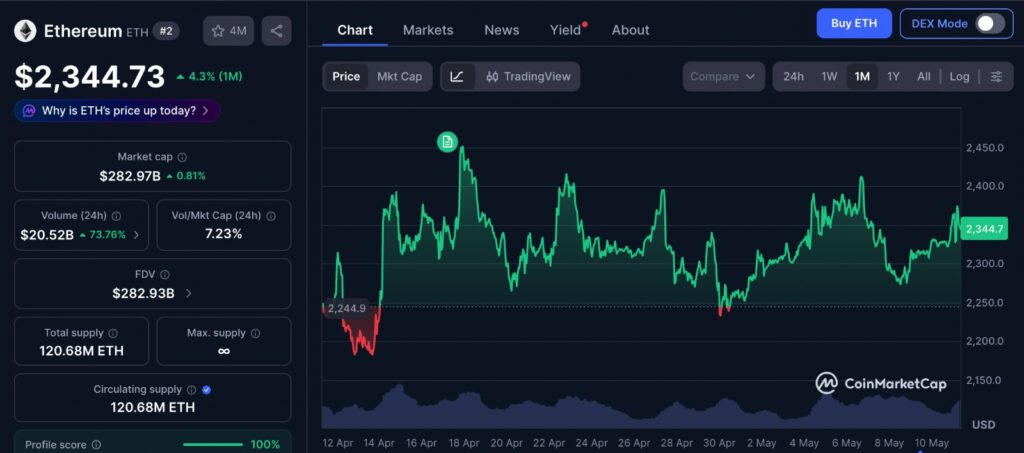
The one-month ETH chart gives useful context to this weakness. It shows that Ethereum can still produce short-term rebounds, but those moves have not yet turned into clear sustained strength. This matters because a price bounce alone does not prove that demand has returned. For ETH to change the market’s view, buyers need to keep absorbing supply after the first rebound, not only step in during brief relief moves. Recent price action shows why the ETH/BTC weakness remains important: Ethereum may recover in dollar terms, but it still needs stronger follow-through to prove that capital is choosing ETH with real conviction.
Ethereum Needs Demand, Not Just a Price Bounce
Ethereum’s biggest challenge is not that it cannot rally. It can.
The bigger issue is whether those rallies create lasting confidence. A move higher against the dollar can happen when the entire crypto market rises. But a move higher against Bitcoin requires something stronger. It requires investors to actively prefer ETH over BTC.
That is a higher bar.
For now, Ethereum still needs clearer evidence of demand. Stronger network activity, improved fee generation, healthier spot accumulation, and a better ETH/BTC structure would all help. Without those signals, rallies can continue to look like relief moves rather than a true rotation back into ETH. This is why Ethereum price rallies can fade when network demand does not confirm the move.
This is where many traders make a mistake. They look at ETH in dollar terms and assume strength has returned. But if Bitcoin is rising faster, ETH is still losing relative market share. That relative performance question has also appeared in broader Bitcoin and Ethereum analysis, where BTC’s stronger market position has continued to shape how investors compare both assets.
Relative weakness can hide inside a bullish market.
A stronger shift would require ETH to hold strength when Bitcoin pauses, not only rise when Bitcoin leads the market higher. That would show buyers are choosing Ethereum on its own terms, rather than simply following general crypto momentum.
Why This Matters for the Broader Crypto Market
The Ethereum Bitcoin relationship affects more than ETH holders. It also influences the entire altcoin market.
When ETH outperforms BTC, it often signals that investors are becoming more comfortable taking risk beyond Bitcoin. That can support broader altcoin liquidity. But when ETH keeps losing against BTC, the market usually remains more selective. Capital stays concentrated, and smaller assets need stronger narratives to attract attention.
This is why ETH/BTC is one of the most important charts in crypto.
It shows whether the market is expanding into risk or staying defensive inside Bitcoin.
Right now, the signal remains cautious. Bitcoin continues to look like the preferred asset, while Ethereum is still trying to prove that its ecosystem strength can translate into stronger relative demand.
For altcoins, this matters because Ethereum often acts as the bridge between Bitcoin strength and wider risk appetite. If ETH cannot lead, capital may remain concentrated near the top of the market instead of spreading more confidently into the rest of crypto.
Editor’s View
Ethereum does not need a dramatic narrative reset to recover against Bitcoin. It needs evidence that capital is willing to stay in ETH when BTC offers a simpler and more liquid alternative. That is the real test.
The market is not dismissing Ethereum. It is asking Ethereum to prove that its ecosystem value can become sustained buyer demand. Until that happens, ETH rallies may continue to attract attention without fully changing market conviction.
Conclusion
Ethereum Bitcoin weakness shows that the market is still favoring BTC as the stronger relative asset. ETH has not lost relevance, but it has lost momentum against Bitcoin, and that difference matters.
The current setup does not confirm a permanent downtrend. It does, however, show that Ethereum needs stronger demand signals before traders can treat its recovery as more than a temporary rebound.
For now, ETH remains in a difficult position. The structure changes only when buyers stop treating Ethereum as a secondary trade and begin absorbing supply strongly enough to challenge Bitcoin’s lead.
Disclaimer: This content is for informational purposes only and does not constitute financial advice.
Keep yourself updated with the latest crypto news with FYI Gazette
Keep yourself updated with the latest Altcoin News with FYI Gazette
 Bitcoin
  Ethereum
  Tether
  BNB
BNB  XRP
XRP  Solana
  TRON
TRON  Dogecoin
  Litecoin
  Pepe
Pepe