

Bitcoin Looks Undervalued While Ethereum Shows Early Strength as Q2 Begins
Bitcoin is entering a phase where price alone is no longer the clearest signal of value. Despite holding above key levels, the market is not showing the urgency typically seen during expansion cycles. This gap between price stability and participation is driving the narrative that Bitcoin may be undervalued as Q2 begins.
At the same time, Ethereum is showing early signs of renewed activity, not through sharp price moves, but through subtle shifts in market positioning.
This divergence is less about which asset moves first, and more about where capital is beginning to lean.
Bitcoin’s Stability Masks a Participation Gap
Bitcoin continues to trade in a relatively stable range, holding above key levels with dominance still intact.
However, stable price does not always mean strong participation.
Recent sessions have shown that while price has held, underlying activity has not expanded at the same pace. Spot volumes across exchanges have declined, pointing to reduced urgency from both buyers and sellers. This connects with the broader issue of Bitcoin demand lagging during the current bull run, where price strength can remain intact even as participation weakens beneath the surface.
This creates a structural imbalance:
- Price is being maintained
- Participation is thinning
- Conviction is not expanding
When this happens, the market is not weak, but it is incomplete.
From a structural standpoint, price can hold even when demand is not increasing if there is not enough aggressive selling to push it lower. In these conditions, liquidity becomes thinner on both sides, so stability reflects reduced activity rather than strong support.
Liquidity is not continuous. Once nearby orders are absorbed, price must move to find the next available interest.
An undervalued condition here does not mean price is simply “cheap.” It means the current level is not fully backed by active demand, leaving room for repricing if participation returns.
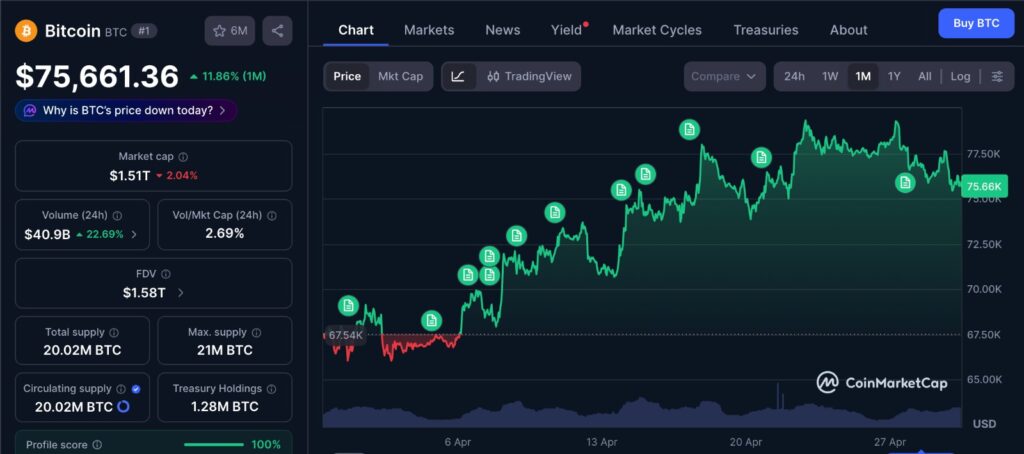
The 1-month BTC chart helps show why the current setup is being viewed through a valuation lens rather than a simple price trend. Bitcoin has continued to hold its range, but the movement has not been supported by a clear expansion in participation. This makes the chart useful because it shows the difference between price stability and market conviction. For Bitcoin to move beyond balance, activity needs to return with enough strength to challenge the current range.
Markets do not move because price appears stable. They move when participation returns and tests whether that stability is real.
Why “Undervalued” Does Not Mean Immediate Upside
The idea that Bitcoin is undervalued can be misleading if interpreted as a short-term signal.
Markets do not reprice simply because something appears underpriced. They reprice when:
- New demand enters
- Existing supply becomes constrained
- Positioning shifts force reallocation
At the moment, Bitcoin is not lacking structure. It is lacking urgency.
This is visible in how the market reacts to volatility events. Even during liquidation-driven moves, price has not transitioned into sustained expansion. This is why recent episodes of crypto liquidations across Bitcoin positions matter, because forced selling can create volatility without always producing lasting direction.
This suggests that forced moves are being absorbed by available liquidity rather than triggering follow-through. When this happens, buyers and sellers are still matching each other without one side gaining control.
In practical terms, the market is stabilizing, not accelerating.
Ethereum’s Strength Is Emerging Through Positioning, Not Price
While Bitcoin reflects stability, Ethereum is beginning to show signs of early structural improvement.
This is not visible through aggressive price appreciation, but through:
- Gradual increase in participation
- Renewed interest in derivatives exposure
- Subtle shifts in capital allocation
That renewed derivatives interest has already appeared in Ether open interest surging as trader exposure builds, showing that Ethereum’s setup is being shaped by positioning before price fully reacts.
Ethereum’s behavior suggests that traders are beginning to engage again, but cautiously.
This matters because early positioning often forms before price confirms the shift. Participants tend to build exposure gradually when conviction is still developing and risk remains controlled.
Unlike Bitcoin, where activity has cooled despite stable price, Ethereum is showing the opposite pattern:
- Price is not aggressively rising
- But underlying activity is slowly rebuilding
This also fits with recent signs of Ethereum taker volume rising near key liquidity levels, where stronger execution activity can reveal whether demand is returning with intent.
This divergence points to a change in how capital is being distributed across the market.
Capital Rotation May Be Starting, But Not Yet Confirmed
The current environment reflects the early stages of a possible rotation, but not a confirmed one.
Historically, when Bitcoin stabilizes without expanding, capital tends to look for:
- Higher volatility opportunities
- Undervalued narratives
- Assets with improving participation metrics
Ethereum fits part of this profile, but the transition is not yet decisive.
What we are seeing instead is a probing phase, where capital is testing conditions rather than committing aggressively.
Structurally, this phase is driven by positioning rather than conviction. Early participants begin to allocate selectively, but broader market involvement has not yet followed. This matters because rotation only becomes meaningful when participation spreads beyond early movers.
This phase is often overlooked because it lacks strong directional signals, but it is where positioning begins to build.
Market Structure Remains Intact, But Incomplete
From a structural perspective, the broader crypto market remains stable:
- Bitcoin is holding key levels
- Ethereum is showing early signs of engagement
- Volatility events are being absorbed rather than extended
However, the market is not yet in a fully coordinated phase.
For a sustained move to develop, three things need to align:
- Participation must expand across both spot and derivatives
- Liquidity must support continuation, not just reaction
- Capital rotation must become consistent, not selective
Until then, the market remains in transition, where stability reflects balance rather than strength.
Editor’s View
What stands out in the current environment is not what the market is doing, but what it is refusing to do.
Bitcoin is holding its ground, but without the follow-through that usually confirms strong demand. Ethereum is not rallying aggressively, yet it is beginning to attract attention beneath the surface.
This divergence reflects hesitation more than conviction.
It is the phase where participants watch each other, waiting for clearer intent before committing more capital. The market is not lacking direction, it is still deciding who is willing to take it there.
What This Means Going Into Q2
As Q2 begins, the focus shifts away from price levels and toward behavior.
Bitcoin’s undervaluation narrative depends on whether participation returns. Without it, price can remain stable without expanding.
Ethereum’s early strength depends on whether current positioning turns into sustained demand.
The transition only becomes meaningful when participation expands alongside price, not before it.
The move begins when balance breaks and price is forced to search for liquidity elsewhere.
Disclaimer: This content is for informational purposes only and does not constitute financial advice.
Keep yourself updated with the latest crypto news with FYI Gazette
Keep yourself updated with the latest Altcoin News with FYI Gazette
 Bitcoin
  Ethereum
  Tether
  BNB
BNB  XRP
XRP  Solana
  TRON
TRON  Dogecoin
  Litecoin
  Pepe
Pepe