

ASTER Futures Demand Tests $0.90 Rally Setup
ASTER futures demand is rising after the token climbed to a two-month high, but the real question is whether this move is being driven by lasting conviction or short-term positioning.
ASTER recently pushed as high as $0.78 before easing back toward $0.74, while daily trading volume reportedly jumped 342% to around $344 million. That kind of volume expansion shows traders are paying attention again, especially after speculation grew around Binance’s upcoming product, widely referred to in market discussions as “Haystack.”
The key detail is that Binance had not fully clarified the product at the time of the move. That means ASTER’s rally was reacting to expectation, not confirmed utility.
That makes the setup interesting, but also fragile.
When price moves before confirmation, the market is pricing in what traders hope will happen next. For ASTER, that hope appears tied to stock-related or tokenized equity speculation, a theme that traders believe could fit Aster’s market position.
Aster already supports stock perpetuals, allowing traders to gain long or short exposure to U.S. stock-linked perpetual contracts settled in USDT. That gives ASTER a clearer narrative than many short-term altcoin rallies. The token is not moving only because of random hype. It is moving because traders see a possible link, not confirmed integration, between stock-style crypto products and Aster’s derivatives infrastructure.
Still, narrative alone does not create support.
A strong story can attract attention. Only sustained demand can turn that attention into price stability.
ASTER Futures Demand Is Now the Real Signal
The most important part of this rally is not just the spot price move. It is the behavior in derivatives.
ASTER open interest reportedly rose 22% to about $475.6 million, while derivatives volume climbed 356% to roughly $1.1 billion. That shows traders were not just watching the rally. They were actively adding exposure.
This is where the story becomes more complicated.
Rising open interest can support a rally when fresh capital enters gradually and buyers continue to absorb supply. But it can also make the move fragile if too much of the price action depends on leveraged longs. This is similar to how rising open interest has affected other altcoin setups, including Solana’s $100 positioning test, where trader exposure became a key part of the market structure.
In simple terms, open interest shows how crowded the trade is becoming. If price keeps moving higher while new positions build steadily, momentum can remain supported. But if open interest rises quickly while price starts slowing, more traders are exposed without enough fresh buying underneath them.
That is why ASTER futures demand matters. It does not only show where excitement is growing. It shows where risk is building.
A clean rally usually shows strength across spot demand, liquidity depth, and controlled derivatives positioning. A fragile rally often moves fast, attracts leverage quickly, and becomes sensitive to rejection.
The token now has strong attention, rising volume, and whale participation. But it also has a structure where too many traders may be leaning in the same direction.
When positioning becomes crowded, liquidity can thin out faster than it appears. Buyers may look active on the way up, but if price turns, many of those same participants can become sellers trying to exit at once.
Liquidity is not continuous. Once nearby bids or offers are absorbed, price has to move to find the next area where real interest is waiting.
Recent sessions have shown that ASTER is not struggling for attention. The harder test is whether that attention remains when price stops moving in a straight line.
Whale Long Shows Confidence, but Also Adds Pressure
One of the key data points behind the move was a whale opening a 5x leveraged long position on 1.98 million ASTER, worth around $1.4 million.
That type of position matters because whale activity often influences retail psychology. When traders see large wallets taking aggressive long exposure, they may read it as a sign of confidence. In some cases, that can pull more capital into the same trade.
But a whale long is not the same as guaranteed upside.
A large leveraged position can become a source of pressure if price fails to move quickly. The same position that looks bullish during a breakout can become vulnerable during a pullback, especially when it is built around leverage rather than slow spot accumulation.
This is the difference between conviction and exposure. Conviction can sit through volatility. Leverage often cannot. That is why cautious leverage readings matter across the market, as seen in Bitcoin funding rates showing cautious leverage rather than clear directional conviction.
That distinction matters because leveraged trades carry pressure even before liquidation risk appears. Funding costs, margin management, and emotional stress increase when price stops moving in the expected direction. If enough traders are positioned the same way, even a normal pullback can become sharper because exits cluster together.
This is why ASTER’s next move matters. If price holds near the recent breakout area and volume remains elevated, the whale trade may reinforce confidence. If price slips while open interest stays high, the market may start testing how committed those longs really are.
The real signal is not that a whale entered. The real signal is whether the market can absorb volatility after that entry.
Why $0.79 and $0.80 Matter for ASTER
ASTER’s move toward $0.78 placed the token near an important short-term resistance area. A clean push above $0.79 and $0.80 could make $0.90 a focus for traders, but that does not make the level automatic.
The path from $0.80 to $0.90 depends on whether demand remains active after the initial Binance-linked speculation cools down.
This is the difference between a momentum move and a sustainable breakout.
A momentum move can be driven by headlines, whale trades, and rising futures exposure. A sustainable breakout needs repeated buyer absorption, controlled leverage, and proof that traders are not simply front-running a single announcement.
The $0.79 to $0.80 area matters because it is where late buyers usually reveal themselves. If buyers are still willing to enter near resistance, the market is showing confidence. If price rejects there while leverage remains high, it suggests many traders may already be positioned and fewer new buyers are available to push the move forward.
This matters because resistance is not just a line on a chart. It is where supply often appears, early buyers consider taking profit, and new buyers must prove they can absorb that selling. The same absorption logic can be seen in Ethereum’s taker volume and liquidity setup, where buyer behavior around key levels mattered more than the level itself.
If ASTER clears resistance while open interest rises in a controlled way, the move becomes healthier. If price struggles while leverage keeps building, the risk shifts toward a sharper shakeout.
That is why the $0.79 to $0.80 zone is more than a price level. It is a behavior test.
ASTER Price Chart Shows Whether Buyers Are Holding the Move
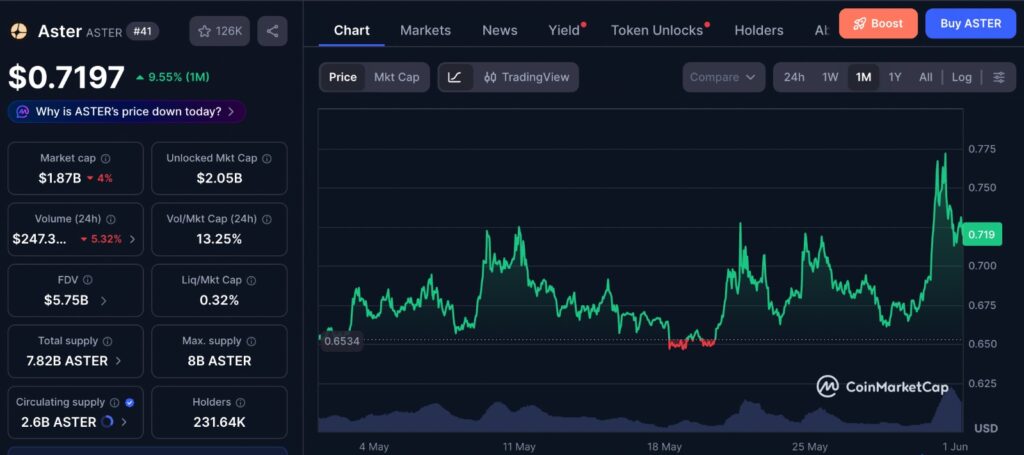
The one-month CoinMarketCap chart shows why ASTER’s current setup needs confirmation beyond the initial spike. The recent price recovery shows that buyers have returned, but the pullback from the two-month high also shows that supply is still appearing near the upper range. If ASTER continues holding close to the breakout zone while volume remains active, it would suggest buyers are still absorbing selling pressure. If the chart starts showing a deeper fade, it would support the idea that the move was driven more by short-term speculation than durable demand.
The chart should not be read as a prediction. It should be used to judge market behavior. A rally that holds near its highs usually shows buyers are absorbing supply. A rally that quickly fades after heavy volume often suggests early demand was more reactive than committed.
The Global Crypto Market Impact
ASTER’s rally fits into a wider market theme: selective altcoin rotation is still alive when a clear catalyst appears.
That matters because traders are not spreading liquidity evenly. They are concentrating attention around specific stories, especially where there is a link to exchange products, derivatives, or new market infrastructure.
In ASTER’s case, the catalyst is not only price momentum. It is the combination of futures demand, tokenized stock speculation, and whale positioning. That gives traders a reason to focus on the token while many altcoins still struggle for attention.
However, selective rotation also comes with risk.
If ASTER sustains demand after the Binance reveal, it could support interest in exchange-linked and derivatives-focused tokens. If the move fades, it would reinforce that many altcoin rallies remain short-term catalyst trades rather than broader market rotations.
Editor’s View
ASTER’s current setup is not weak, but it is not clean either.
The strongest part of the rally is that it has a real narrative behind it. Aster’s connection to stock perpetuals gives traders something concrete to discuss, especially as speculation builds around Binance’s next product direction.
The weakest part is timing.
A large part of the move appears to have happened before full confirmation. That means some buyers may already be positioned for good news. If the announcement fails to match expectations, the market could quickly shift from anticipation to profit-taking.
That does not make the rally meaningless. It means the market has pulled future expectations into the present price.
The institutional-level insight here is simple: ASTER is being priced less like a normal altcoin and more like a leveraged bet on a product narrative. That can create strong upside pressure when the story is fresh, but it also makes the token sensitive to disappointment.
Recent sessions have shown that traders are not ignoring ASTER. The real question is whether they are accumulating the asset because they believe in the platform’s longer-term role, or simply borrowing conviction through leverage.
Borrowed conviction can move price. Real demand is what keeps it there.
What ASTER Needs Before $0.90 Becomes Realistic
ASTER can move toward $0.90 if buyers reclaim and hold the $0.79 to $0.80 area with strong volume. The setup becomes stronger if open interest rises alongside stable price action rather than extreme volatility.
But if speculation fades, or if leveraged longs begin closing after the announcement, ASTER could lose momentum quickly. In that case, the market may revisit lower support areas as traders reduce exposure.
For now, ASTER is not just testing resistance.
It is testing whether ASTER futures demand can become real market support.
That distinction matters because a rally built only on expectation can move fast, but a rally backed by sustained demand can last longer. Price does not hold because traders expect a catalyst. It holds when buyers keep absorbing supply after the easy part of the move is over.
Disclaimer: This content is for informational purposes only and does not constitute financial advice.
Read more about Memecoins with FYI Gazette
Keep yourself updated with the latest Altcoin News with FYI Gazette
 Bitcoin
  Ethereum
  Tether
  BNB
BNB  XRP
XRP  Solana
  TRON
TRON  Dogecoin
  Litecoin
  Pepe
Pepe