

Ethereum OG Sale Tests ETH Holder Conviction as Short-Term Supply Moves
Ethereum OG Sale activity has returned to the center of market debate after an early ETH investor reportedly sold around $136 million worth of Ether near the $2,000 region.
At first glance, that kind of sale can create fear. When a wallet connected to Ethereum’s early years moves a large amount of ETH, traders often read it as a warning sign. The simple narrative is that early holders know something, confidence is weakening, and the market may be preparing for more downside.
But that framing may be too aggressive.
A large Ethereum OG sale can pressure sentiment, especially when ETH is already trading near an important psychological level. However, one wallet sale does not prove that long-term Ethereum holders are abandoning the asset. The stronger story is more balanced: older-holder data still appears relatively stable, while short-term holder cohorts seem to be driving much of the recent supply movement.
That difference matters. A visible whale sale can shape market mood, but the real signal is whether short-term supply pressure spreads while older-holder conviction remains stable.
Ethereum OG Sale Creates Pressure, But Not Proof of Capitulation
The reported sale involved an early Ethereum investor offloading tens of thousands of ETH in separate transactions. In a weak market, that kind of selling can have an outsized emotional effect because traders are already looking for confirmation that downside pressure may continue.
Large old-wallet sales are not just about supply. They are about perception.
When an early holder sells, the market often treats it as a signal. Some traders assume older investors are better informed, more patient, and less likely to sell unless they see risk ahead. That may be true in some cases, but it is not enough to support a broad market conclusion.
A single wallet can sell for many reasons, including profit-taking, portfolio rebalancing, liquidity needs, risk reduction, or a long-delayed exit. Without confirmation across other old-holder cohorts, it is risky to say Ethereum’s long-term base is breaking down.
Markets do not move when one wallet sells. They move when that sale changes how other participants position around it.
The sale may increase short-term pressure, but it does not prove a structural loss of conviction among Ethereum’s oldest holders.
Old Ethereum Holder Data Still Looks Relatively Stable
The more important question is whether this sale is part of a wider trend. Based on holder-age data cited in the market discussion, there is no clear evidence that older Ethereum investors are selling aggressively as a group.
That is the key point.
If Ethereum OGs were broadly exiting, the market would likely show stronger movement in older supply cohorts. Instead, the data suggests that supply held by older investor groups has not shown the kind of breakdown needed to support a broad “OG capitulation” narrative.
Some older-holder cohorts also appear to have remained stable or increased slightly over the recent period. That does not remove risk from ETH. It simply means the bearish argument should not be overstated.
This is where market reactions often become too emotional. Traders focus on visible wallet movement because it is easier to understand than supply distribution across multiple holder groups. But the broader conviction signal comes from holder cohorts, not one headline transaction.
One large sale can dominate headlines. Holder data shows whether the behavior is spreading.
Right now, the cleaner interpretation is that Ethereum has seen a major old-wallet sale, not a confirmed wave of old-holder exits.
Short-Term ETH Holders May Be Driving the Real Supply Movement
The more interesting part of the setup is not the old-wallet sale itself. It is where the recent supply movement appears to be coming from.
Shorter-term holder cohorts reportedly saw more noticeable declines in supply share. That suggests recent buyers, active traders, or medium-term participants may be moving ETH more aggressively than the oldest holders.
This creates a different market story.
If short-term holders are reducing exposure, ETH may be dealing with positioning stress rather than long-term holder abandonment. Short-term supply is usually more reactive. These holders are more likely to respond to price weakness, failed rallies, leverage pressure, and changing sentiment. This positioning pressure also connects with rising Ether open interest and trader exposure, where active market participants can amplify short-term moves even when older-holder behavior remains steadier.
That can still hurt price in the near term.
When short-term holders sell into weakness, they add supply at the same moment buyers become more selective. This is where liquidity matters. If buyers are deep and patient, the market can absorb selling without much damage. If buyers are thin or waiting lower, even normal selling can look heavier on the chart. That same liquidity problem was visible in Ethereum taker volume and buyer absorption signals, where aggressive trading activity showed how quickly ETH can react when demand is not strong enough to absorb supply.
Liquidity is not continuous. Once nearby buy orders are absorbed, price has to move lower to find the next group of willing buyers.
That is why nervous selling can have more impact than the size of the sale alone suggests. Uncertain buyers can wait, but pressured sellers often execute first.
If buyers absorb the sale without ETH losing structure, the event becomes isolated. If they fail, the sale can turn into a signal that short-term holders use to justify exiting first.
Recent sessions have shown how quickly ETH sentiment can shift near the $2,000 area, where each failed rebound makes short-term holders more sensitive to fresh selling pressure.
This can make ETH’s recovery harder, especially if spot demand is not strong enough to absorb available supply. But it is not the same as long-term investors collectively losing faith in Ethereum.
The distinction matters because markets respond differently depending on who is selling.
Long-term holder selling can signal deeper conviction damage. Short-term holder selling often reflects stress, fear, or positioning cleanup. Both can pressure price, but they carry different meanings.
Why ETH Near $2,000 Is a Sentiment Test
Ethereum’s position near the $2,000 area makes this discussion more sensitive. Round-number levels often become psychological battlegrounds because traders use them as simple reference points.
When ETH trades near $2,000, every large wallet movement feels more important. A whale sale near that area can make traders question whether support is weakening. At the same time, buyers may hesitate because they do not want to step in too early if more selling appears.
That creates a fragile environment.
ETH does not need a massive wave of old-holder selling to face downside risk. It only needs enough short-term supply, weak demand, and cautious liquidity to keep pressure on the market. This is why the current setup should be read through supply absorption, not just wallet headlines.
The real question is not whether one Ethereum OG sold.
The real question is whether the market can absorb that supply without triggering wider fear among shorter-term holders.
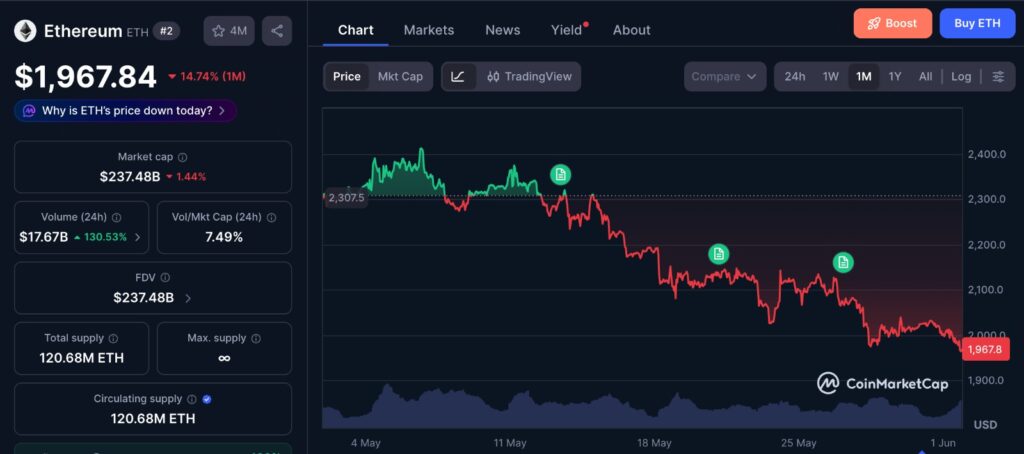
The 1-month ETH chart shows how price has reacted around the $2,000 region after the reported Ethereum OG sale. The key detail is not the headline alone, but whether ETH can hold structure while short-term supply is being tested. If price remains stable despite the added selling pressure, it would suggest buyers are absorbing the supply. If ETH weakens quickly, it would show that demand remains cautious and short-term holders are reacting more aggressively.
Ethereum OG Sale Does Not Cancel the Bigger ETH Story
Ethereum still has deeper long-term narratives around staking, institutional infrastructure, tokenized assets, stablecoin settlement, and decentralized finance activity. But those narratives do not automatically protect ETH from short-term price pressure. A similar supply question appeared when Ethereum unstaking activity raised fresh ETH supply concerns, showing why large ETH movements need to be judged by market absorption rather than the headline alone.
This is where the market is often misunderstood.
A strong long-term network thesis can exist at the same time as weak short-term price structure. Ethereum can remain central to crypto infrastructure while ETH still struggles if demand is not strong enough to absorb available supply.
That is why the current moment is not about choosing between bullish and bearish labels. It is about separating structural holder behavior from short-term market stress.
The Ethereum OG sale is important because it affects sentiment. But the available holder data suggests it should not be treated as proof that Ethereum’s oldest investors are rushing for the exits.
Editor’s View: The Market Is Watching the Wrong Signal
The most important signal may not be the $136 million sale itself. It may be how the market behaves after the sale becomes public.
That is when positioning starts to matter.
If ETH weakens after the headline, traders may use the old-wallet sale as a bearish explanation. That is how narratives work in fragile markets. Price moves first, and traders attach the most visible reason to it afterward.
But if older-holder cohorts remain stable, then the pressure is likely coming from short-term confidence, not deep structural abandonment.
That distinction is more useful than the headline.
Old wallets create attention. Short-term holders often create volatility.
For Ethereum, the current risk is not that one OG sold. The risk is that visible selling near a key psychological level causes weaker hands to move first, while stronger buyers wait for clearer confirmation.
That makes ETH’s next phase less about panic and more about absorption. If the market absorbs the supply and older holders remain steady, the “Ethereum OGs are leaving” narrative may fade quickly. If short-term holders keep reducing exposure and demand stays weak, ETH could remain under pressure even without broad old-holder selling.
The cleaner read is this: the Ethereum OG sale matters because it can change positioning, not because it proves abandonment. Price does not weaken because an old wallet moves alone. It weakens when that movement meets thin demand, cautious buyers, and short-term holders willing to sell first.
Disclaimer: This content is for informational purposes only and does not constitute financial advice.
Read more about Memecoins with FYI Gazette
Keep yourself updated with the latest Altcoin News with FYI Gazette
 Bitcoin
  Ethereum
  Tether
  BNB
BNB  XRP
XRP  Solana
  TRON
TRON  Dogecoin
  Litecoin
  Pepe
Pepe