
SpaceX Pre-IPO Crypto Demand Shows How Price Discovery Is Moving Before Wall Street Opens
SpaceX pre-IPO crypto demand is becoming one of the clearest signs that market attention is no longer waiting for traditional exchanges to open.
Around SpaceX’s public-market debut, Binance’s SpaceX-linked tokenized IPO campaign reportedly attracted more than $557 million in USDC deposits from about 27,689 wallet addresses. That figure does not mean investors were buying actual SpaceX shares. It shows something different for crypto markets.
Traders are using crypto rails to express demand, price expectations, and risk appetite before a major private company is fully available in public-market trading.
That distinction matters. The story is not simply that SpaceX generated strong IPO interest. The more important development is that crypto platforms are becoming an early venue where traders try to price demand before Wall Street fully opens.
Why the SpaceX Pre-IPO Crypto Demand Matters
The strongest part of the Binance campaign was not only the size of the deposits. It was the shape of participation.
Reported campaign data showed that wallets contributing up to $20,000 accounted for more than 81% of participating addresses, but only 18.39% of total funds. At the same time, 114 addresses reportedly contributed more than $500,000 each, representing about 10.2% of the funds.
That split suggests broad retail participation, while also showing larger wallets were active in the same market. In practical terms, SpaceX-linked crypto products became a venue where different types of traders positioned around one of the most watched public listings in years.
This is where the market signal becomes important.
When a private company is still outside normal public trading, price discovery is usually limited. Institutional investors, underwriters, private market holders, and selected participants tend to see the market first. Retail traders often wait until the listing opens, when the first major price move may already have happened.
Crypto markets are testing a different model. Instead of waiting for shares to trade, traders can use synthetic products and tokenized exposure to price expectations earlier.
That does not make the pricing perfect. It makes the demand visible.
Markets do not always wait for permission. They move toward the first venue where demand can be expressed.
Crypto Rails Are Turning IPO Hype Into Live Markets
SpaceX’s IPO reportedly priced at $135 per share, raising $75 billion and valuing the company near $1.77 trillion. That made the listing one of the most significant public-market events in recent memory.
However, the crypto-market response showed that traders were willing to price SpaceX-linked exposure before deeper public-market liquidity was fully available.
On some crypto venues, SpaceX-linked pricing reportedly traded above the IPO reference level before moving closer to public-market pricing. That gap matters because it shows how restricted access can push demand into synthetic markets first.
Recent sessions have shown the same pattern across event-driven crypto markets: when direct access is limited, traders often crowd into the nearest liquid instrument first, then reassess once deeper markets open.
The key question is whether those synthetic prices are discovering real demand or reflecting speculative pressure. That same distinction matters across crypto markets, where futures demand can reveal early positioning before spot demand confirms whether the move has real support.
Both can be true at the same time.
Crypto markets often move faster than traditional finance because they are easier for active traders to access. That speed allows sentiment to appear earlier. It also increases the risk that prices detach from the underlying asset, especially when the product does not represent direct share ownership.
This is the central tension behind SpaceX pre-IPO crypto demand. Crypto rails can reveal appetite before Wall Street fully opens, but earlier pricing does not automatically mean better pricing.
That is the mechanism behind the premium: demand arrived before deep liquidity, so price discovery happened in the narrowest available market first.
Execution also matters. If buyers use synthetic markets because they cannot access the underlying shares, prices can rise faster than the liquidity behind them. Once public trading begins, that gap has to face deeper and more transparent order books.
Liquidity is not just where traders want to buy. It is where enough opposite interest exists to absorb them.
Why This Is Different From Buying SpaceX Shares
The biggest risk for readers to understand is that these products are not the same as owning SpaceX stock.
Pre-IPO perpetuals and tokenized exposure products can track expectations around a company’s valuation, but they do not necessarily give holders ownership rights in the underlying company. Binance has also warned that tokenized securities do not represent direct ownership of SpaceX shares and do not provide voting rights, dividend rights, or other shareholder rights.
That makes the product closer to a market opinion than a traditional investment in the company itself.
For traders, that can still be useful. A synthetic product can allow positioning around an event, hedging, or short-term speculation. For long-term investors, however, the distinction is critical. Exposure to a price-linked contract is not the same as holding equity, receiving shareholder rights, or participating directly in the company’s ownership structure.
This is where excitement around tokenized stocks and pre-IPO products can become misleading.
A trader may be right about SpaceX demand and still face product risk, liquidity risk, funding-rate risk, or pricing gaps. A market can correctly sense strong demand and still overprice the event in the short term.
That is why the SpaceX campaign should be read as a signal, not confirmation.
What SpaceX Demand Says About Crypto Market Structure
The SpaceX-linked activity also says something broader about crypto’s role in financial markets.
For years, crypto was often treated as a separate risk market centered on Bitcoin, Ethereum, altcoins, and DeFi. That line is becoming less clean. Stablecoins, tokenized assets, prediction markets, and synthetic exposure products are pulling traditional financial events onto crypto infrastructure. That makes stablecoin market risk more relevant, because even non-crypto market events now depend on stablecoin rails for fast capital movement and participation.
The SpaceX IPO shows how quickly that shift can happen when a major public-market narrative meets crypto-native trading tools.
The real innovation is not only tokenization. It is the ability to turn restricted or delayed market access into a 24-hour tradable expectation. The same question appears across broader tokenized asset demand, where market interest can grow before it becomes clear whether that demand translates into deeper ownership or lasting liquidity.
That could become increasingly relevant if more high-profile private companies approach public listings. Traders may build expectations through crypto venues first, especially when the company has global name recognition and limited pre-listing access.
At the same time, this creates a new problem for markets. If synthetic pricing becomes visible before an IPO, traditional investors may start watching crypto markets as sentiment indicators. But those signals may be noisy, leveraged, and unevenly liquid.
In other words, crypto can become a useful early signal without becoming a reliable valuation model.
The value is not that crypto markets are always right. The value is that they can show where demand is building before traditional markets fully reveal it.
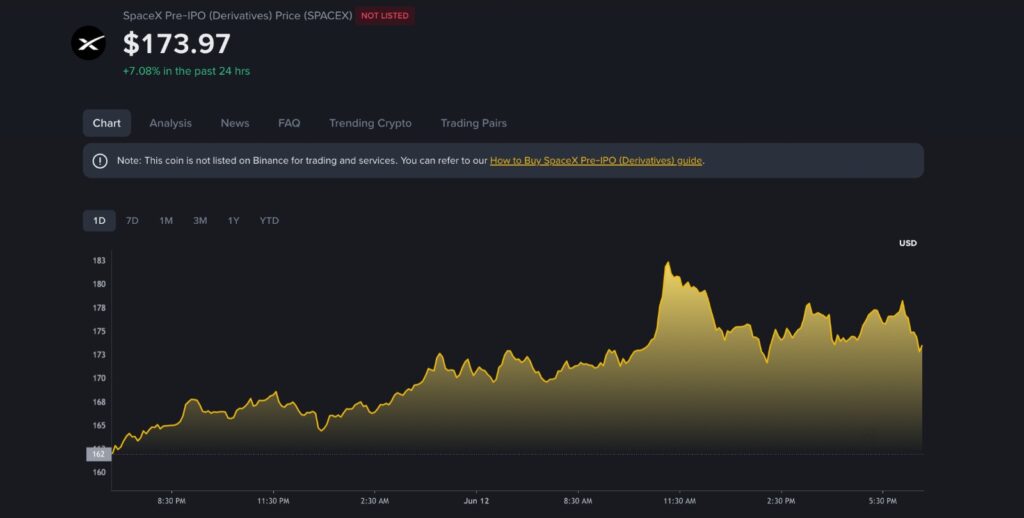
A chart of Binance’s SPCXUSDT pre-IPO perpetual would help readers see how crypto traders priced SpaceX-linked demand before deeper public-market liquidity was fully available. The key point is not whether the synthetic price was accurate, but whether early crypto-market pricing showed demand forming before traditional equity trading fully opened.
The Real Test Comes After Public Trading Begins
The most important phase for SpaceX-linked crypto markets may not be the deposit campaign itself. It may be what happens after the stock begins trading publicly.
If synthetic prices align more closely with public-market trading, crypto venues may gain credibility as early price discovery tools. If prices diverge sharply or liquidity becomes unstable, the products may be viewed more as speculative side markets than serious valuation signals.
That outcome will matter beyond SpaceX.
Binance and other platforms are trying to build markets around pre-IPO exposure at a time when private companies are staying private longer and retail traders want earlier access to major growth stories. The demand is real. The risk is also real.
For crypto, the opportunity is clear: become the infrastructure layer where global traders price major financial events before traditional markets fully open.
For traders, the lesson is more cautious.
SpaceX pre-IPO crypto demand shows that crypto rails can attract serious attention around major equity-market events. It does not prove that every synthetic price is fair, that every contract is liquid, or that pre-IPO exposure removes the risks of trading around hype.
The better reading is that crypto is becoming an early venue for market expectations, not a replacement for equity ownership.
That makes the SpaceX moment important. It is not just about one IPO. It is about whether crypto markets can become the first place where the next major private-company valuation is tested in public.
Editor’s View
SpaceX pre-IPO crypto demand shows a market structure shift that should not be dismissed as simple speculation.
The deposits, wallet activity, and synthetic pricing all point to the same thing: traders want access before traditional finance gives it to them. Crypto platforms are stepping into that gap by turning IPO expectations into live markets.
Still, the difference between exposure and ownership remains the key line. This is where the market can easily confuse a tradable signal with the asset itself. One measures demand around the event. The other represents actual ownership.
If traders understand that line, these products may become useful price discovery tools. If they ignore it, the same products can turn into another leverage-driven hype cycle.
Early markets show where interest is forming. Reliable price discovery begins only when that interest meets enough liquidity to absorb both buyers and sellers.
Disclaimer: This content is for informational purposes only and does not constitute financial advice.
Keep yourself updated with the latest crypto news with FYI Gazette
Read more about Memecoins with FYI Gazette
Keep yourself updated with the latest Altcoin News with FYI Gazette
 Bitcoin
  Ethereum
  Tether
  BNB
BNB  XRP
XRP  Solana
  TRON
TRON  Dogecoin
  Litecoin
  Pepe
Pepe