

Bitcoin CPI Bounce Shows Traders Were Watching Expectations, Not Inflation Alone
Bitcoin’s latest rebound came at an unusual moment. US inflation reached its highest level in three years, yet BTC moved higher instead of breaking down immediately.
That reaction may look confusing at first. Higher inflation usually creates a difficult setup for risk assets because it can keep interest rates higher for longer, support Treasury yields, and reduce appetite for speculative exposure. For Bitcoin, that matters because BTC still trades partly as a liquidity-sensitive asset.
However, the move was not simply about inflation being high. It was about whether inflation was worse than traders had already priced in.
The latest US Consumer Price Index showed headline inflation rising 4.2% year over year in May, while monthly CPI increased 0.5%. Core inflation, which excludes food and energy, rose 2.9% annually and 0.2% on the month. The headline number was uncomfortable, but it broadly matched expectations. That difference mattered.
Markets rarely react to the headline alone. They react when the headline forces traders to change position.
Why Bitcoin Rose Despite Hot Inflation
Bitcoin’s post-CPI bounce suggests traders were reacting less to the inflation level itself and more to the absence of a negative surprise.
A three-year high in inflation is not bullish on its own. It keeps macro pressure alive and makes it harder for investors to assume that monetary conditions will ease quickly. But if traders were already positioned for a hot print, a matching result can reduce the immediate fear of a more aggressive policy response.
That was the key distinction in this move.
If inflation had come in above expectations, the market could have been forced to price in a tougher Federal Reserve stance. That would likely have pressured Bitcoin because higher-for-longer rates reduce the appeal of risk assets. Instead, the report matched what economists were already looking for, allowing traders to treat the result as bad but not shocking.
This is why Bitcoin recovered intraday losses and moved higher after the data. The market was not celebrating inflation. It was adjusting to the fact that inflation did not force traders to price in something worse than they already feared.
That is the mechanism behind the bounce: once the feared surprise failed to appear, bearish positioning lost urgency and buyers had less resistance to absorb. That positioning angle also connects with recent Bitcoin funding rates, which show whether traders are adding aggressive leverage or staying cautious around volatile macro events.
Inflation Still Matters for Bitcoin
The bounce does not remove the larger risk. It only shows that one data release was not strong enough to force immediate selling.
High inflation remains a problem for Bitcoin because it keeps the macro environment tighter than bulls would prefer. When inflation stays elevated, investors become less confident about rate cuts, liquidity expansion, and easier financial conditions. Bitcoin can rally during inflationary periods, but it usually needs strong spot demand, clear risk appetite, or a weaker dollar backdrop to sustain the move.
This is where the setup becomes more complicated.
The CPI report was heavily influenced by energy pressure, while core inflation remained more moderate. That difference matters because energy-driven inflation can shock headline CPI without proving that underlying demand inflation is accelerating at the same pace.
Still, headline inflation is what consumers feel most directly, and it is also what keeps policy uncertainty alive. For Bitcoin, that means the market cannot ignore inflation just because BTC bounced once.
A single CPI reaction can create relief. It cannot prove that macro pressure has disappeared.
The Real Test Is Follow-Through
Bitcoin’s reaction after the CPI print should be read as a short-term relief move, not a confirmed reversal.
The strongest part of the move is that BTC did not collapse on a clearly uncomfortable inflation number. That shows sellers did not control the release window. It also suggests some traders were positioned too defensively before the data, which allowed Bitcoin to rebound once the result came in line with forecasts.
However, Bitcoin still needs follow-through above nearby resistance zones to prove that buyers are doing more than reacting to a one-day macro event.
Relief rallies often begin when bad news fails to create new lows. Sustainable recoveries require something more: continued demand after the initial surprise fades. That is why recent Bitcoin bull run demand analysis remains relevant, because a post-CPI bounce still needs sustained buyer participation to become more than a short-term reaction.
That is the next test for BTC.
If buyers continue to absorb supply after the CPI bounce, the move becomes more meaningful. It suggests traders are willing to look past headline inflation and focus instead on whether inflation is peaking, stabilizing, or becoming less threatening for policy expectations.
If Bitcoin fails to hold the bounce, the CPI reaction may look more like a temporary reset in positioning than a real shift in market structure.
This is where liquidity matters. A bounce after macro data often begins with thin selling pressure and short-covering, but it becomes stronger only when real buyers keep accepting higher prices. Liquidity is not continuous. Once nearby orders are absorbed, price needs fresh demand to prevent the move from fading back into the previous range.
Recent sessions have shown how quickly Bitcoin can react when traders are positioned for one macro outcome and the data leaves them without a clear reason to keep pressing that trade.
CMC chart analysis
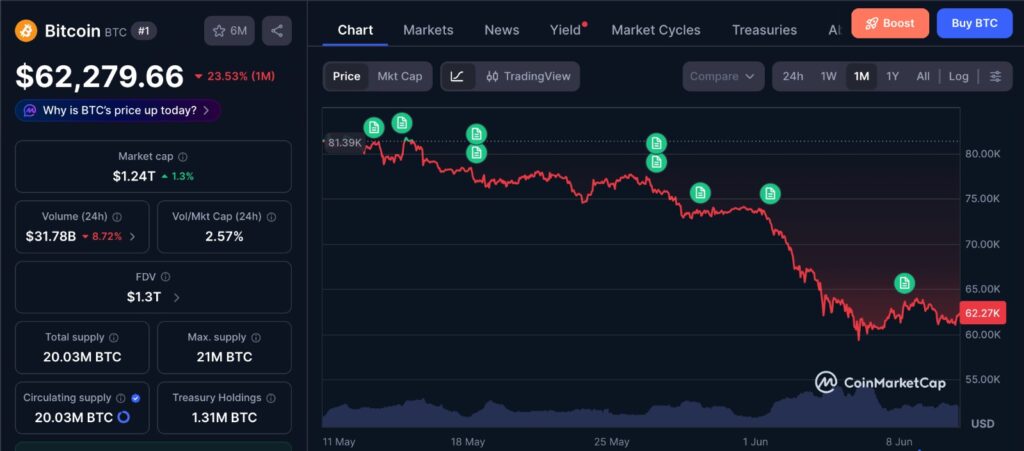
The 1-month Bitcoin chart from CMC helps show how BTC reacted around the CPI release and whether the post-data bounce is holding above nearby support. The key point is not simply that Bitcoin rose after hot inflation, but whether buyers continue absorbing supply after the initial expectations reset. If BTC holds the rebound area, it would support the idea that traders were positioned too defensively before the data. If the move fades quickly, it would suggest the bounce was more of a short-term macro reaction than a confirmed shift in demand.
Why Expectations Matter More Than The Headline
This event highlights one of the most important rules in macro-driven crypto trading: the headline number is only part of the story.
A hot inflation print can still produce a bounce if traders had already priced in that outcome. A softer print can still create selling if the market expected something even weaker. Bitcoin reacts not only to data, but to the gap between data and expectations.
That is why the latest CPI reaction matters.
The market had already prepared for a hot inflation reading. When the number arrived in line with expectations, the immediate fear trade lost strength. Traders who expected a sharper downside reaction had less reason to press short exposure, while buyers had a cleaner window to step in near support.
This does not make inflation irrelevant. It makes positioning more important.
Bitcoin often moves hardest when macro data forces traders to unwind crowded assumptions. In this case, the crowded assumption may have been that hot CPI would automatically break BTC lower. Instead, the data was hot but not worse than expected, and that was enough to create a bounce.
Bad news hurts most when it catches the market leaning the wrong way.
Bitcoin Still Needs Confirmation
The more important question now is whether Bitcoin can turn this reaction into a stronger recovery.
For that to happen, BTC needs more than one inflation-driven bounce. It needs to show that buyers are willing to support price after the CPI volatility fades. That means holding key support areas, reclaiming short-term resistance, and avoiding a quick reversal back into the range that existed before the data. ETF flows are another part of that confirmation test, especially when Bitcoin ETF outflows raise questions about whether institutional demand is strong enough to support a broader recovery.
If Bitcoin continues higher, the CPI bounce may be remembered as the moment traders stopped treating high inflation as an automatic sell signal. If the move fades, it will likely confirm that macro pressure is still limiting risk appetite.
The difference will come down to follow-through.
High inflation did not break Bitcoin lower this time. But it still raised the bar for bulls.
Editor’s View
This was not a bullish inflation report. It was a positioning event.
Bitcoin bounced because traders did not get an immediate reason to increase bearish exposure. The data was hot, but it did not force the market to price in a worse outcome than expected.
That makes the next phase more important than the initial reaction. Once the CPI move fades, BTC needs active buyers to remain present. Otherwise, the bounce risks looking like a short-term expectations reset rather than a stronger demand signal.
What This Means for BTC
Bitcoin’s rise after the CPI report should not be read as a simple bullish signal. It is better understood as a market expectations signal.
Traders were not ignoring inflation. They were responding to the fact that inflation was not worse than feared. That gave Bitcoin room to bounce, but not enough evidence to declare that macro conditions have turned supportive.
For now, Bitcoin has survived the inflation shock. The next move depends on whether buyers can prove that survival was the start of demand, not just the end of fear.
Price does not move higher because bad news is ignored. It moves higher when sellers lose pressure and buyers are still willing to absorb supply.
Disclaimer: This content is for informational purposes only and does not constitute financial advice.
Keep yourself updated with the latest crypto news with FYI Gazette
 Bitcoin
  Ethereum
  Tether
  BNB
BNB  XRP
XRP  Solana
  TRON
TRON  Dogecoin
  Litecoin
  Pepe
Pepe