

Strategy’s 1,550 BTC Buy Turns Bitcoin Sale Controversy Into Confidence Test
Strategy’s latest 1,550 BTC purchase has shifted the conversation around its Bitcoin treasury model from damage control back to conviction.
According to the company’s latest filing, Strategy bought 1,550 Bitcoin for approximately $101.3 million at an average price of $65,332 per BTC, bringing its total holdings to 845,256 BTC. On paper, this looks like another routine accumulation update from the world’s most aggressive corporate Bitcoin holder. However, the timing makes this purchase more important than the size alone.
The buy comes shortly after Strategy faced criticism for Strategy’s earlier Bitcoin sale, a small disposal that carried symbolic weight because it challenged the market’s assumption that the company was only a one-way Bitcoin accumulator. The latest purchase now tests whether investors see that sale as an exception, or as evidence that Strategy’s treasury model is becoming more flexible under pressure.
Recent sessions have shown how quickly sentiment can shift when a company built around accumulation makes even a small sale. The issue was not the amount of Bitcoin sold. It was what the sale made investors question about future behavior.
Strategy’s larger buy helps restore the accumulation narrative. It tells the market that last week’s sale was not necessarily a shift away from the company’s core Bitcoin strategy, even as investors continue to judge whether the model can hold up during weaker liquidity, deeper drawdowns, and rising scrutiny around leverage.
That is the mechanism behind the confidence test: the buy reduces concern from the sale, but only future consistency tells investors whether the sale was an exception or a new flexibility in the model.
Strategy Adds 1,550 BTC After Last Week’s Sale
According to the filing, Strategy’s latest acquisition was funded through proceeds from Class A common stock sales under its at-the-market offering program.
That detail matters because Strategy’s model depends on more than Bitcoin conviction. It also depends on market access, investor appetite, equity issuance, preferred stock obligations, and the company’s ability to raise capital without weakening confidence in the structure.
The company has long positioned itself as a Bitcoin treasury vehicle, using financing tools to expand its BTC holdings. During strong markets, that model can look powerful because rising Bitcoin prices support balance sheet value, stock performance, and future fundraising potential.
During weaker markets, the same structure attracts sharper scrutiny.
That is why the latest purchase lands differently. Strategy is not adding Bitcoin while conditions are easy. It is adding after a controversial sale, after a major Bitcoin drawdown, and during a period when investors are asking whether corporate Bitcoin accumulation can remain credible under pressure.
A routine buy becomes more meaningful when it follows a moment of doubt.
Why the 32 BTC Sale Still Matters
The 32 BTC sale was small compared with Strategy’s total holdings. In balance sheet terms, it was not enough to change the company’s Bitcoin position in any meaningful way.
But markets do not react only to size. They react to signals.
For years, Strategy built its identity around relentless Bitcoin accumulation. That made even a minor sale feel larger than the number suggested. Traders and analysts immediately questioned whether the sale was a one-off treasury decision or an early sign that pressure inside the model was rising.
That is where symbolic supply becomes market-relevant. A small sale can matter if it changes how investors interpret future behavior.
Strategy’s new 1,550 BTC purchase helps push back against that concern. It suggests the company is still committed to expanding its Bitcoin position, not retreating from it. However, it does not fully erase the question raised by the sale.
The reason is simple. Once a company is valued partly on the belief that it will keep accumulating Bitcoin, consistency becomes part of the asset story. Any break in that pattern forces investors to ask whether the strategy is still disciplined, flexible, or under stress.
One purchase can restore some confidence, but repeated behavior is what rebuilds trust.
Bitcoin Treasury Confidence Is Now the Bigger Story
Strategy’s Bitcoin holdings are now far beyond the scale of a normal corporate treasury allocation. That makes the company an important sentiment marker for institutional Bitcoin exposure.
Strategy’s larger buy helps restore the accumulation narrative, even as investors continue to judge whether the model can hold up during weaker liquidity, deeper drawdowns, and cautious Bitcoin funding rates.
When Strategy buys, the market often reads it as a sign of long-term conviction. When Strategy sells, even slightly, traders look for stress signals. That is why the latest move is less about the 1,550 BTC itself and more about what it says about the company’s confidence in its own model.
The purchase suggests Strategy wants investors to see the 32 BTC sale as an exception, not a reversal.
However, Bitcoin treasury confidence is not built only through accumulation. It depends on whether the company can keep buying without creating concerns around dilution, leverage, or forced selling risk.
This is the tension investors are now trying to price.
If Bitcoin stabilizes and Strategy keeps adding without balance sheet pressure becoming the main story, the latest purchase could help repair sentiment. If Bitcoin weakens again and attention returns to financing risks, the confidence test may continue.
Markets do not move when one buyer appears. They move when enough participants believe that buying can survive pressure.
Why This Purchase Matters for Bitcoin
Strategy’s latest acquisition also matters for Bitcoin because corporate treasury demand remains one of the most visible forms of institutional accumulation.
Unlike short-term trading flows, treasury purchases are usually treated as long-duration demand. They remove supply from active circulation and reinforce the idea that Bitcoin can function as a strategic reserve asset for public companies.
But the current market is not rewarding accumulation automatically.
Bitcoin has been under pressure, and investor confidence has become more selective, especially as Bitcoin demand weakness remains a key concern across the broader market. In that environment, large buyers need to prove that demand is strong enough to absorb selling, not just visible enough to create headlines.
That is why Strategy’s purchase may help sentiment, but it does not guarantee an immediate Bitcoin recovery.
The key issue is absorption. If the market can absorb recent volatility while Strategy continues buying, the purchase strengthens the case that long-term demand remains active. If Bitcoin struggles despite renewed accumulation, it may show that broader liquidity is still too weak for one buyer to change the trend.
Liquidity is not continuous. Once nearby bids are absorbed, price has to search for the next area where buyers are willing to step in with enough size.
This matters because treasury buying does not hit the market in isolation. Sellers, leveraged traders, and short-term holders also react to volatility. When liquidity is thin, even strong demand can look weak if sell orders arrive faster than bids can absorb them.
A large buyer can support confidence, but it cannot replace broad participation. Bitcoin needs more than a headline bid. It needs enough buyers across price levels to absorb sellers without relying on one institution to carry the narrative.
This is the difference between accumulation and confirmation.
Strategy has shown accumulation. Bitcoin still needs market confirmation.
BTC Chart Analysis
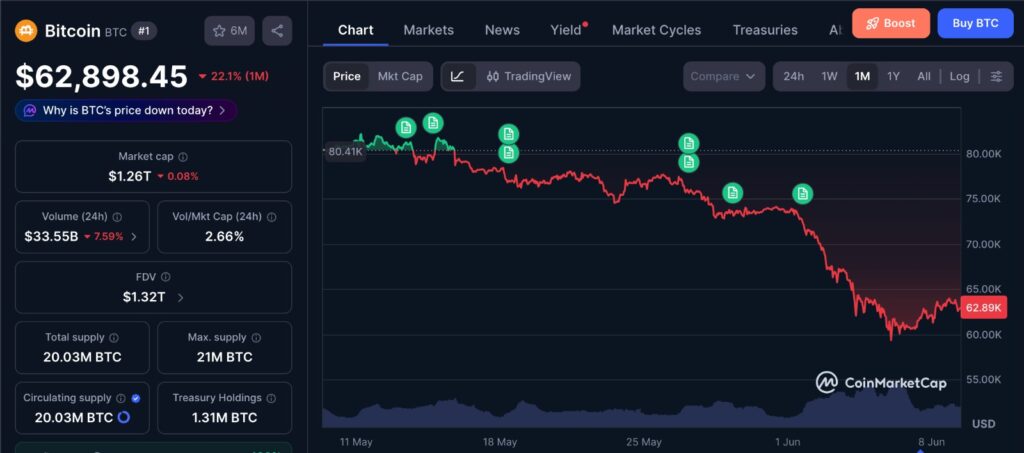
The 1-month Bitcoin chart helps show why Strategy’s latest purchase comes at a sensitive point for market confidence. BTC has been trading through a period of weaker sentiment, making the reaction around the earlier 32 BTC sale and the later 1,550 BTC purchase important to watch. The key point is not whether Strategy alone moved the market, but whether Bitcoin can stabilize while one of its largest corporate holders continues to accumulate. If BTC holds firmer after the purchase, it supports the confidence-repair narrative. If the reaction stays weak, it shows that broader liquidity pressure still matters more than one buyer.
Shareholder Approval Adds Another Layer
The latest update also came alongside shareholder approval for a change in the dividend payment schedule for Strategy’s STRC preferred stock. Market reports noted that the schedule is shifting from monthly to semi-monthly payments, with the first semi-monthly payment expected in July for shareholders of record at the end of June.
This matters because Strategy is now being judged on more than Bitcoin accumulation. Investors are also watching whether its capital structure can support that accumulation without putting pressure on the core BTC position.
Bitcoin conviction may remain the headline, but execution now matters just as much. The company has to manage funding, preferred stock obligations, equity issuance, and investor appetite while keeping the treasury story intact.
The company’s Bitcoin thesis has not changed. What has changed is the level of scrutiny around how that thesis is funded and maintained.
What Traders Should Watch Next
The next major signal is whether Strategy’s latest buy calms concerns around the 32 BTC sale or whether investors continue treating the sale as an early warning sign.
For Bitcoin, traders will watch whether the market can hold key support zones while institutional accumulation remains visible. A stronger Bitcoin reaction would suggest that buyers are willing to treat Strategy’s move as confirmation of demand. A weak reaction would suggest that broader market pressure still matters more than one corporate purchase.
For Strategy, the market will watch consistency.
If the company continues buying while avoiding further surprise sales, the 32 BTC disposal may fade into the background as a temporary controversy. If another sale appears during weakness, the debate around the treasury model could return quickly.
Confidence is not rebuilt by one transaction. It is rebuilt when the next few decisions match the story investors were asked to believe.
That makes the latest 1,550 BTC buy important, but not final.
It gives Strategy a chance to reset the narrative. It does not end the test.
Final Takeaway
Strategy’s 1,550 BTC purchase is not just another accumulation headline. It is a direct response to a confidence problem created by last week’s symbolic 32 BTC sale.
The company is trying to prove that its Bitcoin treasury model remains intact, even after market stress and public criticism. The purchase helps that argument, but the real proof will come from consistency, funding resilience, and Bitcoin’s ability to absorb pressure around major support levels.
Confidence is not rebuilt by one transaction. It is rebuilt when the next few decisions match the story investors were asked to believe.
A treasury model is strongest when the market does not have to guess what comes next. The real test is whether Strategy’s future actions keep reinforcing the accumulation story instead of reopening questions about flexibility under pressure.
Disclaimer: This content is for informational purposes only and does not constitute financial advice.
Keep yourself updated with the latest Altcoin News with FYI Gazette
 Bitcoin
  Ethereum
  Tether
  BNB
BNB  XRP
XRP  Solana
  TRON
TRON  Dogecoin
  Litecoin
  Pepe
Pepe