

Ethereum Binance Inflows Rise as ETH Below $1.7K Tests Fresh Demand
Ethereum Binance inflows are becoming a key signal as ETH struggles below the $1.7K area and traders look for signs that fresh demand can absorb supply.
The issue is not only weak price action. More ETH appears to be moving toward exchange liquidity before fresh demand has clearly returned. That changes the market question. ETH is no longer just testing a chart level. It is testing whether buyers can absorb supply before sellers gain more control.
According to recent market data cited by analysts, Binance recorded net inflows of about 57,700 ETH over the past few days. At the same time, recent figures showed new ETH depositor activity near 320 addresses, below levels usually linked to stronger demand expansion.
That gap matters because exchange inflows can increase available sell-side liquidity, especially when they arrive on a deep venue like Binance. New depositor activity helps show whether fresh participants are entering the market or whether price stability is relying mostly on existing holders.
When supply moves faster than new demand, support becomes more fragile.
Ethereum Binance Inflows Put Supply Back in Focus
Ethereum’s move below $1.7K has drawn attention because it comes as exchange flow data turns cautious. Large inflows do not automatically mean immediate selling, but they do increase the amount of ETH that can be sold quickly if market conditions weaken.
That is why Binance inflows matter. Binance remains one of the most liquid crypto exchanges, so inflows to the platform can become market-relevant faster than smaller movements elsewhere.
For ETH, the concern is not only the size of the inflow. It is the timing.
The market is already trading near a sensitive zone, and buyers have not shown enough participation to turn the move into a clear recovery. If inflows continue while fresh demand stays limited, rallies may face heavier supply before momentum can build.
That is the mechanism behind the risk: exchange inflows make supply easier to execute, while weak depositor growth shows fewer fresh buyers are arriving to absorb it.
This matters because liquidity is not evenly spread across the market. When more supply sits close to execution, nearby bids can be absorbed quickly, and price must search for the next area where buyers are willing to step in. That makes liquidity quality important, especially when earlier ETH moves already showed how Ethereum taker volume can shift near key liquidity zones.
Recent sessions have shown that ETH is not just struggling to reclaim a level. It is struggling to prove that lower prices are attracting enough demand to meet the supply moving toward exchanges.
Markets do not weaken when price falls alone. They weaken when sellers have easier execution than buyers have conviction.
New ETH Depositor Activity Remains Muted
The more important signal may be what is not happening.
New ETH depositor activity remains muted, with recent figures showing around 320 new depositor addresses. That suggests fresh participation has not expanded meaningfully even as ETH trades near a lower price range.
This is important because lower prices do not automatically create durable demand. A cheaper ETH price can attract attention, but the market still needs actual capital, fresh deposits, and stronger participation to absorb available supply. This same demand problem has appeared in earlier Ethereum rebounds, where Ethereum price rallies faded as network demand stayed weak.
If new depositors remain limited, Ethereum’s recovery attempt may depend mostly on existing holders and spot buyers defending the range. That can work for a period, but it leaves the market more exposed if exchange inflows keep rising.
In practical terms, ETH needs more than dip-buying interest. It needs demand large enough to meet the supply already moving toward liquid venues.
A cheap price is not the same as strong demand. Demand only matters when it arrives with enough size to absorb sellers.
ETH Below $1.7K Becomes a Demand Absorption Test
The $1.7K area now matters because market structure, sentiment, and liquidity are being tested at the same time.
A simple price rebound above the level would not be enough on its own. The stronger signal would be a rebound supported by improving participation and lower pressure from exchange-bound supply.
If buyers absorb the Binance inflows without ETH losing deeper structure, the market can begin to treat the current range as a demand zone. If buyers fail to absorb that supply, the same area can turn into a distribution zone where rallies are sold into.
That is the real test below $1.7K.
Ethereum does not need a dramatic narrative shift to stabilize. It needs evidence that demand is broad enough to meet the supply already visible in exchange data.
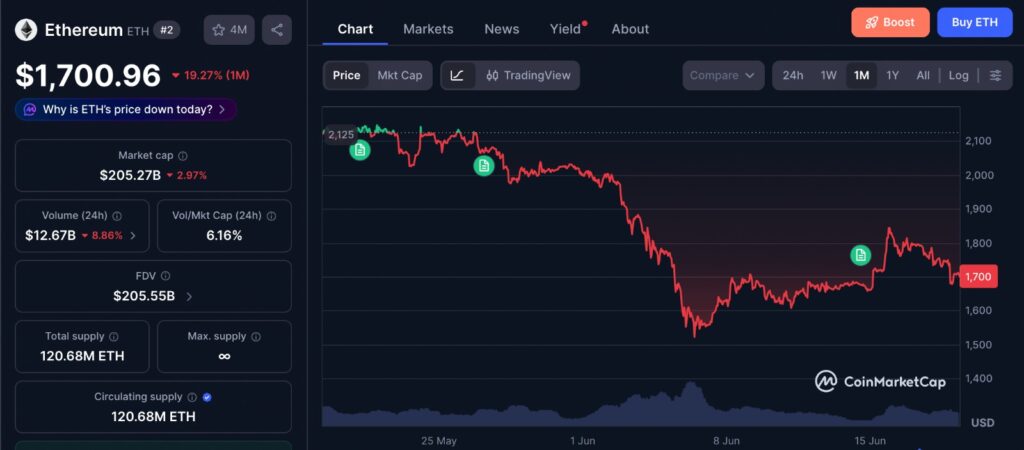
The 1-month ETH chart shows Ethereum struggling to regain momentum after moving below the $1.7K area. This image fits the article because the key issue is not only the price decline, but whether buyers can absorb the supply moving toward exchanges as Binance inflows rise. If ETH holds the range with stronger participation, it would suggest demand is beginning to meet available supply. If the reaction stays weak, it would show that fresh demand has not yet returned with enough size to defend the level.
Futures Open Interest Shows Trader Conviction Has Cooled
Derivatives data also shows that trader conviction has weakened.
Ether futures open interest reportedly dropped to about $10.3 billion from around $15 billion over the past month, marking a decline of roughly 31%. That suggests speculative exposure has been reduced as ETH lost momentum.
Lower open interest can reduce liquidation risk because there is less leverage in the system. However, it can also show that traders are less willing to take directional exposure. That shift matters because previous ETH setups showed how Ether open interest can increase trader exposure when leverage builds around key levels. In this case, the decline in open interest does not automatically create a bullish setup because spot-side demand has not clearly strengthened.
A leverage reset can reduce forced selling, but it does not replace real demand. If futures traders step back and new depositors remain muted, the burden shifts to spot buyers. They must decide whether the current ETH range offers value or whether lower liquidity areas still need to be tested.
This is where participant behavior matters. When leverage leaves the market, price becomes more dependent on real buying and selling instead of forced liquidations. That can make moves cleaner, but it can also expose weak demand faster because there are fewer leverage-driven rebounds to hide soft spot participation.
Ethereum’s Weekly Range Still Carries Downside Risk
Ethereum is also trading near an important weekly demand area. Analysts are watching the broader $1.4K to $1.7K zone because that range has become the battleground between buyers trying to defend the market and sellers testing weaker liquidity.
If ETH loses that zone with rising exchange pressure, attention may shift toward the April 2025 low near $1,384.
However, the current setup is not only bearish. Analysts have also noted that some momentum readings appear stretched after the sharp decline, which can support a relief bounce.
The question is whether any bounce has real demand behind it. If ETH rebounds while inflows stay elevated and new depositor activity remains weak, the move may still be vulnerable. If inflows cool and participation improves, the recovery would have stronger backing.
Why This Ethereum Setup Is Different
Ethereum’s current weakness is different from a normal pullback because it combines three signals at the same time.
First, ETH is trading below a key psychological area near $1.7K. Second, Binance inflows are rising, pointing to more supply moving toward liquid exchange venues. Third, new depositor activity remains muted, suggesting fresh demand has not yet confirmed a stronger recovery.
That combination makes the market less about price alone and more about absorption.
A healthy recovery would show buyers stepping in while sell-side pressure fades. A weaker recovery would show ETH bouncing into resistance while exchange-bound supply remains active.
The next phase will likely depend on which side changes first: demand participation or exchange supply.
That is why the current setup cannot be judged only by whether ETH prints a green candle. The market needs to show that buyers are not just reacting to a lower price, but actually absorbing the supply that has moved closer to execution.
Ethereum Needs Demand Confirmation, Not Just a Bounce
Ethereum can still stabilize, but the market needs stronger confirmation than a short-term rebound.
A bounce below or around $1.7K may relieve pressure after a sharp drawdown. But unless fresh participation improves, the recovery could remain exposed to renewed selling.
For now, Binance inflows show that supply is still a market factor. Muted new depositor activity shows that fresh demand has not fully answered that supply yet.
That is why ETH’s next move matters. If buyers absorb the exchange-bound supply, the current range can become a base. If they do not, the market may begin treating the same range as another failed recovery attempt.
Ethereum’s risk below $1.7K is not just weak price action. The real test is whether fresh demand arrives before exchange-bound supply turns support into an exit zone.
Disclaimer: This content is for informational purposes only and does not constitute financial advice.
Keep yourself updated with the latest crypto news with FYI Gazette
Keep yourself updated with the latest Altcoin News with FYI Gazette
 Bitcoin
  Ethereum
  Tether
  BNB
BNB  XRP
XRP  Solana
  TRON
TRON  Dogecoin
  Litecoin
  Pepe
Pepe