
Bitcoin Altcoin Rotation Weakens as Altseason Trade Fades
Bitcoin altcoin rotation is weakening as traders move away from the old bull market playbook that once pushed BTC profits into smaller crypto assets.
In previous cycles, a strong Bitcoin rally often created a familiar second phase. Traders would take profits from BTC, move into Ether and large caps, then chase smaller altcoins as risk appetite expanded. That pattern helped define the 2017 and 2021 altseason narrative.
This cycle looks different.
Recent market data shows that BTC-priced altcoin trading activity has fallen to its weakest level since 2021. That matters because the metric helps show whether traders are actively using Bitcoin to buy smaller altcoins. When that volume is strong, capital is spreading across the risk curve. When it collapses, traders are staying in Bitcoin, moving into stablecoins, or becoming far more selective with altcoin exposure.
The result is not necessarily the end of altseason. It is a change in what altseason means.
Recent sessions have shown the same pattern in price behavior: Bitcoin remains the main liquidity anchor, while many smaller altcoins struggle to hold follow-through after short rallies.
Bitcoin Altcoin Rotation No Longer Looks Automatic
The biggest shift is that Bitcoin strength is no longer lifting the entire altcoin market in the same way.
In earlier cycles, traders often treated Bitcoin gains as fuel for broader speculation. Once BTC moved first, smaller assets could benefit because liquidity was rotating. A strong Bitcoin market created confidence, and that confidence pushed traders into higher-risk names.
Now, that automatic rotation appears weaker.
Smaller altcoins are not receiving the same broad follow-through, even while Bitcoin remains the center of market attention. Instead of capital spreading widely, liquidity is staying concentrated in Bitcoin and a smaller group of large or more established crypto assets. This keeps the wider market rotation more selective than the old altseason playbook.
That makes the current market more selective. Traders are no longer rewarding every token because Bitcoin is holding up. They are asking whether a project has liquidity, users, revenue, a clear narrative, or a reason to attract capital beyond short-term hype.
Altseason has not disappeared because traders stopped taking risk. It has weakened because risk capital is no longer spreading evenly.
Markets do not rotate because Bitcoin rises. They rotate when traders believe the next layer of risk can absorb real money.
Capital Is Concentrating in Fewer Altcoins
Another important signal is concentration.
The non-Bitcoin, non-stablecoin crypto market is still large, but more of that value is sitting in fewer assets. Recent figures show the top non-stablecoin altcoins account for the majority of the altcoin market’s value, while the number of billion-dollar altcoins has dropped sharply compared with the last major bull cycle.
That tells a simple story. Capital has not left crypto completely. It has become more selective. That selectivity also reflects uneven crypto market confidence, where traders are still willing to take risk but not across every altcoin equally.
This is why many smaller tokens continue to struggle even when headline market conditions appear supportive. A token may have a strong community, an old narrative, or a previous cycle reputation, but that alone is no longer enough to attract durable demand.
The market is beginning to separate liquid assets from illiquid stories.
Concentration changes the market’s rhythm. Stronger assets get repeated liquidity, while weaker names need fresh attention every time they try to move.
In practical terms, fewer assets are absorbing more of the available capital. That gives stronger names better depth, smoother execution, and more consistent attention, while smaller tokens rely more on short bursts of speculation.
This matters because liquidity is not continuous. Once nearby buyers are absorbed, price has to move further to find the next layer of demand, which makes thin altcoin rallies easier to reverse.
Why the Old Altseason Playbook Is Weakening
The old altseason model depended on three things working together: strong Bitcoin gains, rising trader confidence, and easy liquidity across speculative assets.
The first part can still happen. Bitcoin can still lead the market. The problem is with the second and third parts. When Bitcoin demand weakness remains visible, confidence has less room to spread into the wider altcoin market.
Traders are more aware of dilution, low-float token structures, weak unlock schedules, and narratives that do not convert into real usage. Many altcoins from previous cycles failed to recover their old strength, making market participants less willing to rotate blindly.
At the same time, liquidity is not spreading across the market with the same force. When money is limited, it does not move into everything. It moves into the assets that traders believe can hold attention, volume, and exit liquidity.
That is why large caps, revenue-linked protocols, stablecoin infrastructure, tokenized asset themes, and stronger on-chain businesses may attract more attention than random smaller tokens.
Right now, the reason to take risk is harder to find across the long tail of altcoins.
The structural issue is simple. Smaller altcoins need fresh buyers more urgently than large assets do. Without steady inflows, even a strong price move can struggle because there may not be enough depth behind the rally.
Execution risk also matters. In thinner altcoins, larger orders can move price sharply, making entries more expensive and exits less reliable. That keeps bigger traders focused on assets where liquidity is deeper and risk is easier to manage.
This is why positioning matters. If traders are already cautious, they are less likely to chase weaker altcoins after the first bounce. They wait for proof that other buyers are also willing to step in.
Bitcoin Dominance Keeps Pressure on Smaller Tokens
Bitcoin dominance remains a key pressure point for the wider altcoin market.
When dominance rises or holds firm, BTC is taking a larger share of total crypto market value. That can delay broad altcoin rotation because capital is not spreading deeply enough beyond Bitcoin and the most liquid names.
A few strong altcoin rallies do not automatically confirm altseason. A real altseason requires breadth, not just isolated moves in a handful of tokens.
Breadth matters because it shows whether risk appetite is spreading or only hiding in a few liquid trades. Without it, the market can look active on the surface while the smaller end of the altcoin market remains fragile.
Altcoin Market Chart Shows the Breadth Test
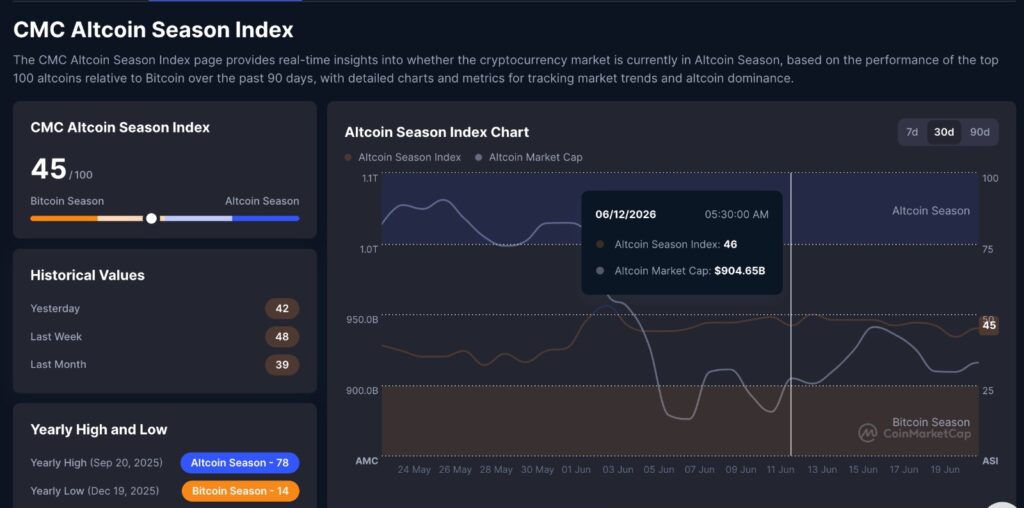
The CoinMarketCap Altcoin Season Index chart adds another layer to the breadth test. Over the past month, the chart shows whether altcoin strength is spreading across the market or remaining limited to a smaller group of liquid names. For Bitcoin altcoin rotation to look healthier, the index would need to show sustained improvement, not just a short spike. If the reading stays muted or uneven, it supports the idea that traders are still selective and that the market is not yet seeing the kind of broad participation normally linked to a full altseason.
If the chart shows broader participation while Bitcoin remains stable, rotation may be improving. If gains remain limited to a few liquid names, the market may still be selective rather than entering a full altseason.
The New Altseason May Look Smaller and More Selective
The better question is not whether altseason is dead. The better question is whether the market has outgrown the old version of it.
The next altcoin cycle may not look like 2017 or 2021. It may not reward every low-cap token simply because Bitcoin moved first. Instead, capital may rotate into fewer sectors with stronger narratives and clearer demand.
That could include assets tied to real revenue, stablecoin infrastructure, tokenized real-world assets, decentralized finance usage, exchange-linked activity, and crypto businesses with measurable traction. That could include assets tied to real revenue, stablecoin infrastructure, tokenized real-world assets, decentralized finance usage, exchange-linked activity, and crypto businesses with measurable traction. The common thread is that these areas give traders something more concrete to price.
This is a more mature but less forgiving market.
For smaller altcoins, that creates a tougher environment. Tokens without liquidity, users, or a clear reason to exist may struggle to attract meaningful capital. Stronger assets may still benefit, but only if traders believe Bitcoin has already absorbed enough of the market’s trust to let risk move outward.
The rotation is not gone. It is being filtered.
That filter changes the risk for traders. In older cycles, being early to the broad altcoin wave often mattered more than being selective. In this cycle, selectivity may matter more because weak assets can stay weak even while stronger parts of the market recover.
What Traders Should Watch Next
The most important signal now is breadth.
If altseason is going to return in a meaningful way, the market needs more than isolated moves in a few large tokens. Traders should watch whether BTC-pair altcoin volume begins to recover, whether more altcoins regain billion-dollar market valuations, and whether Bitcoin dominance starts to weaken in a sustained way.
A short-term dip in dominance may not be enough. The stronger signal would be capital moving into a wider set of assets while Bitcoin remains stable instead of breaking down.
That distinction matters.
Altcoins can rise because Bitcoin is calm and liquidity is expanding. They can also rise briefly because traders are chasing oversold bounces. The first is healthier. The second is easier to reverse.
For now, the evidence points to a market that is still interested in crypto risk, but not interested in funding every altcoin equally.
A real rotation would show up in participation, not just price. More assets would need to move with stronger volume, better follow-through, and less dependence on one-day bursts of momentum.
Editor’s View: Altseason Is Being Filtered, Not Cancelled
The old altseason trade is not dead, but it has lost its automatic power.
Bitcoin remains the main liquidity anchor, while smaller altcoins now have to compete harder for attention and capital. This cycle is less about broad rotation and more about selective survival.
The market is no longer asking which altcoin can pump after Bitcoin. It is asking which altcoin deserves liquidity after Bitcoin has already absorbed most of the trust.
That is a major shift.
For traders, this makes the current market harder but cleaner. Weakness in smaller altcoins is not just a timing problem. It reflects a market that is more careful about where it sends capital and less willing to support every narrative at once.
That means weak altcoins can stay weak even while stronger parts of the market recover. The split is not only about price. It is about which assets can attract repeat buyers when attention becomes scarce.
Bitcoin Altcoin Rotation Now Depends on Breadth
Bitcoin altcoin rotation has not disappeared, but the old trade has weakened. Bitcoin still anchors liquidity, and capital is no longer flowing automatically into the wider altcoin market after BTC strength.
For altcoin rotation to look healthier, the market needs breadth, volume, and follow-through. More assets would need to hold gains, not just spike briefly while liquidity remains concentrated in a few names.
The next altseason may be narrower and more selective than the last one. Real confirmation comes when liquidity can move beyond Bitcoin and stay there.
The move does not begin when traders talk about altseason. It begins when liquidity can leave Bitcoin and still find enough demand in the assets waiting underneath.
Disclaimer: This content is for informational purposes only and does not constitute financial advice.
Keep yourself updated with the latest crypto news with FYI Gazette
Keep yourself updated with the latest Altcoin News with FYI Gazette
 Bitcoin
  Ethereum
  Tether
  BNB
BNB  XRP
XRP  Solana
  TRON
TRON  Dogecoin
  Litecoin
  Pepe
Pepe