

SharpLink Buys $62.4M ETH as Treasury Demand Faces Market Test
SharpLink has added another major Ether purchase to its treasury strategy, giving the Ethereum market a fresh signal while price action remains under pressure.
The company bought $62.4 million worth of ETH across three days last week, according to on-chain data cited in the original report. The buying followed an eight-month pause and came as Ether continued to trade near weak levels after a sharp decline this year.
The move matters because SharpLink is not only adding to its own balance sheet. It also shows that the Ethereum treasury trade may still be active beyond BitMine, which has been the more visible name in corporate Ether accumulation.
However, the purchase does not remove the bigger question facing ETH.
Treasury demand can support sentiment when public companies accumulate during weakness. But for the market to treat this as a durable turning point, buyers need to see whether treasury accumulation can become broader demand, or whether it remains concentrated buying while ETF flows and spot sentiment stay weak.
SharpLink ETH Purchase Revives Treasury Demand Narrative
SharpLink reportedly bought nearly 40,000 ETH over three days. According to on-chain data cited in the original report, the company first received 5,000 ETH on Thursday, then another 5,000 ETH on Friday. It later added 29,196 ETH across three over-the-counter transactions on Saturday.
That brought the three-day purchase total to about $62.4 million.
The timing is important because the purchase came after months of inactivity. SharpLink had paused active Ether buying for around eight months, so the new inflows suggest the company may be restarting its accumulation strategy rather than making a one-off balance sheet adjustment.
In market terms, that changes how traders read the move. A single purchase can look opportunistic. A multi-day buying sequence after a long pause sends a stronger signal that management still sees strategic value in holding ETH through volatility.
It also matters because treasury purchases can affect supply without immediately moving exchange prices. When a company buys through larger blocks or over-the-counter routes, ETH can be absorbed away from active trading venues, reducing available supply even if the market reaction is delayed.
Liquidity is not continuous. Once nearby supply is absorbed, the market has to find the next willing seller, and that is where larger buyers can begin to change the balance before price fully reflects it.
Still, the signal is not the same as confirmation.
Corporate treasury buying can support sentiment, but it does not automatically create a price floor. ETH still needs organic demand from spot buyers, ETF inflows, network activity, and broader risk appetite. Without that follow-through, treasury purchases remain visible support rather than market-wide conviction.
Markets do not move when one large buyer appears. They move when enough supply is absorbed to make sellers less confident.
Ethereum Treasury Trade Expands Beyond BitMine
The SharpLink purchase is especially relevant because Ethereum treasury demand has recently been associated more closely with BitMine. BitMine has become one of the most watched corporate ETH holders, and SharpLink’s renewed buying now tests whether Ethereum treasury demand is expanding beyond BitMine’s ETH accumulation strategy or still depends on a few visible buyers.
BitMine has become one of the most watched corporate ETH holders, and its aggressive accumulation has helped frame ETH as a balance sheet asset for public companies. SharpLink’s renewed buying suggests that this narrative may not be limited to one highly visible company.
That matters for Ethereum because Bitcoin already has a stronger corporate treasury template through Strategy and other public holders. ETH has not yet built the same level of treasury credibility. For Ether, each additional corporate buyer helps test whether the asset can attract balance sheet demand beyond crypto-native funds and ETF products.
SharpLink’s move therefore sits at the center of a larger question. Can ETH become a repeatable treasury asset for companies that want exposure to Ethereum’s settlement layer, staking yield, tokenized assets, stablecoins, and institutional on-chain activity? Ethereum’s institutional case is also tied to stablecoin settlement and tokenized assets, but Ethereum’s RWA dominance still leaves an ETH demand gap when activity does not translate into stronger spot demand.
The same week, SharpLink and BitMine also backed Ethlabs, giving the purchase a stronger institutional Ethereum backdrop.
Still, the market will separate narrative from execution. Treasury demand becomes more meaningful when it repeats across different companies, market conditions, and price levels. Until then, it remains an early test of broader participation rather than a confirmed corporate treasury trend.
ETH Price Weakness Still Creates A Harder Test
The bullish side of the story is easy to understand. SharpLink is buying during weakness, not after a clean breakout. That can be read as conviction.
The harder part is that ETH remains under pressure.
Ether was down 22.8% over the month and nearly 50% compared with the start of the year, according to the original report. That means SharpLink is buying into a market where the broader trend has not yet repaired itself.
This makes the purchase more interesting, but also harder to treat as a market signal on its own.
When an asset is falling, treasury buyers can look early if the market later recovers. They can also look isolated if price continues lower and broader demand does not return. For ETH, the next stage depends on whether other buyers treat SharpLink’s move as validation or wait for stronger confirmation.
Recent sessions have shown that Ethereum’s issue is not only price weakness. It is also hesitation from buyers who want proof that large purchases can absorb supply without relying on one or two names.
That confidence gap matters because weak markets often punish isolated buying. When sellers still feel in control, even large purchases can be treated as liquidity events rather than trend changes. Buyers may wait for proof that supply is being absorbed consistently before chasing price higher.
This is why positioning matters. If traders remain defensive and ETF investors keep redeeming exposure, a treasury purchase may slow selling pressure, but it may not be enough to change the market’s direction on its own.
That is the mechanism behind the test: treasury buyers can remove supply from the market, but ETH only reprices higher if that absorption is joined by broader spot demand, ETF stabilization, and stronger risk appetite.
CMC Chart Analysis
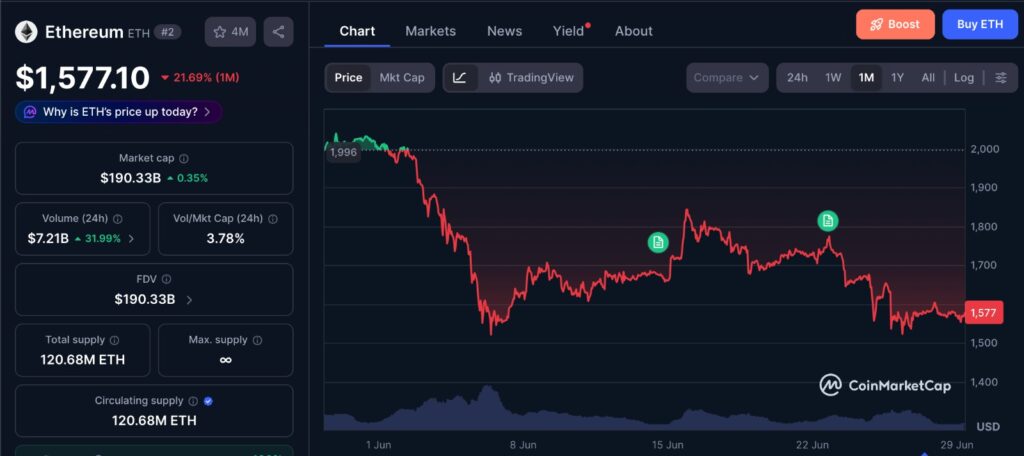
The 1-month ETH chart from CoinMarketCap helps show how Ether has traded while SharpLink restarted treasury accumulation and broader demand signals remained mixed. The key point is not only the $62.4 million purchase, but whether ETH can stabilize while ETF flows and spot sentiment remain weak. If price holds better after treasury buying, it would suggest absorption is helping support the market. If ETH struggles to react, it would show that broader demand has not yet followed.
Ether ETF Outflows Keep Pressure On The Market
SharpLink’s purchase also comes as US spot Ether ETFs continue to face outflows.
The original report noted that US spot Ether ETFs recorded their seventh straight week of outflows last week, with $12.9 million in net outflows. That is important because ETF demand is one of the clearest ways to measure institutional appetite for ETH outside direct treasury purchases.
If corporate buyers are adding ETH while ETFs are losing assets, the market is receiving mixed signals.
On one side, companies like SharpLink and BitMine are supporting the long-term treasury narrative. On the other side, ETF outflows show that some investors are still reducing exposure through regulated products. The contrast matters because earlier Ethereum price rallies have faded when network demand failed to strengthen, showing why treasury buying still needs broader market follow-through. That split does not cancel SharpLink’s purchase, but it prevents the signal from becoming clean confirmation.
A stronger setup would require both sides to improve. Corporate accumulation would need to continue, while ETF outflows would need to slow or reverse. Until then, ETH may struggle to turn treasury buying into broader market confidence.
This is the key difference between accumulation and demand. Accumulation shows that specific buyers are willing to absorb supply. Demand shows that the wider market is becoming more willing to reprice the asset higher.
Right now, SharpLink strengthens the accumulation story. It does not yet settle the demand question.
Why SharpLink’s ETH Buy Matters Now
SharpLink’s purchase comes at an important point for Ethereum because the market is trying to decide whether ETH is being accumulated quietly or still failing to attract enough fresh demand.
The distinction matters.
If treasury buyers continue adding ETH during weakness, it could help create a stronger base for the asset. That would give traders a reason to watch whether Ethereum is forming a deeper institutional accumulation phase rather than only reacting to short-term price pressure.
But if treasury buying remains limited to a few companies, the impact may be smaller. ETH would still need stronger ETF demand, improved spot flows, and better market structure before traders can treat the move as a broader turning point.
For now, SharpLink’s $62.4 million purchase gives Ethereum bulls a credible signal. It shows that at least one major treasury buyer is willing to restart accumulation despite weak price action.
The next test is whether the rest of the market follows.
That does not mean ETH needs every signal to turn positive at once. It means the market needs fewer contradictions. Treasury buying, ETF flows, and spot demand do not have to move perfectly together, but they cannot keep pulling in opposite directions if ETH is going to build a stronger base.
Editor’s View
SharpLink’s latest ETH purchase should not be ignored, but it should not be overstated either.
The move is important because it shows that Ethereum treasury demand may be expanding beyond BitMine and may still be active during market weakness. That gives ETH a stronger narrative than a normal bounce attempt.
However, treasury buying alone is not enough. ETH still needs proof that demand is broadening, especially with ETF outflows continuing and price still down sharply.
The cleanest way to read this purchase is as an absorption signal. SharpLink is showing willingness to take ETH off the market while sentiment is weak. That matters, but it becomes stronger only if other buyers start doing the same.
For Ethereum, the real signal will not be one company buying ETH. It will be whether treasury accumulation, ETF flows, and spot demand begin to point in the same direction.
The move begins when treasury buyers stop looking isolated and start becoming part of a wider demand base. Until then, SharpLink’s purchase is a serious test of absorption, not final confirmation that ETH demand has broadened.
Disclaimer: This content is for informational purposes only and does not constitute financial advice.
Keep yourself updated with the latest crypto news with FYI Gazette
Keep yourself updated with the latest Altcoin News with FYI Gazette
 Bitcoin
  Ethereum
  Tether
  BNB
BNB  XRP
XRP  Solana
  TRON
TRON  Dogecoin
  Litecoin
  Pepe
Pepe