

Ethereum Tokenization Momentum Faces $1,800 Demand Test
Ethereum has moved back toward the $1,800 level as tokenization activity and growing institutional exposure give traders a reason to reassess ETH’s recent weakness.
Ether gained roughly 3% between Thursday and Friday, outperforming the broader crypto market. However, the recovery has not resolved the larger question facing Ethereum.
The market is testing more than whether ETH can briefly trade above $1,800. It is testing whether growth across tokenized assets, new layer-2 networks, and corporate treasuries can create enough repeated demand to support a broader recovery.
Robinhood Chain has become an important part of that debate. The network uses ETH as its native gas asset and supports tokenized financial products within an Ethereum-compatible environment. Its early activity has strengthened the tokenization narrative, but its effect on ETH will depend on how users deploy their capital after moving onto the network.
That makes $1,800 a confirmation level rather than a simple bullish target.
Robinhood Chain Strengthens Ethereum Tokenization Narrative
Robinhood launched the mainnet version of Robinhood Chain on July 1 alongside an expanded suite of tokenized stock and decentralized finance products.
The Ethereum-compatible layer-2 network had attracted around $106 million in bridge deposits by July 11, according to market data. Robinhood has also expanded its tokenized stock offering, giving eligible customers outside the United States access to products linked to US stocks and exchange-traded funds.
This matters for Ethereum because users need ETH to pay transaction fees and interact with applications on Robinhood Chain.
However, bridge deposits alone do not show how much recurring demand the network will generate.
Capital often moves onto a new chain because users expect incentives, early access, or short-term trading opportunities. That can produce strong launch figures without creating durable activity. The stronger signal is whether users continue trading, posting collateral, and returning after the initial attention fades.
The amount deposited shows attention. The way that capital is used shows whether the network is gaining real economic activity.
For ETH, gas demand comes from repeated transactions, not from capital sitting inside a bridge.
Ethereum Still Leads the Tokenized Asset Market
The Robinhood launch adds to Ethereum’s established position in real-world asset tokenization.
Ethereum accounts for close to half of the tokenized real-world asset value tracked across public blockchains, excluding stablecoins. Recent data placed its share near 47%, with approximately $16 billion in tokenized assets hosted on the network.
That position matters because institutions tend to value deep liquidity, established custody systems, stablecoin access, and compatibility with widely used decentralized finance applications. Ethereum already connects asset issuers with a broad network of custodians, trading venues, and settlement tools.
Tokenization could therefore reinforce Ethereum’s role as a financial settlement layer even when retail activity remains weak.
The connection to ETH’s price is not automatic.
A tokenized asset can grow in value without creating equivalent buying pressure for ETH. That gap is also visible in Ethereum’s broader RWA dominance and ETH demand gap, where growth in tokenized assets strengthened the network’s position without creating equal demand for ETH. The effect becomes stronger when users make repeated transactions, post ETH as collateral, pay gas, or hold the asset for settlement.
That is the mechanism behind the demand test: tokenization can increase Ethereum’s relevance, but ETH only captures more value when users keep transacting, posting collateral, paying gas, or holding the asset for settlement.
Infrastructure matters when the activity built around it becomes repeatable.
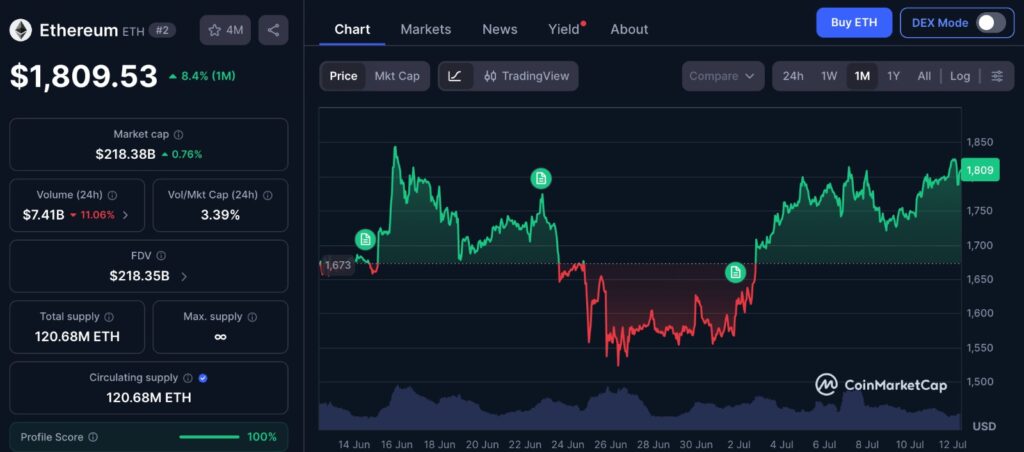
The 1-month ETH chart shows Ether recovering toward the $1,800 level as tokenization momentum and early Robinhood Chain activity improved market attention. The key signal is not the rebound alone, but whether ETH can remain near resistance while application revenue, active addresses, and derivatives positioning remain mixed. A sustained hold would suggest buyers are absorbing available supply and placing greater value on Ethereum’s tokenization growth, while another rejection would show that adoption has not yet translated into consistent demand for ETH.
Weak Network Activity Complicates The ETH Recovery
Ethereum’s tokenization position looks strong, but broader network activity remains less convincing.
Recent data showed Ethereum applications generating around $11 million in weekly revenue, down from roughly $20 million during the first quarter of 2026. Weekly active addresses also fell to approximately 3.2 million from about 5.4 million over the same comparison period.
Lower application revenue suggests users are producing fewer fees across the ecosystem. Fewer active addresses also mean demand may be concentrated among a smaller group of participants.
That makes the recovery less clearly demand-led. A similar pattern has appeared during previous Ethereum price rallies that faded as network demand weakened, showing why stronger price action still needs support from user activity and fee generation. Large buyers and narrative-driven flows can lift price, but they do not provide the same market depth as broad user participation.
Recent sessions have shown ETH recovering faster than its underlying activity.
Liquidity is not evenly spread across the market. Once nearby sell orders are absorbed, price can move quickly toward the next area of supply, but the same lack of depth can make the move easier to reverse when fresh buying slows.
Ethereum’s infrastructure and institutional relevance appear stronger than its current usage metrics, but markets eventually require adoption to show up in activity.
Derivatives Traders Remain Cautious Near $1,800
The derivatives market also suggests traders are not positioning aggressively for a sustained move higher.
ETH perpetual futures funding reportedly fell to an annualized rate near 3% after reaching stronger levels earlier in the week. That remained below the level commonly associated with balanced bullish demand.
Low positive funding has two implications. Leverage is not overheated, reducing the immediate risk of a crowded long-position unwind. At the same time, traders are not paying heavily to chase ETH above resistance.
A move driven mainly by futures positioning could fade if spot buyers do not follow. Spot demand is more durable because buyers are absorbing available ETH rather than relying on borrowed exposure.
Leverage can start a move, but spot demand decides whether the market can hold it.
For now, derivatives traders appear cautious rather than fully committed.
Corporate ETH Purchases Provide A Separate Demand Source
Corporate treasury accumulation has added another source of support to Ethereum’s market structure.
BitMine describes itself as the largest corporate Ethereum treasury and has continued pursuing a strategy of accumulating a significant share of ETH supply. Its earlier Ethereum purchase near the $2,000 demand zone also showed how treasury accumulation can absorb available supply without replacing the need for broader market participation. The company also operates a large institutional staking platform around its holdings.
Large treasury purchases can reduce the amount of ETH immediately available for sale, particularly when the assets move into long-term custody or staking.
Execution still matters. Gradual purchases can absorb supply without sharply moving price, while large market orders may create a faster but less durable reaction if other buyers do not follow.
Corporate accumulation is therefore constructive, but it does not replace broader participation from spot investors, exchange-traded products, application users, and tokenized asset issuers.
Why $1,800 Is An Ethereum Demand Test
The $1,800 area matters because ETH has approached it without establishing a decisive break.
A sustained move above the level would show that buyers are absorbing the supply waiting near resistance. Earlier shifts in Ethereum taker volume and liquidity showed why aggressive buying matters most when it continues long enough to clear nearby sell orders and support price after the initial move. That supply can include profit-taking from short-term traders and exits from investors who bought before the recent decline.
A brief move above $1,800 followed by rejection would send a different message. It would suggest that tokenization interest attracted buyers, but not enough sustained demand to clear the available sell orders.
The quality of the move matters more than the first price print above $1,800.
Traders will likely want to see ETH hold above $1,800, spot buying improve without overheated leverage, Robinhood Chain retain capital after launch, and Ethereum application revenue and active addresses stabilize.
Together, those signals would help separate a narrative-driven rebound from a genuine improvement in demand.
Ethereum Needs Activity To Catch Up With Adoption
Ethereum remains the leading blockchain for tokenized real-world assets, and Robinhood Chain gives that position a new distribution channel.
The launch could bring tokenized finance to a wider audience while creating additional uses for ETH inside an Ethereum-compatible ecosystem. Corporate accumulation provides another source of demand, while cautious derivatives positioning reduces the risk of an obviously overcrowded rally.
Yet Ethereum is still dealing with weaker application revenue, fewer active users, and limited evidence that tokenization activity is producing broad native-asset demand.
That leaves ETH in a transitional phase. Holding above $1,800 would not prove that the recovery is complete, but it would show that fresh buyers are absorbing supply near resistance.
Ethereum’s next step will not be defined by how much tokenized activity arrives, but by how much of that activity becomes repeated usage, lasting ETH demand, and enough buying pressure to hold the $1,800 test.
Disclaimer: This content is for informational purposes only and does not constitute financial advice.
 Bitcoin
  Ethereum
  Tether
  BNB
BNB  XRP
XRP  Solana
  TRON
TRON  Dogecoin
  Litecoin
  Pepe
Pepe