BitMEX Shutdown Marks End of Crypto’s Early 100x Leverage Era
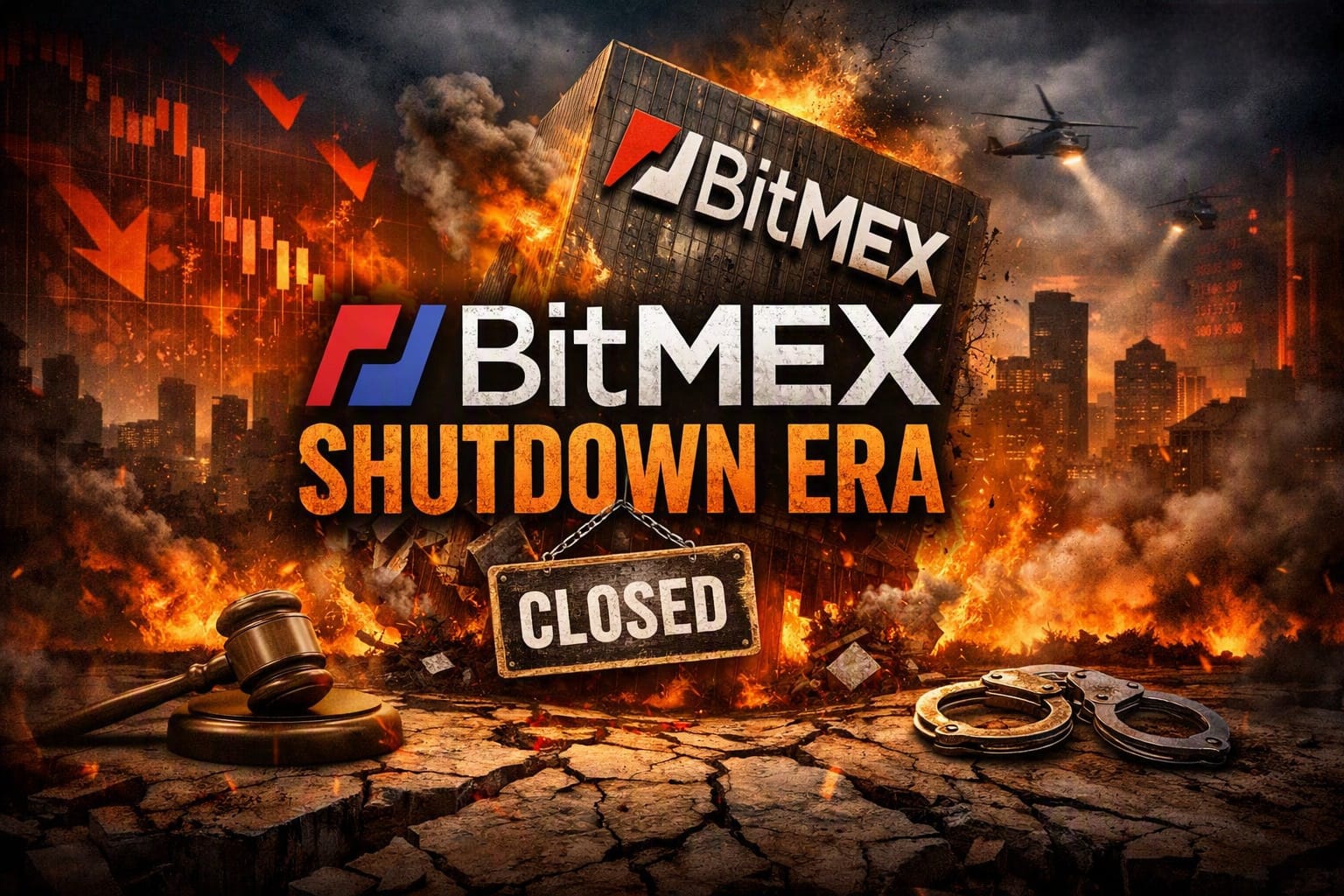
BitMEX is preparing to close its crypto derivatives exchange after more than 11 years, ending the run of a platform that helped define crypto’s earliest era of high-leverage trading.
The exchange will stop operating on September 23, 2026, at 04:00 UTC. New account registrations have already been suspended, while existing users have been encouraged to close their positions and withdraw their assets before the deadline.
BitMEX said the decision followed a strategic review of the business and the wider cryptocurrency industry. It did not identify one specific event as the reason for closing.
The immediate market impact may be limited. Recent estimates placed BitMEX’s daily trading volume at around $400,000 and its market share below 0.01%.
Its historical importance, however, is much larger than its final volume suggests.
BitMEX helped turn perpetual swaps and extreme leverage into defining features of crypto trading. Its shutdown does not mean crypto leverage is disappearing. It marks the exit of the exchange that made 100x perpetual trading iconic while the model it popularized spread across the wider market.
BitMEX Sets September Deadline for Exchange Closure
HDR Global Trading, the owner and operator of BitMEX, has stopped accepting new registrations and introduced a staged process for winding down the exchange.
The platform is expected to operate normally until August 26, 2026, at 04:00 UTC. From that point, risk limits will prevent traders from increasing exposure, leaving them able only to reduce existing positions.
BitMEX said it may begin force-closing positions during this period to support an orderly wind-down. Any positions still open when the exchange closes on September 23 at 04:00 UTC will be closed immediately.
Users will still be able to access account balances, transaction histories and withdrawals after trading services end. However, verified users who leave assets on the platform beyond the deadline will face a monthly account charge equal to $50 or an annualized 1% of the remaining balance, whichever is greater.
BitMEX has also warned customers about phishing messages or offers of priority withdrawals. The exchange said no accelerated withdrawal service exists.
The practical message is straightforward: users should reduce exposure, close positions and withdraw assets through official BitMEX channels before the final deadline.
The Exchange Helped Popularize Crypto Perpetual Swaps
BitMEX began operating in 2014, when professional crypto derivatives markets were still at an early stage.
The exchange became closely associated with the perpetual swap, a derivative that allows traders to maintain leveraged exposure without a fixed expiration date. Recurring funding payments help keep the contract’s price close to the underlying spot market.
BitMEX also became known for the 100x leverage perpetual swap, allowing traders to control positions far larger than the collateral supporting them. The exchange says the structure it pioneered was later adopted widely across the industry.
Perpetual contracts became some of crypto’s most actively traded instruments. Funding rates, open interest and liquidation data are now routinely used to assess positioning and short-term market pressure. Recent analysis of Bitcoin funding rates and cautious leverage shows how these signals can reveal whether traders are building aggressive exposure or remaining defensive.
At the height of BitMEX’s influence, its order book, funding rate and liquidation activity could affect sentiment across the wider Bitcoin market. Large liquidations often accelerated price moves by adding forced buying or selling to already volatile conditions.
A leveraged trader may choose when to enter, but once the position moves far enough against them, the market decides when they must leave.
That is the mechanism behind BitMEX’s legacy: the exchange lost the flow, but the products and risk behavior it normalized became part of the wider crypto market.
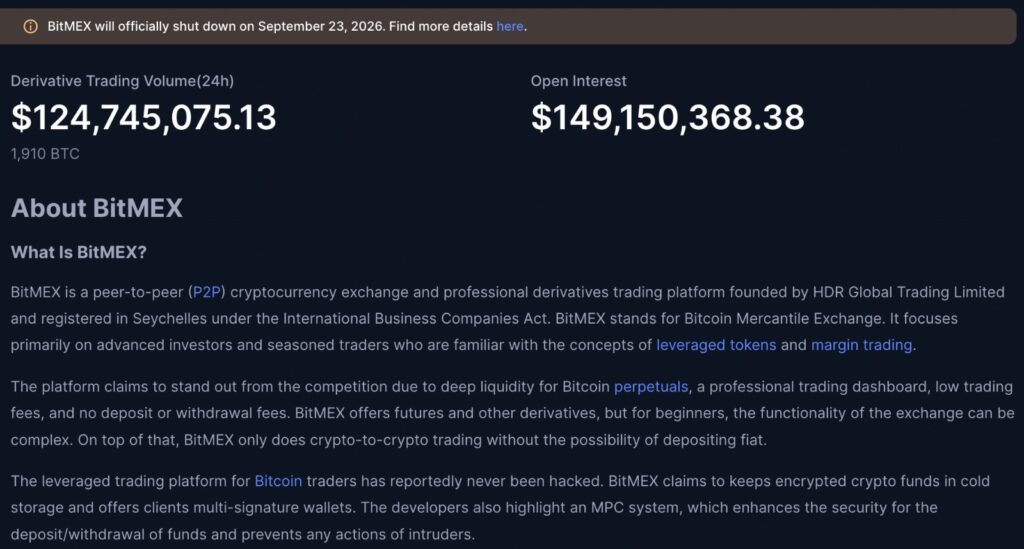
CoinMarketCap data shows BitMEX with roughly $124.7 million in 24-hour derivatives volume and about $149.2 million in open interest at the time of the screenshot. The figures confirm that trading activity remains on the platform ahead of its closure, but they do not reflect the dominant position BitMEX once held. The broader point is that demand for perpetual contracts and leveraged exposure did not disappear. Liquidity and trader activity shifted toward larger centralized exchanges and newer decentralized platforms, leaving BitMEX’s product legacy much larger than its final share of the market.
Extreme Leverage Was Both the Attraction and the Risk
The ability to trade with leverage of up to 100x gave BitMEX a clear identity, but it also exposed the weakness built into extreme leverage.
At 100x, a relatively small move against a position can consume the collateral supporting it. That leaves little room for normal volatility, particularly in a market capable of moving several percentage points within a short period.
Liquidation risk was therefore not a side issue. It was part of the product’s structure.
When many traders entered similar positions at similar prices, their liquidation points could cluster in the same area. If the market reached that zone, forced closures could add pressure and push price toward the next group of vulnerable positions.
The reason this happens is simple: liquidation orders must execute immediately. Once nearby orders are absorbed, price has to move further to find enough buyers or sellers to complete those exits.
Recent sessions across the crypto market have continued to show how quickly a price move can deepen when crowded leveraged positions are forced out together. A recent $820 million crypto liquidation wave showed how forced market pressure can intensify once leveraged positions begin closing at the same time.
The sharpest moves are often driven not by a sudden change in belief, but by traders losing the ability to hold their positions. Bitcoin’s liquidation reset near $60,000 provided a recent example of how forced exits can remove excess leverage without immediately restoring sustained demand.
Leverage has not disappeared as the industry matured. What changed was where that leverage accumulated. The same mechanism is visible beyond Bitcoin, with $170 million in Ether long liquidations showing how leverage resets now affect derivatives markets across major crypto assets.
BitMEX’s early advantage came from offering a product and trading experience that few competitors could match. Once perpetual swaps became standard, the exchange had to compete on liquidity, fees, compliance, asset coverage and user access.
The innovation survived. The platform that popularized it gradually lost its dominant position.
Crypto Derivatives Liquidity Moved Elsewhere
That loss of dominance reflects a broader feature of exchange competition: trading activity tends to concentrate around venues offering the deepest and most reliable liquidity.
Large traders prefer markets where they can enter and exit positions without causing substantial price movement. Deeper order books reduce slippage, improve execution and make it easier to manage exposure during volatile periods.
This creates a reinforcing cycle.
More traders attract more market makers. More market makers add orders to the book. Better execution then attracts additional traders, concentrating activity further.
Liquidity is not simply the amount of capital on an exchange. It reflects whether participants trust that they can exit when conditions become difficult.
When traders expect poor execution or thin order books, they reduce position sizes or move elsewhere. That withdrawal of activity weakens liquidity further and makes the venue less attractive to the next trader.
Once that confidence shifts toward competing venues, recovering market share becomes difficult even for a historically important platform.
Kaiko estimates cited in recent reporting placed BitMEX’s daily trading volume at roughly $400,000 and its market share below 0.01%. That suggests the shutdown itself is unlikely to remove enough active liquidity to disrupt the wider derivatives market materially.
BitMEX helped shape modern crypto derivatives, but the flow had already migrated.
Regulatory Pressure Changed the Competitive Environment
Liquidity was only one part of that shift. The derivatives business also became more demanding from a regulatory and operational perspective.
BitMEX and its founders faced legal action in the United States over failures to maintain adequate anti-money-laundering and customer-identification controls.
The company pleaded guilty in 2024 to violating the Bank Secrecy Act and was fined $100 million in January 2025. U.S. authorities said BitMEX had failed to establish and maintain adequate AML and know-your-customer programs.
Co-founders Arthur Hayes, Benjamin Delo and Samuel Reed had separately entered guilty pleas in 2022 over related Bank Secrecy Act violations.
These cases formed part of a broader change in the industry.
During BitMEX’s early years, exchanges could expand across jurisdictions with limited oversight. As crypto became larger and more connected to mainstream finance, trading venues faced greater pressure to identify customers, restrict access where required and build stronger compliance systems.
Established exchanges now compete on more than trading technology. They need legal access to important markets, dependable custody, institutional relationships, risk controls and compliance operations that are expensive to maintain.
Those costs increasingly reward scale. A venue with more users and deeper liquidity can spread its expenses across a larger trading base, while smaller platforms face similar demands with less revenue to absorb them.
BitMEX said only that its closure followed a strategic review. It would therefore be inaccurate to attribute the decision entirely to regulation, past legal cases, current crypto prices or declining volume.
Together, however, these pressures explain why historical importance is not enough to protect an exchange once its competitive environment changes.
Decentralized Perpetual Markets Add a New Competitive Layer
The migration away from BitMEX has not happened only within centralized trading.
Decentralized perpetual platforms have developed into increasingly credible alternatives, allowing users to trade from self-custodied wallets while positions and collateral are managed through blockchain-based systems.
These platforms still carry smart-contract, oracle, liquidity and liquidation-design risks. Decentralization changes how assets are held, but it does not remove the risks created by leverage.
A trader using a centralized exchange depends on the operator to safeguard assets, process withdrawals and maintain the trading system. A decentralized platform reduces some custody dependence but introduces exposure to code, network conditions and protocol design.
The competition is therefore not simply between older and newer exchanges. It is between different approaches to custody, execution and trust.
Large centralized venues compete through liquidity and product range. Regulated derivatives platforms compete for institutions seeking clearer legal protections. Decentralized protocols compete through self-custody, transparency and onchain access.
BitMEX helped establish the early crypto-native derivatives model. Its closure comes after that model split into several competing forms.
The 100x Era Did Not End, but It Lost Its Center
It would be misleading to argue that BitMEX’s closure means extreme leverage has disappeared.
High-leverage products remain widely available. Perpetual swaps continue to generate substantial trading activity, while funding rates and liquidations remain important forces behind short-term crypto volatility.
What ended was BitMEX’s role as the exchange most closely associated with that market.
During its strongest period, the combination of Bitcoin-margined contracts, perpetual swaps and 100x leverage represented a distinctly crypto-native form of speculation.
Today, that activity is distributed across larger centralized exchanges, institutional futures markets and decentralized perpetual protocols.
The market did not reject the product BitMEX helped popularize. It absorbed it.
Successful financial products often outlive the companies that first made them important.
BitMEX Leaves a Larger Legacy Than Its Final Market Share
BitMEX’s shutdown should not be interpreted as evidence that crypto derivatives are losing relevance.
Perpetual swaps became so deeply integrated into crypto trading that no single exchange could continue to define the category. Liquidity moved, execution improved elsewhere and traders gained access to more venues offering similar exposure.
BitMEX’s final market share may be small, but its influence remains visible whenever traders examine funding rates, track open interest or watch leveraged positions disappear during a liquidation cascade.
The exchange lost its place at the center because trader flow followed deeper liquidity, broader access and more reliable execution.
BitMEX did not fade because the market abandoned its model. It faded because the products and leverage culture it normalized became larger than the platform that introduced them.
Disclaimer: This content is for informational purposes only and does not constitute financial advice.
 Bitcoin
  Ethereum
  Tether
  BNB
BNB  XRP
XRP  Solana
  TRON
TRON  Dogecoin
  Litecoin
  Pepe
Pepe