

Ethereum Short Squeeze Risk Builds as Bears Crowd Near $2K
Ethereum short squeeze risk is becoming one of the most important setups in the market as ETH struggles to hold the $2,000 zone while bearish positioning continues to build.
At first glance, Ethereum’s weakness looks simple. ETH has failed to reclaim the $2,150 area, price remains under pressure, and traders are watching whether the $2,000 region can survive another test. But the bigger story is not only that Ethereum has fallen. The bigger story is how traders are positioned after the decline.
When price falls while open interest rises, the move can carry a different meaning. It often suggests that new positions are entering the market rather than old positions simply closing. In Ethereum’s case, reported futures data showed aggregate open interest rising by roughly 350,000 ETH as price moved lower. That does not automatically mean every new position is short, but it does show that leverage is building while ETH sits near a major pivot.
Recent sessions have shown ETH struggling to recover cleanly while traders continue adding exposure around the same support area. That mix can make the market more sensitive to any move back toward resistance.
Ethereum is weak near $2,000, but if bearish positioning becomes too crowded and ETH refuses to break down, short exposure can become fuel for a reversal.
Markets do not move when everyone sees the same level. They move when positioning around that level becomes too crowded to hold.
Ethereum Short Squeeze Setup Depends on the $2,000 Defense
The $2,000 level matters because it is where bearish continuation is being tested. If ETH loses that area cleanly, sellers may gain more control, and long liquidations could add pressure.
But if Ethereum keeps defending $2,000, shorts that entered late into the decline may face a different problem. A short position needs price to keep falling. When price stalls near support, the trade becomes more fragile because the expected follow-through is no longer happening.
That is why the $2,150 area is important. ETH failed to reclaim that zone earlier, turning it into a major resistance area. Because bearish liquidity is now building above it, a move back through $2,150 could force short sellers to reduce exposure, close positions, or buy back ETH to manage risk.
This matters because short covering creates buy pressure even when sentiment has not improved. A relief rally does not always begin with fresh optimism. Sometimes it begins because bearish traders are forced to exit.
For that move to last, spot buyers still need to absorb supply after shorts begin covering. Without that demand, the squeeze can fade into another relief rally.
Why Rising Open Interest Changes the Meaning of ETH Weakness
Ethereum’s price weakness would be less important if open interest were falling. Falling price with falling open interest usually suggests that traders are closing positions, reducing risk, and stepping away from the move.
But falling price with rising open interest is different.
It suggests traders are adding exposure into the decline. In this case, that may point to fresh bearish positioning entering while ETH trades near support. This does not guarantee a reversal, but it does increase the risk of a sharper move if price turns against those positions. For a deeper look at how rising ETH futures exposure can change market risk, read our earlier analysis on Ether open interest surging as trader exposure builds.
That is the hidden tension in the current Ethereum setup.
The market can look weak on the chart while becoming risky for late shorts under the surface. A crowded bearish trade can work when momentum continues, but it can unwind quickly when price refuses to follow through.
The reason this happens is simple. Leveraged traders do not always have the luxury of waiting. When price moves against them, margin pressure and stop-loss orders can turn a defensive exit into forced buying.
Liquidity is not continuous. Once nearby orders are absorbed, price must move toward the next area where buyers, sellers, or forced exits are waiting.
That is why Ethereum’s next move may not be decided by sentiment alone. It may be decided by positioning.
Price shows where the market is. Positioning shows where the pressure is building.
ETH Bears Face a Liquidity Problem Above $2,150
Liquidity above $2,150 matters because that is where crowded shorts may become vulnerable. If ETH pushes into that area, it could trigger stop losses, forced covering, and automated risk reduction from leveraged traders.
That does not mean Ethereum is guaranteed to rally. It means the market has created a structure where a move higher could become sharper than expected if bearish positioning has to unwind quickly.
This is why every bearish move should not be read as clean weakness. A market can fall because sellers are in control, but it can also fall because leverage is building heavily in one direction. When too many traders crowd the same side, the market often moves toward the level that forces them to react. This liquidity-driven behavior has also appeared in previous ETH setups, including our analysis of Ethereum taker volume and the $2.6K liquidity zone.
Right now, that pressure zone appears to sit above $2,150.
If ETH reclaims that area with strength, the move would not only be a technical recovery. It would suggest that bearish positioning became too aggressive near support.
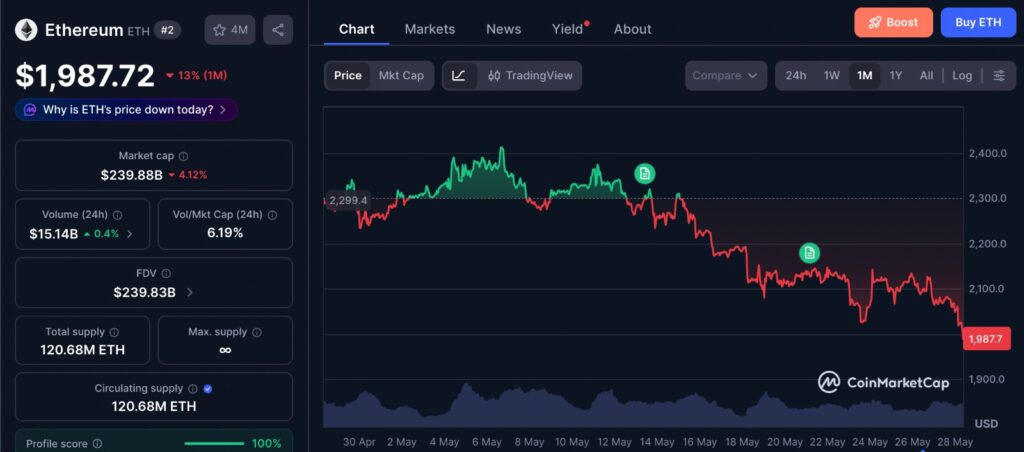
The current Ethereum chart should be used to highlight how price is reacting around the $2,000 support zone and whether ETH is moving closer to the $2,150 resistance area. A one-month CMC chart can help readers see that this setup is not only about one candle or one short-term move. The more important question is whether Ethereum is stabilizing near support or preparing for another liquidity-driven move.
Retail Participation Still Looks Weak
The short squeeze setup does not erase Ethereum’s broader weakness. One reason ETH remains fragile is that retail and mid-sized holder participation has not shown the same strength as earlier market phases.
Reported holder data showed that wallets holding between 100 and 1,000 ETH have reduced their balances sharply from previous peaks. That matters because this group often reflects committed participation between small retail buyers and larger holders.
When this group steps back, Ethereum becomes more dependent on large investors, derivatives traders, and liquidity-driven moves. That can make rallies less organic because price depends more on positioning shifts than broad demand.
A healthy rally usually needs more than short covering. It needs spot demand, stronger conviction, and wider participation. Without that, even a sharp bounce can remain a relief rally rather than a full trend reversal.
This is the key distinction.
Ethereum can squeeze higher without proving that broad demand has returned.
Mega-Whales Are Absorbing Supply, but That Is Not Enough Alone
There is still a constructive side to the Ethereum story. Larger wallets have reportedly continued accumulating ETH over the past year, even as some mid-sized holders reduced exposure.
That suggests the market is not facing one simple bearish story. Smaller and mid-sized participation may be weaker, but larger holders appear more willing to absorb supply during periods of stress.
This creates a divided market.
On one side, Ethereum has weak retail participation, uncertain sentiment, and resistance near $2,150. On the other side, it has large-holder accumulation and the risk that crowded short positions could be punished if $2,000 holds.
That combination makes ETH risky for both sides.
Longs are still vulnerable if support breaks. Shorts are vulnerable if price stabilizes and reclaims resistance.
Editor’s View: Ethereum’s Real Test Is Positioning, Not Price Alone
The easy headline is that Ethereum is weak near $2,000. But the stronger market read is that ETH is sitting in a positioning trap.
If price breaks down, bears remain in control. But if ETH refuses to break and starts moving back toward $2,150, the same short positions that pressured the market lower could become fuel for a relief rally.
That is what makes this setup difficult to ignore.
Ethereum does not need everyone to suddenly become bullish for price to bounce. It only needs enough shorts to be wrong at the same time. That same positioning risk was also visible in our earlier coverage of Ethereum whale short exposure and ETH sentiment risk.
The real signal over the next few sessions will not be whether ETH briefly trades above or below $2,000. The real signal will be whether sellers can force continuation after building leverage into the decline. If they cannot, the market may start treating $2,000 less like a breakdown level and more like a trap for late bears.
This is the part many traders miss. A weak market can still punish weak shorts if the trade becomes too obvious.
Ethereum Short Squeeze Risk Remains the Key Market Watch
Ethereum short squeeze risk is now closely tied to the $2,000 support zone and the $2,150 resistance area. A clean break below $2,000 would weaken the setup and could invite more downside pressure. But a strong defense of that level may force traders to reconsider how crowded the bearish side has become.
The important point is that ETH does not need a perfect bullish backdrop to move higher. In leveraged markets, positioning can matter as much as conviction.
If Ethereum holds $2,000 and pushes back above $2,150, bearish pressure could turn into buying pressure as shorts cover. But if support fails, the squeeze setup loses strength and ETH may face another round of downside risk.
For now, Ethereum is not giving traders a simple signal. It is giving them a crowded setup where leverage, liquidity, and execution risk are sitting near the same zone.
The move begins when crowded positioning can no longer stay contained.
Disclaimer: This content is for informational purposes only and does not constitute financial advice.
Read more about Memecoins with FYI Gazette
Keep yourself updated with the latest Altcoin News with FYI Gazette
 Bitcoin
  Ethereum
  Tether
  BNB
BNB  XRP
XRP  Solana
  TRON
TRON  Dogecoin
  Litecoin
  Pepe
Pepe