

Bitcoin Supply Absorption Caps BTC Upside as Old Holders Sell Into Rallies
Bitcoin supply absorption is becoming one of the most important signals in the market as BTC struggles to build a clean breakout above the $77,000 region.
Bitcoin has recovered from its deeper decline, and short-term sentiment has improved compared with the panic seen during earlier phases of the correction. But the current market is not only dealing with a technical resistance level. It is dealing with supply from holders who appear to be using rallies to exit, reduce exposure, or rebalance after a difficult cycle.
That distinction matters.
Resistance is where buyers and sellers meet. Supply absorption is the question of whether buyers can take in coins being distributed by existing holders without losing momentum. Right now, Bitcoin’s challenge is not simply moving above $77,000. The challenge is proving that demand is strong enough to absorb the supply waiting there.
Markets do not move higher because selling stops. They move higher when buyers can absorb that selling without losing control.
Bitcoin Supply Absorption Becomes the Real Test Near $77K
The $77,000 area has become important because market data suggests that a large share of recently moved coins came from holders whose coins were last transacted at much higher levels, including above $103,000.
That creates a difficult structure.
Some holders who bought or last moved coins near higher levels may be using rebounds to reduce losses. Others may be long-term holders taking profits after seeing Bitcoin recover from lower levels. In both cases, rallies meet fresh supply before they can fully extend.
This does not mean Bitcoin is weak by default. It means the market is being tested at the supply level.
A rally can look strong on the surface while still failing underneath if every push higher is met by older coins returning to circulation. That is why the $77,000 region matters less as a chart line and more as a balance point between fresh demand and recycled supply.
Recent sessions have shown this clearly: Bitcoin can rebound, but follow-through becomes harder when each move toward resistance gives sellers better liquidity to reduce exposure. That demand question has been building for weeks, especially as Bitcoin bull run demand has struggled to keep pace with price recovery.
If buyers absorb that supply without a sharp rejection, the market gains cleaner room to move. If they cannot, Bitcoin may keep rising into selling pressure rather than breaking through it.
Previous-Cycle Holders Are Changing the Market Structure
One of the most important details in the current setup is the behavior of previous-cycle holders. These are not always short-term traders reacting to daily price moves. Many are holders who sat through major volatility and are now deciding whether to stay exposed or use strength as liquidity.
When older coins return to circulation, they do not always create immediate downside. But they change the quality of a rally. A move driven mainly by fresh demand looks different from a move that is repeatedly being used as exit liquidity.
Fresh buyers may still be entering the market, but they are not buying into an empty order book. They are buying into supply from holders who may have waited months, or even years, for a better exit. That makes every rebound harder to sustain.
This matters because sellers need liquidity to exit cleanly. When price rises into a crowded supply zone, it attracts enough buyers for larger holders to reduce exposure without immediately pushing the market lower.
This is why Bitcoin can rise and still feel heavy.
Price can improve, sentiment can recover, and bearish pressure can ease, but if previous-cycle holders keep distributing into strength, upside may remain capped until that supply is absorbed. In simple terms, Bitcoin needs enough committed buying to take coins off the market without quickly losing momentum.
The real question is not whether Bitcoin can touch $77,000. The real question is whether sellers still control what happens when it gets there.
Why This Is Not Just Normal Profit-Taking
Profit-taking is normal in every market recovery. After a sharp rebound, some investors will always sell. That alone is not bearish.
The issue is scale and timing.
If large amounts of supply appear each time Bitcoin moves toward a key resistance area, the market can enter a slow absorption phase. During this phase, price may not collapse, but it may struggle to trend higher. Buyers keep stepping in, while sellers keep using strength to reduce exposure.
This type of structure often creates frustrating price action. Breakouts fail quickly. Short rallies fade. Support levels hold, but momentum does not expand. Traders can mistake that sideways movement for weakness, when the real issue is that the market is still digesting supply. This is also why periods of heavy leverage can make Bitcoin’s upper range more unstable, as seen when crypto liquidations surged near Bitcoin’s $78K zone.
Liquidity is not always available at one price. Once nearby buyers are filled, price needs fresh demand at higher levels. If sellers keep appearing faster than buyers step in, the rally loses pace.
That is the important point here.
Bitcoin does not need every seller to disappear. It needs demand to become strong enough that seller activity no longer controls the pace of the move.
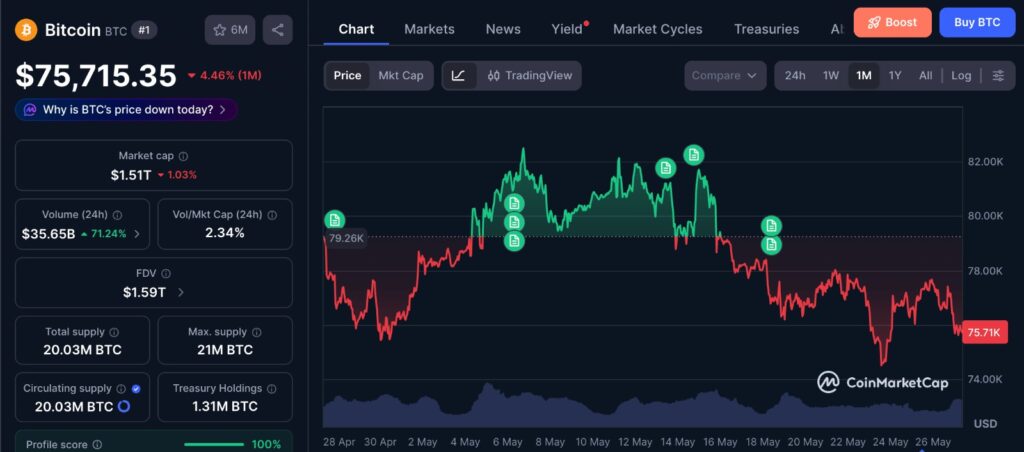
The one-month BTC price chart adds useful context by showing how Bitcoin has reacted around recent recovery attempts and resistance zones. Instead of focusing only on the current price, the chart helps readers see whether buyers are building steady follow-through or whether rallies are still being met by supply. In the current market, that visual matters because Bitcoin’s next move depends less on a single breakout attempt and more on whether demand can keep absorbing coins without losing momentum.
ETF Demand and Institutional Flows Still Matter
The supply issue becomes more important when steady buy-side pressure is not strong enough to offset it. Spot Bitcoin ETF flows matter in this context because they are one of the few visible sources of institutional demand.
This does not mean ETFs are the only force behind Bitcoin’s price. They are not. But when older holders are distributing into rallies, Bitcoin needs consistent inflows or strong spot accumulation to absorb that supply.
If that demand is uneven, rallies can keep meeting seller liquidity before becoming clean breakouts. That is why the ETF picture matters here, not as a separate story, but as part of the supply absorption test.
A move above $77,000 only becomes meaningful if Bitcoin can hold above it while absorbing supply. A quick spike followed by rejection would suggest that sellers still control the upper range. A sustained hold would suggest that buyers are beginning to take control of the supply overhang. That makes the broader upper range important too, especially after Bitcoin’s earlier struggle around the $80K weekly close resistance zone.
The Market Is Stronger Than It Looks, But Not Free Yet
Bitcoin’s recovery from lower levels should not be ignored. The market has shown that buyers are still willing to defend major downside zones, and bearish positioning can become vulnerable if price squeezes higher.
However, a recovery is not the same as a clean expansion phase.
The current market looks like one where Bitcoin is trying to repair structure while older supply continues to rotate. That can be constructive over time, but it often slows upside in the short term. The market may need more time to transfer coins from sellers who want liquidity to buyers willing to hold through volatility.
This is how stronger bases are often formed.
The problem is that traders usually want instant confirmation. They want a breakout, a reclaim, and a continuation move. But Bitcoin may first need to complete the quieter process of supply absorption. That process can look boring, heavy, and frustrating, even when it is necessary for a healthier structure.
Strength is not always shown by speed; sometimes it is shown by how much supply price can absorb without breaking down.
Editor’s View: Bitcoin Needs Absorption, Not Just Excitement
The key mistake traders may make here is treating $77,000 as only a resistance line. The better way to view it is as a supply checkpoint.
If Bitcoin keeps failing near this area, it may not be because the market has turned bearish again. It may simply mean too much old supply is still being offered into strength.
A bearish market rejects because demand disappears. An absorption market struggles because demand is present but still busy digesting supply.
That difference matters. A rejection near $77,000 would not automatically confirm deeper weakness. But a strong hold above that level would become more meaningful if it shows that sellers are losing influence.
This is where market structure becomes more useful than emotion. If price rises on weak follow-through and quickly loses the level, supply is still heavy. If price holds while sellers continue distributing, it shows that the market is quietly becoming stronger underneath.
Bitcoin’s Upside Depends on Who Controls the Next Rally
Bitcoin is not only facing resistance near $77,000. It is facing Bitcoin supply absorption from previous-cycle holders who appear to be using rallies to exit or reduce exposure. Until that supply is absorbed, upside may remain capped even if short-term sentiment improves.
That makes the next rally important.
If Bitcoin moves higher but quickly meets more selling, the market may stay trapped in a slow digestion phase. But if buyers absorb that supply and hold the range, the structure begins to look different.
For now, the message is clear: Bitcoin does not just need a breakout. It needs a shift in control, where rallies stop giving sellers the better side of the trade.
Disclaimer: This content is for informational purposes only and does not constitute financial advice.
Keep yourself updated with the latest crypto news with FYI Gazette
 Bitcoin
  Ethereum
  Tether
  BNB
BNB  XRP
XRP  Solana
  TRON
TRON  Dogecoin
  Litecoin
  Pepe
Pepe