
XRP Supply Tightening Faces a Critical $1.52 Breakout Test
XRP supply tightening is becoming one of the more important stories around the token, but the market has not yet proved that lower exchange reserves and ETF inflows are enough to force a clean breakout.
That distinction matters.
On paper, the setup looks stronger than it did earlier. XRP exchange reserves on Binance have reportedly moved toward roughly 2.70 billion XRP, while institutional inflows into XRP-related ETF products have continued to build. Recent sessions also showed fresh inflow activity, with reported daily inflows of around $9.47 million after earlier sessions added nearly $18.52 million and $10.87 million.
That is not a weak backdrop.
Lower exchange reserves can reduce the amount of XRP immediately available for selling, while ETF inflows show that more structured capital is entering the market. Together, they create a cleaner supply-demand story than a simple speculative push.
But tighter supply does not automatically create a breakout. It only improves the conditions for one.
Markets do not break out when supply looks tighter. They break out when buyers absorb sellers at higher prices.
The real question is whether buyers can absorb the $1.50–$1.52 resistance zone without momentum fading again.
Recent sessions have shown that XRP’s setup is improving beneath the surface, but price still needs stronger participation near resistance before that improvement becomes a confirmed market signal.
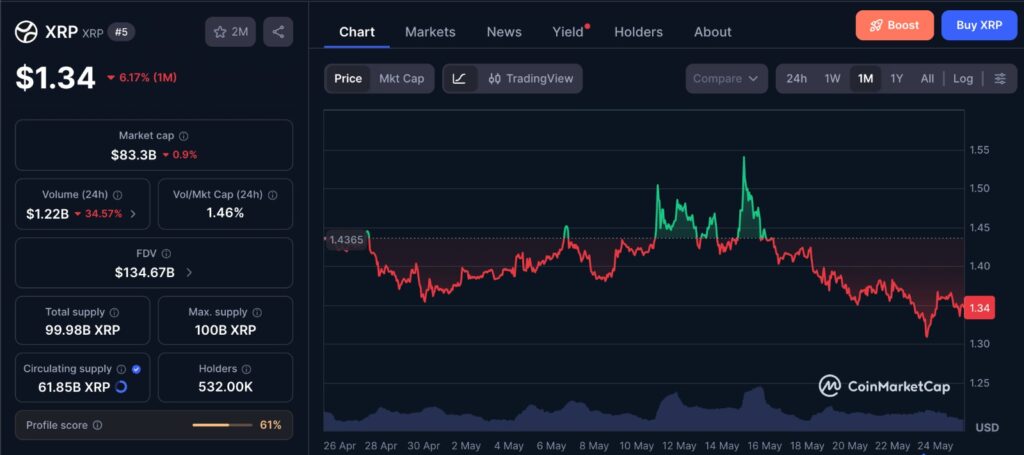
The one-month XRP price chart shows why the $1.50–$1.52 area remains important for the current setup. Price action has improved enough to support the supply-tightening narrative, but the chart also shows that XRP still needs stronger follow-through near resistance. If buyers continue stepping in as price approaches that zone, the lower exchange reserve story becomes more meaningful. If momentum fades again, the chart would suggest that sellers are still active enough to limit the move despite improving supply conditions.
XRP Supply Tightening Improves the Setup, But Not the Outcome
The strongest part of the XRP setup is that available supply appears to be shrinking while institutional demand is improving.
When tokens leave exchanges, traders often read that as a sign of accumulation or reduced sell-side pressure, especially when XRP exchange outflows and their price impact are already part of the broader market discussion. In simple terms, lower exchange reserves reduce immediate sell-side pressure, but they only matter when buyers are active enough to compete for the remaining supply.
That is why exchange reserve declines need context.
Not every drop in exchange balances is automatically bullish. Sometimes it reflects long-term holding. Sometimes it reflects custody movement. Sometimes it comes during periods when speculative activity is also cooling. The XRP supply tightening story still needs confirmation from price action, volume, and buyer behavior near resistance.
The current setup is not just about whether XRP supply is tightening. It is about whether that tighter supply is meeting a market where buyers are willing to pay higher prices.
That is still unconfirmed.
Supply only becomes powerful when it interacts with demand. Until that happens, lower reserves remain a positive background signal rather than proof of a breakout shift.
ETF Inflows Add Support, But Breakouts Need Spot Buyers
The ETF inflow side of the story gives XRP a stronger demand narrative.
Reported cumulative inflows have moved toward roughly $1.41 billion, while ETF-held assets remained above $1.13 billion. That suggests XRP is not only being traded by short-term participants. It is also being accumulated through more structured products.
This can improve confidence because ETF inflows are often seen as steadier than short-term leveraged demand. They may also reduce the amount of XRP moving through active trading venues if holdings continue to build.
Still, ETF inflows alone do not guarantee price expansion.
Institutional demand can support the broader structure, but price still has to deal with resistance, liquidity, and sellers waiting near key levels. That is where the difference between accumulation and breakout pressure becomes visible.
For XRP, that key area remains the $1.50–$1.52 zone.
ETF inflows can support the floor, but spot demand has to lift the ceiling, which is why XRP ETF inflows still needed price confirmation in earlier market setups as well.
If buyers move through that area with strong participation, the tightening supply story becomes more meaningful. If they cannot, the same data may simply describe a healthier market that is still not ready for expansion.
Why the $1.50–$1.52 Zone Matters
The $1.50–$1.52 region is important because it is not just a number on the chart. It is a test of whether demand is strong enough to overcome overhead supply.
Every market has areas where earlier buyers, short-term traders, and larger sellers become active. When price reaches those zones, the question is not whether the narrative sounds bullish. The question is whether real demand can absorb available sell orders.
That is the difference between a setup and a breakout.
XRP has a better setup now because supply conditions have improved and ETF flows are supporting the demand side, building on XRP’s earlier consolidation breakout setup where resistance confirmation was already a key issue. But the market still needs proof that buyers are willing to keep stepping in once price reaches resistance.
If buyers keep absorbing sell orders in that zone, resistance weakens with each test. If they fail, the same level remains a supply ceiling no matter how strong the supply-tightening narrative looks.
A move toward resistance without strong follow-through would not be enough. XRP needs sustained buying, not just a temporary push.
This matters even more when exchange reserves are lower. With less visible supply available, price can move faster if demand expands, but it can also reject quickly if buyers hesitate and sellers use the move to exit.
Liquidity is not continuous. Once nearby orders are absorbed, price has to move toward the next area where enough buyers or sellers are willing to trade.
That creates execution risk. Larger buyers may need to accept higher prices to build positions, while sellers near resistance may use the same move to lock in gains.
That is why the $1.50–$1.52 area matters so much. It is where the market will show whether buyers are building control or simply reacting to a stronger narrative.
The Real XRP Signal Is Absorption
The key word for XRP right now is absorption.
If buyers can keep absorbing sell pressure near $1.50–$1.52, it would show that ETF inflows and tighter exchange supply are translating into real market strength. The level would begin to weaken because sellers would be forced to offer into demand that keeps returning.
But if price repeatedly stalls near the same region, it would suggest that sellers are still active enough to control the pace, even with better supply conditions.
This is why a quick spike is weaker than sustained buying. A spike can reflect short-term excitement, but steady demand shows that buyers are willing to remain active after the first wave of selling appears.
The current XRP setup should not be treated as automatic bullish confirmation. The market has improved, but the main test is still ahead.
Supply is tighter. Institutional demand is more visible. Resistance remains the gatekeeper.
The next signal is not just whether XRP touches the zone. It is how the market behaves once it gets there. A steady move with firm buying would say something very different from a fast push followed by fading momentum.
Editor’s View
The XRP supply tightening story is useful because it shows that market structure may be improving beneath the surface. But the mistake would be assuming that tighter supply alone can force price higher.
Breakouts are not created by supply data in isolation. They are created when buyers meet resistance and continue to absorb what sellers offer.
That is the real test for XRP now.
If ETF inflows continue and exchange reserves remain low while buyers push through the $1.50–$1.52 zone, the market may start treating XRP differently. But if momentum fades again at the same level, the story becomes less about supply tightening and more about demand not being aggressive enough yet.
For now, XRP has a stronger setup than before, but not a confirmed breakout.
The market is giving XRP a better foundation. It has not yet given it a free path higher.
Final Takeaway
XRP supply tightening and ETF inflows are improving the broader market setup, but they do not automatically guarantee a breakout.
The $1.50–$1.52 resistance zone remains the real test. If buyers can absorb that area with stronger participation, XRP’s tightening supply story could gain more weight. If not, the market may continue to treat the move as accumulation without confirmation.
The move does not begin when supply looks tight. It begins when sellers near resistance can no longer slow demand.
Disclaimer: This content is for informational purposes only and does not constitute financial advice.
Keep yourself updated with the latest crypto news with FYI Gazette
Keep yourself updated with the latest Altcoin News with FYI Gazette
 Bitcoin
  Ethereum
  Tether
  BNB
BNB  XRP
XRP  Solana
  TRON
TRON  Dogecoin
  Litecoin
  Pepe
Pepe