
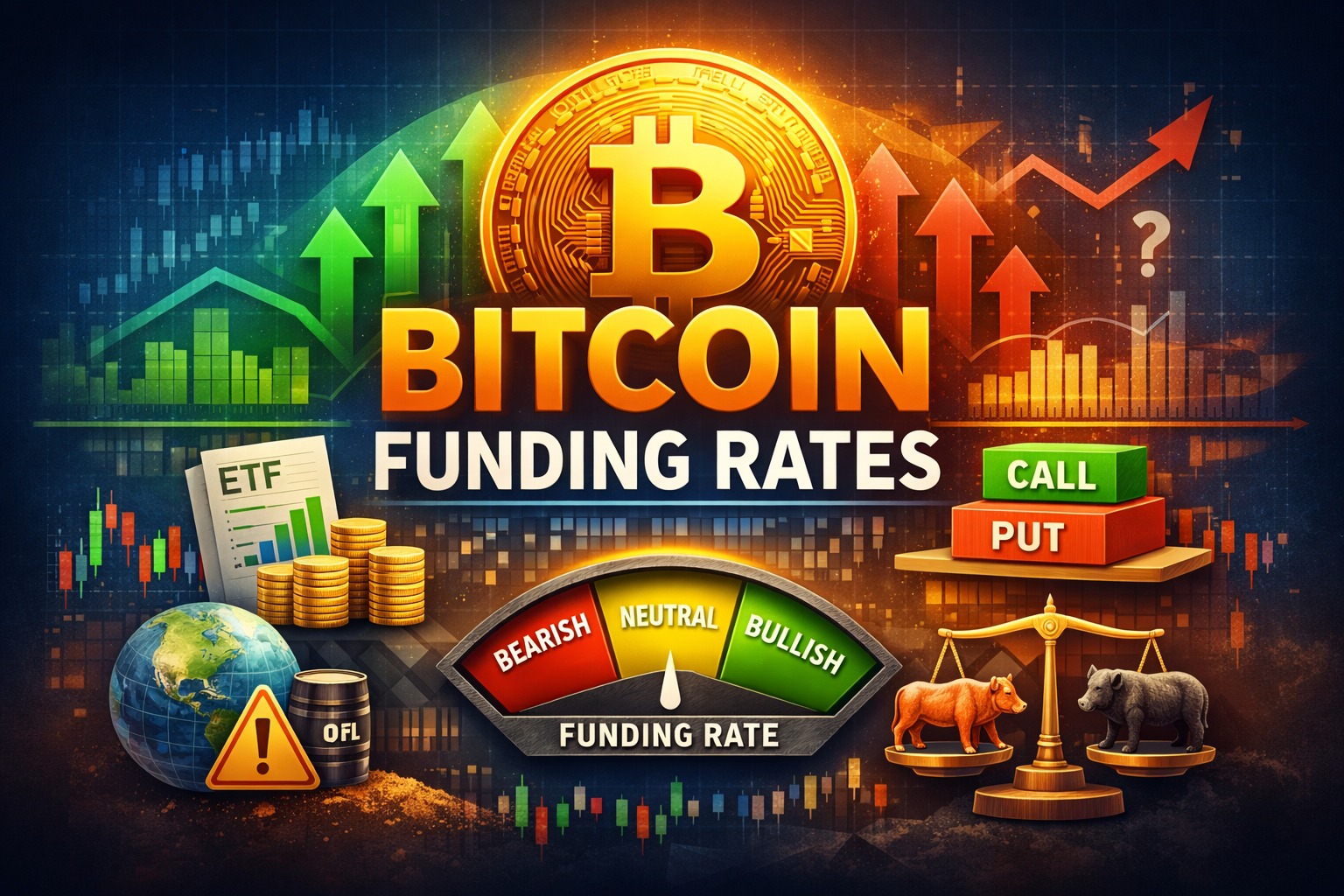
Bitcoin Funding Rates Show Leverage Is Returning, But Traders Are Still Careful
Bitcoin funding rates are starting to show a shift in trader positioning, but the signal is not as simple as it may look at first.
After several weeks of cautious futures activity, Bitcoin perpetual funding briefly moved back into positive territory as BTC held near the $80,000 area. That matters because funding rates show whether traders are paying to hold long exposure or short exposure in the derivatives market.
However, a positive funding print does not automatically mean the market has turned aggressive.
It shows that bullish leverage is returning, but not with the confidence normally seen during a clean breakout phase. Bitcoin is not only reacting to price levels now. It is reacting to the balance between leverage, ETF demand, options hedging, and macro uncertainty.
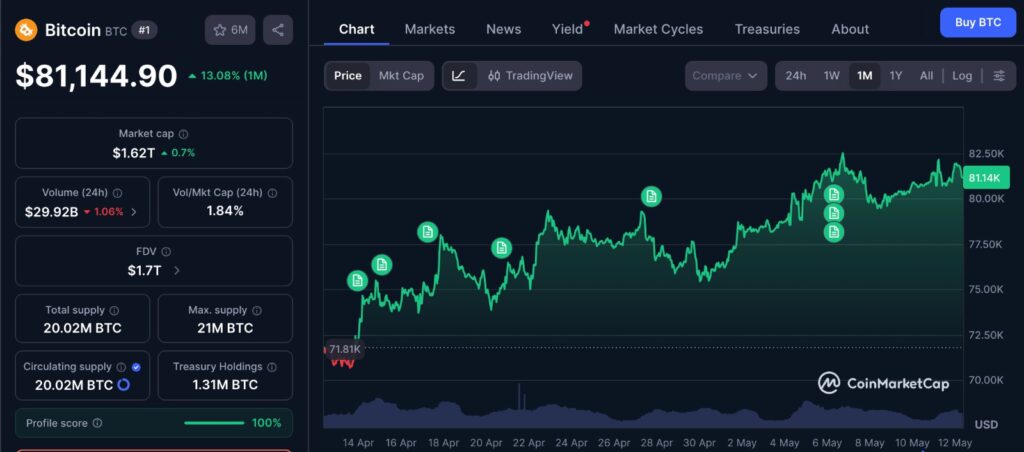
The one-month Bitcoin chart helps show why traders are still cautious despite the return of positive funding rates. BTC has been holding near an important price area, but the recent chart action shows repeated hesitation around higher levels rather than a clean continuation. That fits the broader derivatives picture: leverage is returning, but the market still needs stronger spot demand and steadier liquidity before traders treat the move as fully confirmed.
Bitcoin Funding Rates Turn Positive After Weeks of Caution
Bitcoin perpetual futures funding briefly climbed into neutral-to-bullish territory, with annualized funding touching around 6% earlier this week. That was the first meaningful positive move in more than a month.
On the surface, this looks constructive.
Positive funding means long traders are paying short traders to keep leveraged bullish positions open. In simple terms, demand for upside exposure is improving. When Bitcoin holds an important level and funding turns positive, it usually means traders are no longer positioned only for downside protection.
But the size and context of the move matter.
Funding did not jump into overheated territory. It only moved back into a more balanced bullish range. That suggests traders are testing upside exposure rather than blindly chasing it. This is different from late-stage rallies where funding becomes stretched, leverage crowds into one direction, and even a small pullback can trigger forced exits. Recent liquidation events have shown how quickly crowded leverage can unwind when price moves against overextended traders.
Right now, the signal is measured.
The futures market is saying that bulls are returning, but they are not fully comfortable yet.
Positive Funding Does Not Mean Full Market Confidence
A positive funding rate can attract attention because it gives the appearance of bullish momentum. However, derivatives markets often need confirmation from other parts of the market before that signal becomes reliable.
This is where Bitcoin’s current setup becomes more important.
If futures traders were strongly convinced, funding would likely rise faster and stay elevated. Instead, the market has shown limited conviction. Bitcoin has held near the $80,000 zone, but traders have not priced in a clean continuation with full confidence.
Recent sessions have shown this hesitation clearly. Bitcoin has been able to hold important levels, but each move toward the low $82,000 area has met enough selling pressure to keep traders cautious.
That hesitation makes sense.
Each failed push higher makes leveraged traders more careful because the market starts to question whether upside demand is strong enough or whether price is being supported mainly by short-term positioning.
Leverage can start a move, but liquidity decides whether the move can hold.
This is the key difference between bullish leverage and durable demand.
Leverage can push price higher for a short period. Durable demand is what allows price to hold higher levels after the first move. At the moment, Bitcoin has signs of returning leverage, but not enough evidence that larger buyers are fully comfortable chasing price higher. This is why Bitcoin’s broader demand picture remains important, especially when leverage returns before stronger spot buying is clearly visible.
Options Skew Shows Traders Still Want Downside Protection
The options market is sending a more cautious message.
Bitcoin’s 30-day options delta skew remained near 10%, with put options still carrying a premium over calls. That means professional traders and market makers are still paying more for downside protection than upside exposure.
This does not mean they expect a crash.
It means they are not willing to ignore downside risk.
That distinction matters. In a stronger risk-on phase, call demand usually rises as traders position for higher prices. When puts remain expensive, it shows that larger players still want protection in case Bitcoin fails to hold support or macro conditions weaken.
This also says something about participant behavior. Futures traders can react quickly when price starts moving, but options traders often show how bigger players are managing risk around that move. If they are still paying for protection, it means they may be participating while keeping risk tightly controlled.
That creates a mixed derivatives picture.
Futures funding shows that bullish leverage is returning. Options skew shows that professional traders are still hedging downside risk. When both signals appear together, the market is usually not in full euphoria. It is in a transition phase.
That transition can be useful, but it can also be unstable.
ETF Flow Uncertainty Keeps the Market From Fully Committing
Spot Bitcoin ETF flows remain one of the most important signals for institutional demand.
Earlier inflows helped support sentiment, but late-week outflows created hesitation. That matters because ETF flows have become one of the clearest ways to measure whether regulated capital is adding exposure or stepping back. Recent ETF outflows have already shown how quickly Bitcoin can lose momentum near the $80,000 area when institutional demand becomes less consistent.
When Bitcoin holds a major level while ETF inflows remain strong, traders usually gain confidence. But when ETF flows turn negative near resistance, the market starts to question whether institutional demand is strong enough to absorb profit-taking.
This is why futures traders may be returning before the broader market has fully confirmed the move.
Leverage often moves faster than spot demand. Traders can open futures positions quickly, but ETF flows show whether larger, slower-moving capital is also participating. Without that confirmation, positive funding can remain fragile.
This matters because futures positions can lift price quickly, but they do not always create a stable base underneath the market. A stronger base usually forms when spot buyers absorb supply instead of leaving the move dependent on leveraged traders.
Liquidity is not continuous. Once nearby orders are absorbed, price has to move toward the next area where real buying or selling interest is waiting.
This is also where execution risk matters. If futures buyers push price higher before spot buyers arrive, the move can become thin. In that kind of market, a modest wave of selling can travel farther than expected because fewer committed buyers are waiting underneath.
Price can be pushed higher by fast money, but it is usually defended by slower money.
The market does not only need longs to appear.
It needs buyers who are willing to hold through volatility.
Macro Risk Is Still Limiting Bitcoin’s Breakout Confidence
Bitcoin is also trading in a more complicated macro environment.
Geopolitical uncertainty and elevated oil prices can affect risk appetite across global markets. When macro risk rises, traders often reduce exposure to volatile assets or demand more protection before adding new positions.
This helps explain why Bitcoin derivatives are not showing full confidence even as price holds near an important area.
Crypto-specific signals may look better, but global risk conditions still matter. If traders are worried about oil prices, inflation pressure, or geopolitical shocks, they may be less willing to build aggressive long exposure in Bitcoin.
That is why the market feels cautious rather than euphoric.
Bitcoin has support from returning leverage, but it does not yet have confirmation from every major part of the market.
What This Setup Really Means for Bitcoin
The current setup is not simply bullish or bearish.
It is a positioning reset.
Bitcoin funding rates show that traders are no longer leaning as defensively as they were before. That is a positive shift. But options skew, ETF flow uncertainty, and macro risk all show that professional traders are still managing exposure carefully.
This makes the next phase more dependent on confirmation.
If ETF demand improves and options traders reduce their demand for downside protection, positive funding could become a stronger signal. It would show that futures leverage, spot demand, and options positioning are starting to align.
But if funding rises while ETF flows stay weak and put demand remains elevated, the market could become vulnerable. In that case, leverage would be building without enough spot support behind it.
That is the real risk.
A market can rise on leverage, but it needs real demand to stay there.
Editor’s View
Bitcoin’s current derivatives setup is more useful than a simple price-target discussion because it shows how traders are behaving beneath the surface.
The return of positive funding suggests that confidence is improving, but not enough to remove caution from the market. Options traders are still protecting against downside, ETF flows are not fully consistent, and macro risks remain difficult to ignore. That cautious tone also fits with broader crypto sentiment, where neutral market readings show that traders are not yet acting with full conviction.
That combination does not make Bitcoin weak.
It makes the market selective.
This is often how stronger market phases begin to form, not through one clean signal, but through several uneven signals improving at different speeds. Futures traders may move first because leverage is easy to add. Spot buyers and institutional flows usually need more proof before committing with size.
For now, Bitcoin’s next major signal may not come from price alone. It may come from whether leverage, ETF demand, and options positioning begin to support the same structure.
The move becomes stronger when traders are no longer borrowing confidence through leverage, but when real demand is willing to absorb supply behind it.
Disclaimer: This content is for informational purposes only and does not constitute financial advice.
Keep yourself updated with the latest crypto news with FYI Gazette
 Bitcoin
  Ethereum
  Tether
  BNB
BNB  XRP
XRP  Solana
  TRON
TRON  Dogecoin
  Litecoin
  Pepe
Pepe