StablR Stablecoin Depeg Exposes a Deeper Stablecoin Risk
StablR stablecoin depeg has become another reminder that stablecoin risk is not always about reserves, market panic, or smart contract bugs.
Sometimes, the weakest point is access.
StablR’s euro and dollar stablecoins came under pressure after an ongoing exploit reportedly hit the issuer, with blockchain security firm Blockaid identifying a suspected private key compromise tied to one owner in the minting multisig account. The incident reportedly allowed the attacker to alter control, mint large amounts of USDR and EURR, and then swap the newly minted tokens through decentralized exchanges.
That detail matters more than the dollar amount alone.
The reported loss was around $2.8 million, but the market signal was larger. EURR and USDR both moved away from their intended pegs as traders reacted to newly minted supply and thin liquidity. For a stablecoin issuer, that is a serious stress test because it does not only test token mechanics. It tests whether holders still believe the system can control supply when something goes wrong.
Recent sessions have shown how quickly stablecoin confidence can weaken when supply control, liquidity, and redemption clarity are questioned at the same time.
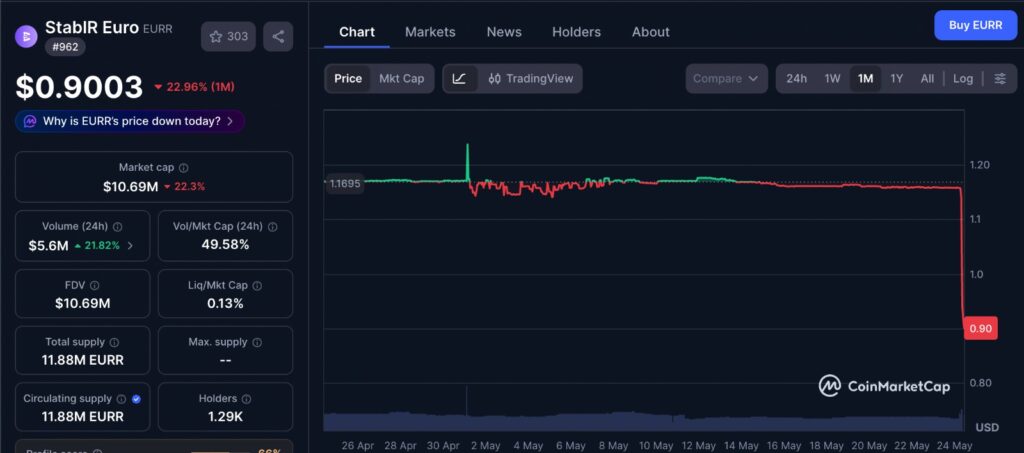
The one-month StablR Euro chart helps show why the depeg matters beyond the exploit headline. A stablecoin is expected to trade close to its intended value, so even a visible move away from that level can change how traders treat it. Once confidence weakens, the chart becomes less about normal price action and more about whether liquidity, redemption confidence, and supply control are strong enough to pull the token back toward its peg.
Why the StablR Stablecoin Depeg Matters
The StablR stablecoin depeg matters because it separates two risks that are often mixed together.
The first is reserve risk. That is whether a stablecoin is properly backed by cash, cash equivalents, or other assets. The second is control risk. That is whether the issuer’s minting, governance, and administrative systems can prevent unauthorized supply changes.
This incident appears to sit more clearly in the second category.
According to Blockaid’s reported analysis, the suspected issue was not a traditional smart contract bug. It was described as a key management and governance failure. That distinction matters because a stablecoin can claim strong backing, regulatory alignment, and proof-of-reserves, but those assurances become weaker if minting authority can be compromised.
Stablecoins depend on a simple promise: one token should represent a claim on one unit of value. If unauthorized tokens can be created, even temporarily, the market starts asking whether the token supply still matches that promise.
That is why depegs can happen quickly. Traders do not wait for full post-incident clarity before repricing risk. They move first, especially when liquidity is thin and the path back to the peg is unclear.
A stablecoin does not lose trust only when reserves are questioned. It loses trust when holders are unsure who controls supply.
Thin Liquidity Made the Damage More Visible
One of the most important parts of this incident is the liquidity gap.
The attacker reportedly minted 8.35 million USDR and 4.5 million EURR, then swapped those tokens for around 1,115 ETH, worth about $2.8 million at the time of the report. The gap between the face value of the minted tokens and the amount extracted shows how thin liquidity can turn a technical exploit into a visible market dislocation. The same execution pressure can be seen when Ethereum taker volume exposes liquidity gaps during aggressive market moves.
This is where many smaller stablecoins face a structural problem.
A stablecoin may look stable during normal conditions because trading activity is light and redemptions are orderly. But once a shock appears, the market quickly reveals how much real liquidity is available. If there are not enough buyers, arbitrageurs, or redemption pathways ready to absorb pressure, the peg can break faster than expected.
This is similar to how crypto liquidity stress can accelerate losses when forced selling meets thin order books.
The reason is simple: liquidity is not continuous. Once nearby buyers step away or existing orders are absorbed, the market has to move lower to find the next layer of real demand.
That does not mean every smaller stablecoin is unsafe. It means investors cannot judge stablecoin strength by branding, reserve language, or regulatory positioning alone. The market also cares about operational security, liquidity depth, exchange support, redemption speed, and how quickly the issuer can respond during stress.
In normal markets, liquidity hides weaknesses. In stress markets, liquidity exposes them.
A stablecoin peg is not defended by reserves alone. It is defended by confidence that controls and liquidity channels will work when pressure arrives.
The Real Issue Is Minting Authority
The most serious concern in the StablR incident is not only that tokens depegged. It is that the reported exploit involved minting authority.
Minting is one of the most sensitive functions in any fiat-backed stablecoin system. If an attacker can gain influence over minting controls, the market immediately questions supply integrity. Even if reserves are otherwise held properly, unauthorized supply can create confusion over which tokens are backed, which tokens are redeemable, and how quickly the issuer can neutralize the damage.
That uncertainty changes participant behavior.
Liquidity providers may step back because they do not want to absorb tokens that could later be frozen, discounted, or treated differently. Traders may rush to exit because they do not know whether the peg can be restored quickly. Arbitrageurs may hesitate because the usual trade depends on a clear redemption path. When these groups pull back together, the peg becomes harder to defend.
That is why multisig design matters.
A weak threshold can create a false sense of protection. A multisig setup sounds safer than a single key, but if one compromised signer can create enough control to change ownership or trigger minting actions, the protection may be much weaker than users assume. In that situation, the system is not only exposed to code risk. It is exposed to human, operational, and governance risk.
Markets do not break only because something goes wrong. They break when the people needed to stabilize them no longer want to take the other side.
For stablecoin users, this is a difficult risk to assess because it is usually invisible until something breaks. Most people can see market cap, price, volume, and peg movement. Very few can easily evaluate signer thresholds, key custody, timelocks, emergency pause controls, or minting restrictions before an incident happens.
That information gap is now becoming a market issue.
Stablecoin Trust Is Becoming More Operational
The crypto market used to treat stablecoin trust mainly as a reserve question. After several years of failures, depegs, bridge hacks, and issuer-specific stress events, that view is too narrow.
The StablR stablecoin depeg shows that users also need to think about operational trust.
Can the issuer prevent unauthorized minting?
Can it pause affected contracts quickly?
Can it communicate clearly during an incident?
Can it separate compromised supply from legitimate circulating supply?
Can liquidity providers and exchanges react without creating more panic?
These questions matter most for stablecoins that are smaller than the dominant dollar tokens. Large stablecoins usually benefit from deeper liquidity, broader exchange support, stronger arbitrage channels, and faster market response. Smaller stablecoins may have compliant structures and serious teams, but they often operate with thinner liquidity and less room for error.
That makes every control layer more important.
The smaller the liquidity base, the less time a stablecoin has to prove that the problem is contained.
Why Euro Stablecoins Face Extra Scrutiny
The EURR depeg also matters because euro stablecoins are still trying to build wider market relevance.
Dollar stablecoins dominate crypto trading, DeFi liquidity, and settlement activity. Euro stablecoins have a clear use case, especially for European users and regulated payment activity, but they still need deeper adoption to compete meaningfully. Any depeg in this category can slow confidence because users are already comparing liquidity, stability, and access against much larger USD alternatives.
This does not mean euro stablecoins are broken as a category. It means the market will demand stronger proof that they can survive real stress.
For euro-denominated stablecoins to grow, they need more than compliance language. They need credible security architecture, transparent incident handling, strong redemption processes, and enough liquidity to keep the peg functional when pressure rises.
That is the bigger lesson from the StablR stablecoin depeg. New stablecoin issuers are not only competing on regulation or currency choice. They are competing on whether users believe the token can remain reliable when something unexpected happens.
Editor’s View
The StablR incident is not just another exploit headline. It is a reminder that the stablecoin market is becoming less forgiving.
In calm markets, users often focus on yield, convenience, and access. In stress events, they focus on control. Who can mint? Who can pause? Who can recover? Who is responsible when the token no longer trades at its intended value?
That is where the next phase of stablecoin competition may be decided.
The strongest issuers will not only be the ones with reserves. They will be the ones that can prove their minting systems, signer structures, liquidity channels, and emergency controls are built for hostile conditions.
This matters because stablecoins are supposed to be the calm part of the crypto market. When they become the source of uncertainty, traders do not treat them like normal risk assets. They treat them like infrastructure that may not be working properly.
The market does not ignore stablecoins because they are boring. It ignores them until they stop behaving like stablecoins.
What Comes Next for StablR and Stablecoin Holders
The immediate focus will likely remain on whether StablR can contain the exploit, clarify the status of affected tokens, and restore confidence around EURR and USDR. Until there is more clarity, traders may continue treating both tokens with caution.
For the broader market, the lesson is already visible.
Stablecoin holders should not look only at the peg during calm periods. They should also look at liquidity, issuer transparency, security design, chain deployment, and whether the token has a reliable path back to par during stress.
The StablR stablecoin depeg shows that a stablecoin can lose confidence quickly when the market sees a break in supply control. In crypto, trust is not just what backs the token. It is whether the market still believes the system can control supply when pressure arrives.
Disclaimer: This content is for informational purposes only and does not constitute financial advice.
Keep yourself updated with the latest crypto news with FYI Gazette
Keep yourself updated with the latest Altcoin News with FYI Gazette
 Bitcoin
  Ethereum
  Tether
  BNB
BNB  XRP
XRP  Solana
  TRON
TRON  Dogecoin
  Litecoin
  Pepe
Pepe