

Ethereum Whale Short Exposes ETH Sentiment Risk Despite Vitalik’s Reassurance
Ethereum whale short activity is again forcing traders to look beyond price and focus on something more important: confidence.
A large Ethereum whale recently opened a leveraged short position worth more than $100 million, creating fresh debate around whether major traders are preparing for deeper ETH weakness or testing a fragile market. The position reportedly involved around 47,600 ETH, used roughly 23x leverage, and carried an entry price near $2,094.92.
At first glance, that sounds aggressively bearish.
But the real signal is not simply that one whale is short ETH. Large traders open high-risk positions all the time. What matters is that a trade of this size appeared even as Ethereum co-founder Vitalik Buterin tried to ease concerns around Ethereum Foundation selling by saying the Foundation would “sell less ETH.”
That contrast matters.
Ethereum is not just fighting a whale short. It is trying to prove that buyer demand can overcome a market where confidence remains fragile.
Ethereum Whale Short Shows How Sensitive ETH Sentiment Remains
The Ethereum whale short does not automatically prove that ETH is breaking down. The position itself looked risky because ETH had rebounded toward the whale’s liquidation zone near $2,150. With ETH trading above the reported entry price, the short was already sitting on an unrealized loss close to $1 million, before including funding costs.
That makes the setup more complicated than a simple bearish headline.
A short position this large can reflect conviction, but it can also create pressure against the trader if ETH moves higher. When leverage is high, the market does not need a major rally to create stress. It only needs enough upward movement to push the position closer to liquidation. This is why rising leverage matters across Ethereum markets, especially when ETH trader exposure is already building through open interest.
That is why this story should not be read as “a whale knows ETH is going lower.”
A better reading is this: some large traders still believe ETH is vulnerable enough to justify aggressive downside exposure, while buyers have not yet shown enough strength to make that bet clearly uncomfortable.
Markets do not move because one whale takes a position. They move when that position changes how other traders manage risk.
Recent sessions have shown exactly that tension, with ETH trying to rebound while traders still react quickly to visible bearish positioning.
Why Vitalik Buterin’s “Sell Less ETH” Comment Matters
Vitalik Buterin’s comment came at a sensitive moment for Ethereum. The Ethereum Foundation has faced repeated criticism over token sales, especially during periods when ETH price action has already looked weak. Traders often view treasury selling as extra supply entering an uncertain market. Those concerns became more visible after Ethereum Foundation unstaking activity raised fresh questions about ETH supply pressure.
Buterin’s message that the Foundation would “sell less ETH” was aimed at reducing that concern.
The point is simple: reassurance helps sentiment, but only changed behavior rebuilds trust.
A smaller selling footprint can reduce fear that the Foundation itself is adding pressure during fragile market conditions. But markets do not instantly rebuild confidence because one concern is addressed. They wait to see whether behavior actually changes.
That is the gap Ethereum is facing right now. Vitalik’s reassurance may calm part of the Foundation-selling concern, but it does not immediately remove questions around ETH demand, ETF outflows, institutional conviction, or weak relative performance against Bitcoin.
In markets, reassurance matters most when execution starts to match the message.
ETH Is Not Just Fighting Sellers
Ethereum’s current setup is not only about selling pressure. It is about whether buyers are willing to absorb that pressure while confidence is still thin.
That distinction is important.
Markets weaken when buyers stop absorbing supply at higher levels.
The whale short highlights this uncertainty. If ETH buyers show stronger demand, a large leveraged short near a tight liquidation zone can become fuel for a squeeze. But if buyers hesitate, the same short becomes a visible sign that major traders are willing to challenge ETH’s rebound.
That is the key mechanism. The whale short becomes dangerous only if buyers fail to absorb pressure, but it becomes squeeze fuel if ETH keeps pushing toward the liquidation zone.
A single bearish whale does not control Ethereum’s market structure. But a visible bearish position can influence how other traders interpret risk, especially when ETH is already dealing with questions around Foundation selling, ETF flows, and institutional positioning.
That is how liquidity often behaves in tense markets. Price is not shaped only by who wants to buy or sell. It is shaped by who has to act first when pressure builds.
Liquidity is not continuous. Once nearby buy orders are absorbed, price has to move lower to find the next layer of demand. If spot buyers step in and ETH holds firm, short sellers may have to reduce risk. If buyers stay passive, bearish traders can press the move with less resistance because there is less visible demand standing in the way. That makes buyer activity especially important, because Ethereum taker volume can reveal whether demand is actually absorbing pressure or simply reacting after price moves.
This matters because leverage can push price around in the short term, but only real buying interest can make a rebound durable. When positioning is heavy and demand is uncertain, even a small move can force traders to adjust faster than planned.
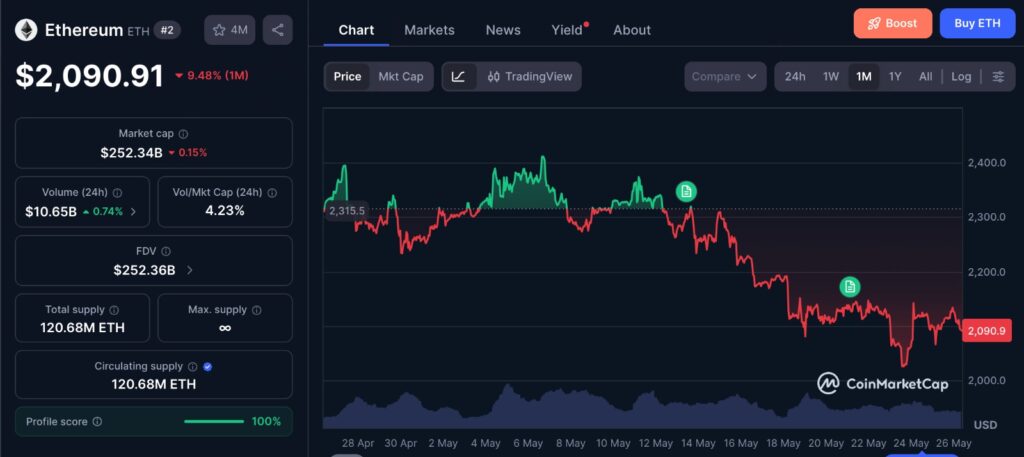
A 1-month ETH price chart from CoinMarketCap would fit well here because this article is centered on short-term sentiment, leverage risk, and ETH’s attempt to hold above key psychological levels. The chart should help readers visually compare the whale’s reported entry zone near $2,094 with ETH’s rebound toward the liquidation area near $2,150.
Why This Is Different From Previous ETH Whale And Demand Stories
This Ethereum whale short story should not be treated as a repeat of a whale-long article or an open-interest article.
The angle is different.
A whale-long story focuses on whether large traders are positioning for upside. An open-interest story focuses on how much leverage is building across the market. Ethereum demand stories focus on whether real buyers, network activity, or institutional flows are supporting ETH.
This story sits between those themes.
It is about the conflict between bearish leverage and attempted confidence repair.
Vitalik Buterin is trying to calm one of the market’s biggest Ethereum concerns: Foundation selling. At the same time, a large trader is willing to place a high-leverage bet against ETH. That creates a cleaner and more useful question:
Can Ethereum rebuild confidence fast enough to make bearish leverage dangerous?
That is the real story.
Editor’s View: Ethereum Needs Proof, Not Just Reassurance
The most important part of this setup is that Ethereum is now in a proof phase.
Vitalik’s statement may help reduce anxiety, but it does not automatically change market behavior. Traders still want to see whether Foundation selling slows, whether ETF outflows stabilize, whether ETH can hold key support zones, and whether buyers are willing to defend higher prices.
That is why the whale short is useful as a sentiment marker.
It shows that some large traders are still willing to bet against Ethereum, even after an attempt to calm the market. But it also shows how quickly bearish positioning can become vulnerable if ETH continues to rebound.
This is not a clean bearish signal. It is a test of buyer absorption.
If ETH fails to attract buyers, the whale short will look like a strong expression of market doubt. If ETH pushes higher and creates pressure near the liquidation zone, the trade could show how quickly leverage can turn against even large players.
Ethereum does not need one statement to change sentiment.
It needs follow-through.
That follow-through does not have to come from hype or sudden price acceleration. It can come from steadier buyer absorption, reduced anxiety around Foundation activity, and fewer signs that institutional flows are leaning away from ETH.
The move does not begin when fear disappears. It begins when buyers become strong enough to force bearish leverage to retreat.
Disclaimer: This content is for informational purposes only and does not constitute financial advice.
Keep yourself updated with the latest Altcoin News with FYI Gazette
 Bitcoin
  Ethereum
  Tether
  BNB
BNB  XRP
XRP  Solana
  TRON
TRON  Dogecoin
  Litecoin
  Pepe
Pepe