

XRP Bear Trap Debate Grows As June Breakdown Tests Bulls
XRP bear trap speculation is rising after the token slipped below a major long-term support area, but the stronger question is not whether XRP is ready for another breakout.
The real question is whether the latest weakness is a genuine macro breakdown or a trap for late sellers.
XRP recently fell toward the $1.25 area during a broader market sell-off, putting pressure back on a long-term structure that traders have watched for years. The drop has brought two levels into focus: the 50-month exponential moving average and a multi-year ascending trend line that has acted as a broad macro reference point.
Recent sessions have shown XRP struggling to turn rebounds into a clean reclaim, which is why the setup remains sensitive rather than confirmed.
A bear trap only becomes meaningful after price proves that sellers were caught on the wrong side. Until XRP reclaims the 50-month EMA and the long-term trend line, the bear-trap argument remains possible but unconfirmed.
XRP Bear Trap Setup Depends On A Reclaim
The most important mistake traders can make here is treating weakness below support as proof of a reversal.
It is not.
When an asset trades below a long-term support area, the first signal is damage, not strength. A bear trap becomes a stronger argument only if price recovers the broken level and holds above it long enough to force late sellers to reassess their positioning.
That is why XRP’s current position is delicate.
If XRP remains below the 50-month EMA and the macro trend line, the market may continue treating the move as a breakdown. Sellers do not need a dramatic collapse to stay in control. They only need price to keep failing where buyers are expected to reclaim structure.
But if XRP reclaims those levels cleanly, the story changes.
A reclaim would suggest that the breakdown did not attract enough follow-through selling. That would leave late shorts exposed, especially if traders sold the break without waiting for confirmation. In that scenario, XRP would not simply be bouncing. It would be forcing the market to reprice the breakdown.
Markets do not reverse because a support level looks important. They reverse when sellers fail to control the move after that level breaks.
That is the real bear-trap setup.
Not the wick below support.
The reclaim after the wick.
Why The June Monthly Structure Matters
Monthly structure matters because it filters out short-term noise.
On lower time frames, XRP can produce sharp moves that look decisive but quickly fade. A monthly view is slower, but it gives a clearer read on whether long-term buyers are defending the broader structure or stepping aside.
That is why the June setup carries weight.
If XRP spends the month below macro support, confidence in the long-term trend can weaken further. Traders who previously saw the trend line as a dependable floor may begin treating it as resistance. That shift matters because support breaks often change market behavior before they change headlines.
Once a major level is lost, buyers become more selective. They do not rush in simply because price is lower. They wait for proof that the breakdown failed.
This is where XRP’s current setup becomes more psychological than mechanical.
A weak monthly open below support can attract bearish positioning. But if the move fails to extend lower and price reclaims the lost structure, that weakness can become fuel for a reversal. Late sellers then have to decide whether they are early to a breakdown or trapped inside a failed move.
That decision can create volatility because markets often move hardest when one side has to exit quickly. If short sellers enter below support and XRP later recovers that same support, their exit demand can strengthen the recovery attempt.
Support Weakness Keeps The Downside Risk Open
The bear-trap case may be possible, but downside risk is still open.
Several traders are watching lower zones if XRP fails to defend the current region. Some downside targets being discussed sit around the $1.10 to $0.94 area, while deeper bearish scenarios have pointed toward the $0.90 to $0.70 range.
Those levels should not be treated as guaranteed targets. They are risk zones, not predictions.
The important point is that once XRP trades below macro support, the market has permission to test lower liquidity. When support is clearly defended, buyers can build around it. When support breaks, price often searches for the next area where stronger demand is willing to step in. This also connects with XRP’s earlier supply tightening breakout test, where the bigger question was whether reduced available supply could translate into stronger buyer control.
Liquidity is not continuous. Once nearby orders are absorbed, price has to move toward the next area where buyers are prepared to act.
That is why breakdowns can feel sharper than the headline suggests. The move does not need new panic every minute. It only needs weak demand at the first support zone.
XRP could bounce sharply and still fail at resistance. It could wick lower before recovering. It could also consolidate below the broken structure and force both bulls and bears to wait.
This is why confirmation matters more than excitement.
A clean reclaim would reduce breakdown risk. A failed reclaim would strengthen the bearish case. A slow drift below support would leave XRP vulnerable to another downside liquidity test.
The Market Is Not Just Watching Price
The current XRP setup is also about positioning.
When traders begin calling a move a bear trap, they are usually arguing that bearish sentiment has become too crowded. That can be true, but crowded sentiment alone does not reverse price. Markets can remain bearish longer than traders expect, especially when a major support level has already been lost.
The stronger signal comes when bearish positioning fails to produce downside continuation.
That is the key difference.
If XRP trades below support and sellers push price lower with momentum, the breakdown remains active. But if sellers gain control on paper and still cannot force continuation, the setup becomes more dangerous for shorts.
A bear trap is not created by optimism.
It is created by failed selling pressure.
That makes the next reclaim attempt important. If XRP moves back above the 50-month EMA and macro trend line, the move would challenge the bearish structure. If the reclaim holds, late sellers could become a source of forced buying as they exit positions.
This is where execution matters. Traders who sell after a major support break often place risk close to the same broken zone. If price moves back above that zone, the trade loses its logic, which can lead to quick exits and sharper movement.
At the same time, larger buyers often avoid stepping in aggressively until the reclaim is visible. That delay makes the first move back above support important because it shows whether demand is willing to absorb supply at a level the market had just rejected. Exchange supply also matters here, especially after previous XRP exchange outflows showed how reduced available supply can affect the way price reacts near key levels.
Until then, the market is still in a decision zone.
June Seasonality Adds Pressure, But Not Certainty
June has not always been a friendly month for XRP. Historical monthly return data shows that XRP has often struggled during June, with several weak closes over the years.
That matters because traders pay attention to seasonal tendencies, especially when price is already sitting near an important technical area. If a token enters a historically weak month below macro support, bearish traders may feel more comfortable pressing the move.
But seasonality is not a trading signal by itself.
It can add context, not certainty.
A weak seasonal backdrop can support the bearish argument if price keeps breaking down. But if XRP reclaims support despite that backdrop, the reclaim may carry more weight because it would happen against a market expectation of weakness.
That is why June should be treated as a pressure test.
Not a verdict.
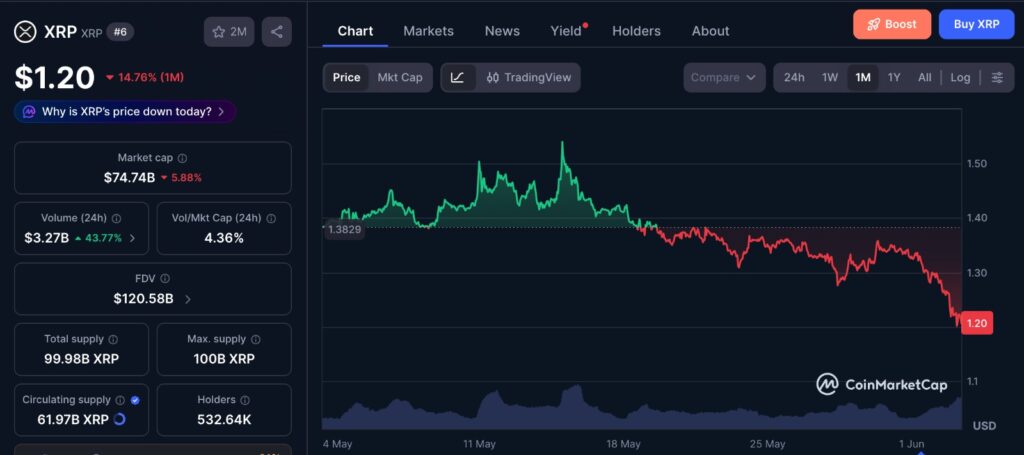
The one-month XRP chart gives useful context for the current bear-trap debate because it shows whether the recent decline is being rejected or accepted by the market. If XRP continues to trade below the broken support area, the move still looks like a weak reclaim attempt rather than a confirmed reversal. But if the chart begins to show stronger follow-through above the lost structure, it would suggest that sellers failed to control the breakdown. For now, the chart should be read as a confirmation tool, not a prediction signal.
The key visual point is not just where XRP traded during the sell-off, but whether the recovery attempt is strong enough to challenge the bearish structure.
What Bulls Need To Prove Next
For bulls, the requirement is simple.
XRP needs to reclaim the 50-month EMA and the long-term trend line with enough strength to make the breakdown look false. A quick move above those levels would be constructive, but holding them matters more.
A temporary spike can trap late buyers just as easily as a breakdown can trap late sellers.
The stronger bullish case would include a reclaim, consolidation above the recovered structure, and a failure by sellers to push price back below it. That would show that the market is no longer accepting lower prices as easily. That same confirmation problem also appeared in XRP’s ETF inflows setup, where demand narratives still needed price action to prove that buyers were actually taking control.
Without that, the bear-trap argument stays unfinished.
It may sound attractive, especially after a sharp decline, but the market has not confirmed it.
Editor’s View
The most important part of this XRP setup is that both sides are being tested at the same time.
Bears have a real argument because price has weakened below a major macro area. Bulls also have a real argument because failed breakdowns near long-term support can create powerful reversals.
But neither side has earned full control yet.
That is what makes this setup important. XRP is not simply preparing for another breakout, and it is not automatically entering a deeper collapse. It is sitting at the point where the market decides whether the break below support was accepted or rejected.
The cleanest signal now is not the size of the bounce, but the quality of the reclaim. If buyers can take back the lost structure and defend it, the bear-trap argument becomes much stronger. If they cannot, the market may continue treating the breakdown as valid.
For now, XRP’s bear-trap case remains alive, but it is not confirmed until price reclaims the 50-month EMA and long-term trend line. The real shift begins when the market can no longer treat the breakdown as accepted.
Disclaimer: This content is for informational purposes only and does not constitute financial advice.
Keep yourself updated with the latest crypto news with FYI Gazette
Keep yourself updated with the latest Altcoin News with FYI Gazette
 Bitcoin
  Ethereum
  Tether
  BNB
BNB  XRP
XRP  Solana
  TRON
TRON  Dogecoin
  Litecoin
  Pepe
Pepe