
XRP Buyers Turn Aggressive, but Holder Data Keeps Breakout Unclear
XRP is showing one of its strongest short-term demand signals of the year, but the setup is not as clean as the headline suggests.
Recent market data showed XRP’s taker buy-sell ratio climbing to its highest level of 2026, a sign that derivatives traders have become more aggressive on the buy side. Taker buying matters because it reflects traders entering immediately rather than waiting for passive orders to fill. Buyers are no longer only placing bids below price. They are stepping in directly and taking available liquidity.
That shift helped support XRP’s recent bounce, with the token rising more than 5% in 24 hours. The 7-day moving average of the taker buy-sell ratio also moved back above 1, showing that aggressive buying volume has started to outweigh aggressive selling volume.
On its own, that would usually strengthen the bullish case.
However, XRP’s current signal is not one-sided. While futures traders are leaning bullish, on-chain data is more cautious. Dormant coins moved during the bounce, top-holder supply slipped through June, and wallet-flow data only partly supports the accumulation case.
That makes this less of a clean breakout signal and more of a market test.
XRP Buyers Turn More Aggressive
The taker buy-sell ratio is watched closely because it shows whether aggressive market orders are coming more from buyers or sellers. A ratio above 1 generally means taker buying is stronger than taker selling. When that happens during a price bounce, it often suggests traders are positioning before a larger move.
That is what makes XRP’s latest reading important.
A move to the highest level of 2026 shows that short-term traders are not treating the bounce as random noise. They are actively building bullish exposure. This behavior can create momentum because urgent buying pushes through available sell orders faster than passive demand.
Liquidity is not continuous. Once nearby sell orders are absorbed, price has to move higher to find the next area where sellers are willing to respond.
That is the mechanism behind the mixed setup: aggressive buyers can lift price quickly, but the move only becomes durable if they absorb the older supply that appears into strength.
For XRP, the return of strong taker buying shows that buyers are trying to control the short-term tape. Still, derivatives-driven strength has limits.
Futures demand can support price quickly because it forces execution through available orders. But it can also fade quickly if spot demand and holder behavior do not confirm the move. When buying is led mainly by derivatives traders, price depends heavily on continued execution pressure. If that pressure slows, the market can lose support before deeper demand has time to form.
That is why XRP’s latest rally needs more than one strong futures metric to become convincing.
CMC Chart Analysis
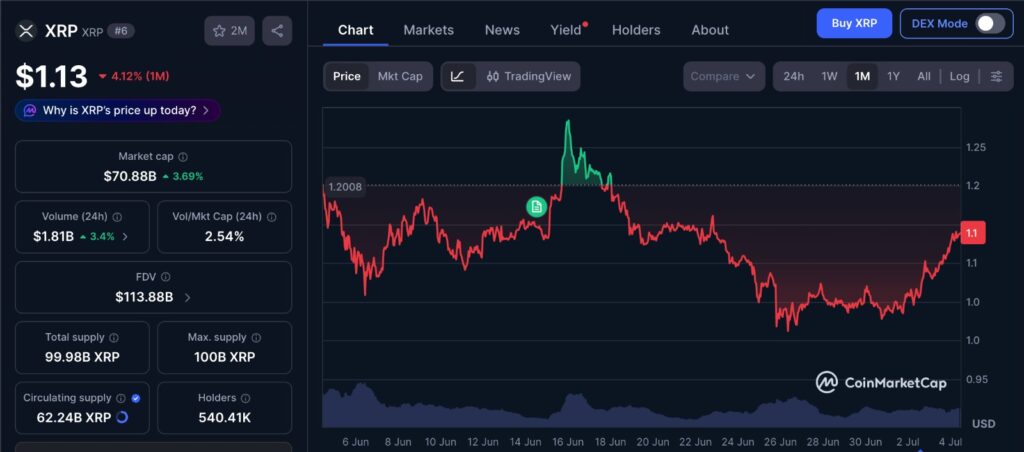
The 1-month XRP chart helps show how price reacted as taker buying reached its strongest level of 2026. The recent bounce matters because buyers became more aggressive, but the chart should be read alongside holder data. XRP’s ability to stay near or above the $1 area is important while dormant coins move and top-holder supply softens. A stronger hold would suggest buyers are absorbing the supply appearing into strength, while a weaker reaction would show that futures demand still needs clearer on-chain confirmation.
Dormant XRP Movement Raises A Caution Flag
The next complication comes from Coin Days Destroyed, or CDD.
CDD measures the movement of older coins by combining the amount of tokens moved with how long those coins had remained idle. When the metric spikes, it usually means previously dormant supply is moving again.
That does not always mean immediate selling. Old coins can move for several reasons, including wallet restructuring or exchange-related activity. However, when CDD rises during a price bounce, traders watch it more closely because long-held coins may be moving into strength.
That is the concern around XRP now.
Recent data showed a sizeable CDD spike, reportedly the largest since April. This happened as XRP bounced above the $1.10 area, raising the possibility that some holders used the rebound to move or reduce exposure.
This is why the current rally should not be judged only by aggressive buying in derivatives markets. If older supply is becoming active at the same time, XRP may be dealing with two opposing forces: short-term traders buying strength while some longer-term holders move coins into the bounce.
That setup can still lead to upside, but it requires stronger absorption.
Absorption means buyers are not only pushing price higher, but also taking in supply without allowing market structure to weaken. The reason this matters is simple: when old supply returns during a bounce, fresh demand must meet it. Otherwise, buying pressure can fade before price builds a stronger base. That is why XRP supply tightening remains a key breakout test, because lower available supply only matters if buyers can absorb the coins that return during strength.
Wallet Flows Support Accumulation, But Not Fully
There is also a more constructive part of the on-chain picture.
Wallet-flow data showed the 7-day net depositing and withdrawing wallet count falling to -6,210 on June 30. A negative reading means withdrawals exceeded deposits, which can be interpreted as a shift away from exchange-bound supply.
That is generally supportive because withdrawals can suggest investors are moving tokens away from trading venues. In many cases, that reduces immediate sell-side pressure and supports the accumulation argument. That makes XRP exchange outflows and their price impact important to watch, especially when traders are trying to decide whether withdrawals reflect real accumulation or simple wallet movement.
However, this signal needs context.
Exchange withdrawals do not automatically prove strong accumulation. Coins can move between wallets, custodians, or platforms without representing fresh conviction from long-term holders. That is why wallet-flow data is useful, but not enough on its own.
The better question is whether the withdrawal trend is being confirmed by large-holder behavior and price structure.
Right now, that confirmation is mixed.
Top-Holder Supply Slipped Through June
The supply held by XRP’s top 1% of addresses weakened during June. Recent data showed that the metric fell from 87.98% to 87.87%, even though it had risen from 87.57% in January to nearly 88% at its 2026 high.
This matters because large-holder supply can help show whether the biggest wallets are adding exposure or quietly reducing it. The June decline was small, but it weakens the idea that the latest bounce is being fully backed by large-holder accumulation. This also fits with the broader question of whether XRP holders are supporting the breakout setup or using strength to reduce exposure.
That is the key difference between a bullish signal and a confirmed bullish structure.
The taker buy-sell ratio shows that derivatives buyers are becoming more aggressive. Wallet withdrawals support part of the accumulation case. But the drop in top-holder supply and the CDD spike suggest that some existing holders may still be using strength to rebalance, transfer, or reduce exposure.
In other words, the market is not rejecting XRP, but it has not fully confirmed a breakout either.
This type of split signal often appears when positioning improves faster than holder conviction. The pressure is building, but control has not clearly shifted.
XRP Still Holds The $1 Area
Despite the mixed signals, XRP has continued to defend the $1 psychological area. That level matters because it gives the market a simple reference point.
If XRP holds above $1 while aggressive buying remains strong, the bullish case stays alive. It would show that the market can absorb supply movement without breaking down. That would make the taker buy-sell ratio more meaningful because futures demand would be supported by price structure. A stronger hold above this area would also keep attention on the wider XRP consolidation breakout setup, where price structure needs confirmation before a larger move becomes convincing.
However, if XRP loses the $1 area after this burst of aggressive buying, the signal would weaken quickly. It would suggest that buyers were active, but not strong enough to overcome older supply movement and softer large-holder concentration.
Recent sessions have shown that XRP is not suffering from a lack of attention. The real test is whether that attention can turn into steady demand while older coins return to activity.
Price strength matters most when it survives supply coming back to market.
That is where the next move becomes important.
Why The XRP Signal Is Not Clean Yet
The strongest part of XRP’s setup is the behavior of derivatives traders. They are clearly more willing to buy aggressively than they were earlier in the year. That can help create momentum, especially if sellers begin to step back.
The weaker part is that the on-chain market is not fully aligned with that bullish pressure.
A clean breakout setup would normally show aggressive buying, reduced dormant supply movement, rising large-holder concentration, and sustained withdrawals from exchanges. XRP has some of that, but not all of it.
Instead, the current structure looks divided.
Buyers are stepping in with force, but some older coins are moving. Wallet flows look supportive, but top-holder supply has slipped. Price has bounced, but confirmation still depends on whether support holds while this supply is absorbed.
For XRP, the signals are not bearish enough to dismiss the bounce, but they are not aligned enough to confirm a breakout.
XRP Breakout Depends On Absorption
The next test for XRP is not whether traders are interested. The taker buy-sell ratio already answers that. Traders are interested, and they are acting more aggressively than at any other point in 2026.
The real test is absorption.
If XRP can hold above key support while dormant supply moves and top-holder concentration softens, it would show that demand is strong enough to absorb distribution. That would give the latest futures-driven buying more weight.
If price stalls or rolls over, the market may treat the taker buy-sell spike as a short-term positioning burst rather than a durable shift in demand.
That is why XRP’s setup is important but still unfinished.
The bullish case is improving because buyers have become more aggressive. The caution is that on-chain signals are not fully confirming the same story.
For now, XRP is not flashing a clear breakout signal. It is flashing a pressure signal.
The stronger move begins only when taker buying is matched by holder confirmation and aggressive buyers absorb the dormant supply that appears when price rises.
Disclaimer: This content is for informational purposes only and does not constitute financial advice.
Keep yourself updated with the latest crypto news with FYI Gazette
Keep yourself updated with the latest Altcoin News with FYI Gazette
 Bitcoin
  Ethereum
  Tether
  BNB
BNB  XRP
XRP  Solana
  TRON
TRON  Dogecoin
  Litecoin
  Pepe
Pepe