
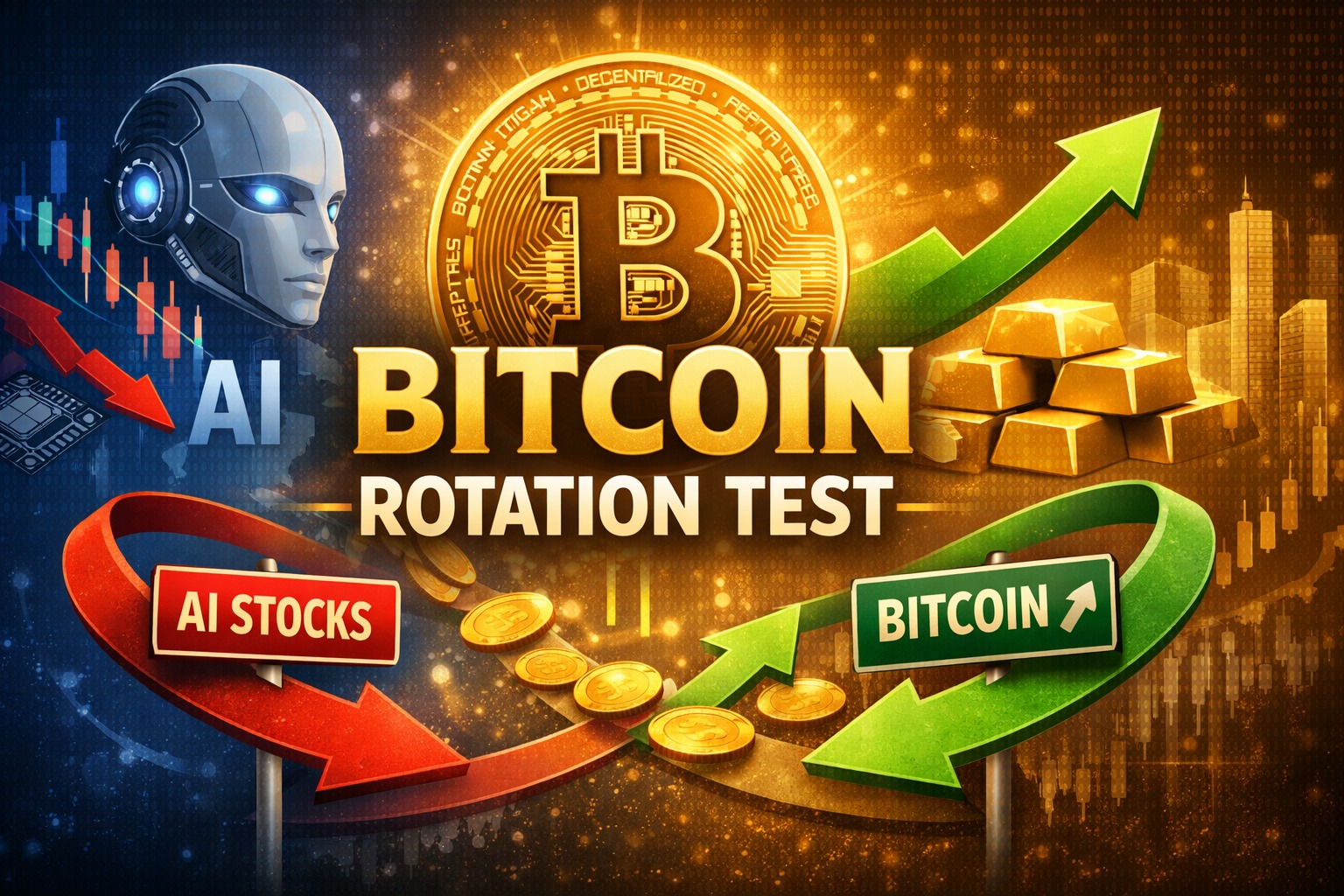
Bitcoin Holds $61K After Jobs Data as AI Stock Weakness Fuels Rotation Test
Bitcoin’s hold near $61,000 is becoming less about whether the market has already found a bottom and more about where capital wants to move next.
The latest shift came after weak US jobs data reduced fears of a more aggressive Federal Reserve path. At the same time, weakness across parts of the AI-linked stock trade raised a separate question for investors: if crowded technology momentum begins to cool, can Bitcoin attract capital looking for scarce, alternative assets?
That is the real test now.
Bitcoin is not only defending a price level. It is testing whether it can behave differently when risk appetite inside traditional markets starts to narrow. A move back above $61,000 helps sentiment, but the larger signal is whether Bitcoin can keep absorbing demand while overheated equity trades lose momentum.
Bitcoin Holds $61K After Weak Jobs Data
Bitcoin reclaimed the $61,000 area after the latest US labor market report came in weaker than expected. Nonfarm payrolls increased by 57,000 in June, below expectations of 113,000, while April and May figures were revised lower by 74,000 jobs, according to data cited in the report.
For Bitcoin, the data mattered because it softened one of the market’s main fears. A stronger labor market could have kept pressure on the Federal Reserve to remain tighter for longer. Instead, the weaker report reduced concern that another rate hike would become necessary in the near term.
That helped Bitcoin recover from recent pressure near $57,750.
However, the move should not be reduced to a simple rate-cut reaction. Bitcoin has already spent months reacting to shifting macro expectations, liquidity conditions, and support levels. What makes this moment different is that Bitcoin held firm while parts of the Nasdaq and AI-linked equity trade weakened.
Recent sessions have shown that Bitcoin’s most important signal is not just whether it can reclaim a level, but whether it can hold that level when other crowded risk trades begin to unwind.
That contrast gives the move more weight.
Markets do not rotate when one asset bounces. They rotate when crowded trades start losing control and capital begins looking for a cleaner place to rebuild exposure.
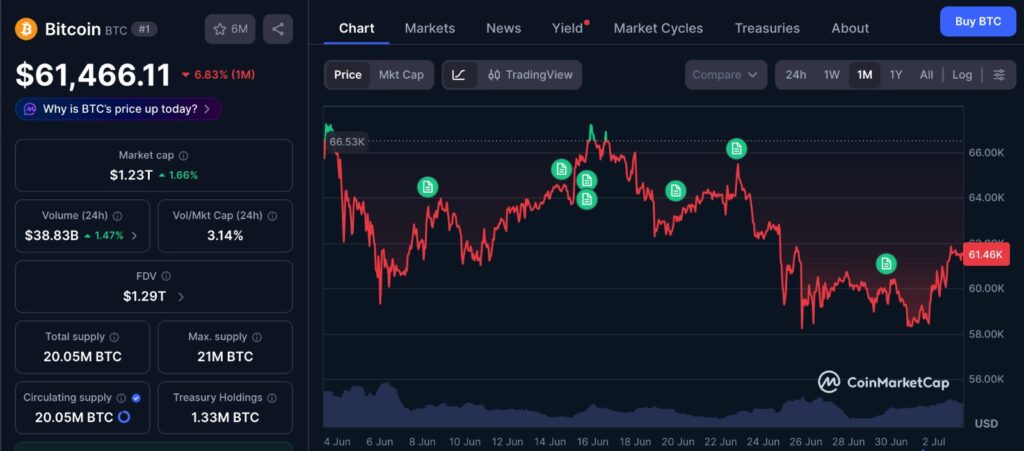
The 1-month Bitcoin chart shows why the $61,000 area matters in this setup. BTC has recovered from recent pressure near $57,750 and moved back above $61,000, but the chart should be read as more than a simple rebound. The key question is whether Bitcoin can keep holding its structure while AI-linked equities weaken and capital begins reassessing crowded technology trades. If the chart continues to show buyers absorbing supply near this range, it would strengthen the rotation argument. If the move fades quickly, it would suggest that Bitcoin still needs broader demand confirmation.
AI Stock Weakness Changes The Bitcoin Discussion
The AI trade has been one of the strongest momentum stories in traditional markets. That strength helped pull capital toward chipmakers, data infrastructure names, and technology-heavy indexes.
But momentum trades become fragile when too much capital depends on the same story continuing.
The latest market reaction showed that pressure clearly. The Nasdaq 100 erased gains from the previous three sessions, while several AI-linked and semiconductor-related stocks saw sharp intraday losses. The report noted that SanDisk, Seagate, Western Digital, and Applied Materials were among the names that fell 9% or more during Thursday’s session.
Bitcoin moved differently.
Instead of following tech lower in a clean risk-off move, Bitcoin held near the $61,000 area. That does not prove a full decoupling from equities. It does, however, explain why traders are watching for a possible rotation out of overheated technology exposure and into assets with a scarcity narrative. This is why the latest move fits into a broader Bitcoin Nasdaq weakness and BTC decoupling test, where the key issue is not whether Bitcoin fully separates from equities, but whether it can hold firmer when technology momentum weakens.
This matters because Bitcoin does not need all technology capital to rotate into crypto. It only needs a small shift in marginal demand to change market structure.
That is the mechanism behind the rotation test: when crowded equity trades lose momentum, even modest capital reallocation can matter if Bitcoin absorbs supply faster than sellers can replace it.
Bitcoin’s fixed supply profile, deep liquidity, and global access make it one of the first assets investors reassess when they want exposure outside traditional growth stocks.
Bitcoin’s Scarcity Trade Returns To Focus
The rotation argument is not just about Bitcoin rising while AI stocks fall. It is about whether investors begin to treat Bitcoin and gold as alternatives when traditional momentum trades weaken.
Gold reacted positively after the weak jobs data, adding to the idea that scarce assets are drawing more attention. Bitcoin sits in the same conversation, although with more volatility and a different investor base.
That makes the current setup more nuanced.
Bitcoin is not acting like a defensive asset in the traditional sense. It still carries risk, leverage, and sentiment-driven volatility. But it can act as a scarcity asset when investors expect easier policy conditions, weaker real growth, or less confidence in crowded equity trades.
This is why the $61,000 hold matters.
If Bitcoin only bounces because short-term traders cover positions, the move can fade quickly. If Bitcoin holds because capital is slowly moving toward scarce assets, the recovery becomes more meaningful.
The market now has to separate a technical rebound from a real demand shift.
Price becomes more durable when buyers absorb supply without needing every headline to be perfect.
Onchain Signals Point To Seller Exhaustion, But Not Confirmation
Onchain data has also helped support the recovery narrative. A CryptoQuant author cited in the report said that Bitcoin’s realized profit-to-loss ratio has fallen to its lowest level since 2022. The analyst also said the net percentage of supply in profit relative to total supply has turned negative, a condition that has historically appeared near major cycle bottom zones.
That kind of data can matter because it shows stress inside the holder base. When fewer holders are sitting on profit and realized losses rise, weaker hands may already have reduced exposure.
Still, this should not be treated as a guaranteed bottom signal.
Onchain indicators can show exhaustion, but they cannot force new demand into the market. Bitcoin needs buyers to step in after the stress, not just sellers to slow down. That distinction is critical.
Seller exhaustion can slow the decline. Fresh demand is what turns stabilization into recovery. That is why the latest onchain stress should be read alongside the broader Bitcoin realized losses capitulation risk, where the main question is whether realized pain has created a cleaner setup or only exposed weaker demand.
That is why the AI weakness angle matters more than the bottom-call angle. The market is not only asking whether Bitcoin has finished falling. It is asking whether Bitcoin can become a destination for capital leaving crowded trades.
Why This Is Not Just Another $60K Support Test
Bitcoin has already tested the market’s patience around the $60,000 area. Support, liquidations, ETF flows, and macro headlines have all shaped the recent debate. That makes the earlier Bitcoin liquidation reset near $60K support useful context, because liquidation resets can clear leverage, but they still need real spot demand to turn support defense into a stronger recovery.
But this setup is different because the key issue is not only price defense.
The real question is whether Bitcoin can absorb capital when leadership inside traditional risk assets starts to look less stable. If AI stocks continue to weaken and Bitcoin holds firm, traders may begin to view BTC as more than a speculative rebound. They may start treating it as part of a broader capital rotation.
That would change the tone of the market.
A support bounce says buyers defended a level. A rotation signal says buyers may be changing where they want exposure.
That difference matters because one is short term and technical, while the other can influence positioning across multiple sessions. A market that only defends support still depends on the next catalyst. A market that attracts rotation begins to build follow-through through positioning, confidence, and liquidity.
The reason this happens is simple: liquidity is not spread evenly across the market. Once nearby sell orders are absorbed, price has to move toward the next area where sellers are willing to act. That is why even moderate buying can matter when positioning is cleaner and supply is harder to find.
What Bitcoin Needs To Prove Next
Bitcoin’s next test is not only whether it can move toward $70,000. The more important test is whether it can hold its structure without relying on one macro headline.
If Bitcoin continues to trade firmly while AI-linked equities remain under pressure, the rotation argument becomes stronger. If Bitcoin quickly gives back the move, the market may treat the $61,000 recovery as another temporary relief bounce.
For now, the signal is constructive but unfinished.
Weak jobs data helped reduce rate-hike fears. AI-sector weakness created room for a rotation narrative. Gold’s positive reaction supported the scarcity-asset theme. Bitcoin’s hold near $61,000 placed it at the center of that debate.
But confirmation still depends on follow-through.
Bitcoin does not need investors to abandon tech entirely. It only needs enough capital to question whether the next trade should still be crowded AI momentum, or whether scarce assets deserve a larger place in the portfolio. That demand question also connects with the broader Bitcoin bull run demand lags analysis, because a rotation setup only becomes stronger if new buyers continue absorbing supply after the first relief move.
The move becomes more important when Bitcoin stops needing perfect conditions to hold. That is when a support bounce starts to look less like relief and more like rotation.
The real signal is not the $61,000 level by itself. It is whether Bitcoin can keep absorbing supply while crowded AI trades lose momentum.
Disclaimer: This content is for informational purposes only and does not constitute financial advice.
Keep yourself updated with the latest crypto news with FYI Gazette
 Bitcoin
  Ethereum
  Tether
  BNB
BNB  XRP
XRP  Solana
  TRON
TRON  Dogecoin
  Litecoin
  Pepe
Pepe