

Bitcoin Nears $53K Realized Price as Investment Opportunity Debate Builds
Bitcoin is moving closer to a price zone where short-term fear and long-term opportunity begin to overlap.
The key level drawing attention is Bitcoin’s realized price, which sits near $53,300, according to on-chain data cited in the report. Realized price reflects the average price at which the Bitcoin supply last moved on-chain. In simple terms, it gives the market a rough view of Bitcoin’s aggregate cost basis.
That makes the level more than just another line on a chart.
If Bitcoin falls closer to realized price, the market will not only be testing support. It will be testing whether long-term holders, dip buyers, and sidelined capital still see the decline as a reset rather than a deeper loss of confidence.
Bitcoin Realized Price Moves Back Into Focus
Bitcoin was recently trading near the low $60,000 area, leaving it within roughly 10% of its realized price, the report noted. That distance matters because previous Bitcoin bear markets have often become more attractive for patient buyers when price moved near or below this cost-basis zone. That makes the risk of a Bitcoin break below $60K toward the $54K confluence zone especially relevant, as it would bring price closer to the realized price area now driving the opportunity debate.
The realized price does not predict the exact bottom or guarantee a rebound. However, it has historically helped identify moments when market stress becomes severe enough to reset expectations.
That is why the current debate is different from a normal support test.
A fall toward $53,000 would likely create a split in market interpretation. Short-term traders may see another breakdown. Longer-term investors may see Bitcoin moving closer to a zone that has previously offered stronger cycle opportunities.
The difference matters because behavior changes as the profit cushion narrows.
When Bitcoin trades far above realized price, many holders can still sell from a position of profit. When price moves closer to realized price, that cushion becomes thinner. Sellers who wanted to protect gains may have already acted, while new buyers begin asking whether the market has repriced enough risk.
That is the mechanism behind the realized price test: as the profit cushion narrows, weaker holders may sell, but patient buyers may also become more willing to absorb supply if they believe the market has repriced enough risk.
Recent sessions have shown how quickly sentiment can shift when Bitcoin trades closer to major cost-basis levels rather than comfortably above them.
The opportunity debate begins because realized price forces the market to compare current fear with Bitcoin’s broader cost basis.
Markets do not move higher because an asset looks cheaper. They move higher when sellers lose control and stronger buyers are willing to absorb supply.
The realized price matters because it can become one of the clearest areas where that absorption is tested.
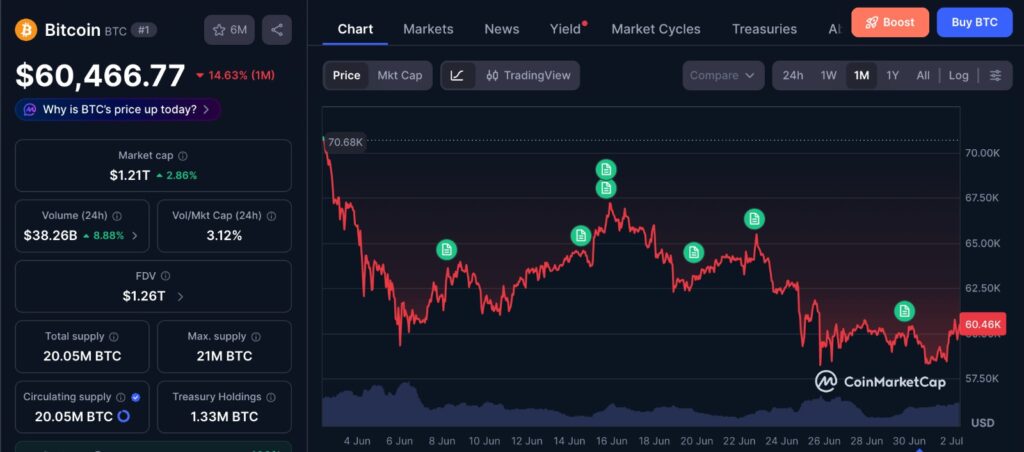
The 1-month Bitcoin chart from CoinMarketCap helps show how BTC has moved closer to the realized price zone near $53,300. The key point is not just the distance between the current price and that cost-basis level, but how the market behaves as fear increases. If Bitcoin moves lower in a controlled way and buyers begin absorbing supply, the realized price debate becomes more meaningful. If the reaction remains weak, it would show that demand still needs confirmation before the zone can be treated as a stronger opportunity area.
Why The $53K Zone Matters For Bitcoin
The $53,000 area is important because it represents a broader cost-basis level across the Bitcoin market. When price trades above realized price, the average coin is generally in profit. When price falls below it, the market enters a more stressful zone where the average holder is no longer sitting on comfortable unrealized gains.
That shift can change behavior.
Some holders may sell to avoid deeper losses. Others may stop selling because the market has already repriced enough pain. New buyers may also begin watching more closely because Bitcoin is no longer trading far above the average on-chain cost basis.
This is why realized price has become part of the current investment opportunity debate.
A move toward $53,000 would not automatically be bullish. It would first be a stress test. The market would need to prove that sellers are becoming exhausted and that buyers are willing to defend the area with real demand. The same demand issue has already appeared in earlier market phases, where Bitcoin demand weakness raised questions about whether buyers were strong enough to support the broader trend.
This matters because major levels only work when there is enough capital willing to absorb supply. Liquidity is not continuous. Once nearby bids are filled, price must move lower to find the next group of buyers. That is why weak demand can turn a key level into a quick breakdown, while stronger demand can turn the same level into a reset zone.
In weaker markets, liquidity often looks solid until sellers test it. That is when the market shows whether buyers are truly present or only waiting lower.
Without demand, the level becomes just another line that price can break. With demand, it can become the kind of area where panic starts turning into opportunity.
Analysts Watch For A Deeper Bitcoin Bottom
The current discussion has gained attention because some analysts have argued that Bitcoin may still need to trade below its realized price before a stronger bottom forms.
That view is based on past cycle behavior. In earlier bear markets, Bitcoin has traded below realized price before a durable recovery developed. Those periods were uncomfortable in real time, but they later became important accumulation zones for investors with longer time horizons.
This does not mean history has to repeat perfectly.
The current Bitcoin market is different from previous cycles. Spot ETF flows, institutional holders, macro liquidity conditions, and derivatives positioning all add new layers to market structure. That means the realized price should not be treated as a magic number.
Instead, it should be treated as a context level.
If Bitcoin approaches that zone with heavy forced selling, weak spot demand, and poor liquidity, the market could remain vulnerable. If it approaches the zone after leverage has already reset and stronger buyers begin absorbing supply, the setup becomes more constructive. That is why the recent Bitcoin liquidation reset near $60K support matters, because forced selling can clear excess leverage before the market tests deeper cost-basis levels.
That is the real question now.
Not whether $53,000 is guaranteed to hold, but whether the market can show enough demand near that zone to turn fear into a higher-quality opportunity.
Short-Term Fear Can Create Long-Term Opportunity
Bitcoin’s move toward realized price would likely feel negative in the moment. Headlines would focus on the breakdown, traders would question whether the cycle has further to fall, and sentiment would likely weaken again.
That is exactly why the level matters.
The best long-term opportunities in Bitcoin have often appeared when the market felt uncomfortable, not when conditions looked clean. That does not make every dip attractive. It means the quality of the decline matters.
A panic-driven fall with no buyer response is dangerous. A controlled reset into a major cost-basis zone, followed by signs of absorption, can be more meaningful.
This is where investors need to separate price from structure.
A lower Bitcoin price alone is not enough. The market needs to show that supply is being absorbed, that long-term holders are not rushing for the exit, and that fresh demand is willing to step in even when sentiment is weak.
The reaction near realized price would matter more than the move toward it. A sharp drop can create attention, but only sustained buying can turn that attention into a market base.
Bitcoin Needs More Than A Historical Signal
The realized price has strong historical relevance, but Bitcoin still needs confirmation from current market behavior.
A move toward $53,000 would become more constructive if it comes with reduced leverage, improving spot demand, stronger ETF stabilization, and signs that large holders are not distributing aggressively. Without those signals, the level could remain vulnerable. This is also why Bitcoin ETF outflows and market exhaustion remain important, as realized price alone cannot offset weak institutional demand.
That is why investors should avoid treating the realized price as a simple buy signal.
It is better understood as a decision zone.
If Bitcoin falls toward realized price and demand strengthens, the market may begin building a stronger base. If demand remains weak, the bear-market debate could deepen.
This also makes execution important. Large buyers rarely need to chase price when sentiment is weak. They can wait for liquidity, test bids slowly, and let the market show whether sellers are still aggressive. That kind of behavior can make bottoms look quiet before they look convincing.
This is why the next stage matters more than the headline number itself. Bitcoin does not need to simply touch $53,000. It needs to show how the market behaves if that level comes into play.
Editor’s View
Bitcoin’s realized price is useful because it brings the debate back to market behavior rather than emotion.
A drop toward $53,000 would sound bearish in the headline, but the level itself is not the story. The story is whether sellers still control execution when price reaches a major cost-basis zone.
If supply keeps hitting the market and buyers stay passive, realized price will not protect Bitcoin. If selling pressure slows and stronger buyers begin absorbing coins, the same level becomes more important.
That is why this setup should not be framed as a guaranteed opportunity or a guaranteed breakdown. It is a test of conviction, liquidity, and patience.
The market is not asking whether Bitcoin is cheap. It is asking whether enough buyers believe it is cheap while fear is still high.
Realized price only matters if it changes behavior. If it forces weaker holders out while patient buyers step in, the level becomes part of a broader reset rather than just another downside marker.
The Bigger Picture For Bitcoin
The current setup puts Bitcoin in a difficult but important position.
On one side, a deeper move toward the realized price would confirm that bearish pressure has not fully cleared. It would show that the market still needs to test lower cost-basis levels before confidence can rebuild.
On the other side, that same move could bring Bitcoin closer to a zone where long-term investors begin paying more attention. Historically, realized price tests have often forced the market to reset expectations and separate weak conviction from patient accumulation.
That is why the $53,000 level is now central to the debate.
It is not only a downside target. It is a market psychology test.
If Bitcoin moves closer to that level, the reaction may reveal whether this decline is simply another breakdown or the beginning of a stronger cycle reset. The move does not begin because Bitcoin reaches realized price. It begins when sellers run out of force, buyers absorb the supply, and fear starts behaving less like panic and more like opportunity.
Disclaimer: This content is for informational purposes only and does not constitute financial advice.
Keep yourself updated with the latest crypto news with FYI Gazette
 Bitcoin
  Ethereum
  Tether
  BNB
BNB  XRP
XRP  Solana
  TRON
TRON  Dogecoin
  Litecoin
  Pepe
Pepe