
Bitcoin Faces $62K Test as US-Iran Tension Reopens Hormuz Risk
Bitcoin moved toward $62,000 as renewed tension between the United States and Iran pushed the Strait of Hormuz back to the center of global market risk.
The decline was not simply a technical breakdown. It developed as oil prices remained elevated, US stocks weakened and traders reacted to President Donald Trump’s comments about a larger American role in controlling the strategically important waterway.
Trump said the US would keep the strait open, potentially “run” it and seek reimbursement for securing the route. His comments added uncertainty around a waterway that remains critical to global energy flows.
For Bitcoin, this creates a different kind of test near $62,000.
The main question is whether spot buyers can absorb risk-off supply while oil pressure, geopolitical uncertainty and aggressive short positioning keep sellers active. Until that becomes clearer, BTC may continue to trade more like a high-volatility macro asset than an immediate geopolitical hedge.
Trump’s Hormuz Comments Add New Pressure To Bitcoin
Bitcoin was already struggling to build a convincing recovery when the latest US-Iran escalation introduced another source of pressure.
Trump said the United States could become the guardian of the Strait of Hormuz and should be reimbursed for keeping it open. The comments followed renewed conflict over access to the waterway and control of shipping through the region.
The Strait of Hormuz connects the Persian Gulf with the Gulf of Oman and serves as a major route for oil and liquefied natural gas exports. Developments around it can quickly affect expectations for energy supply, shipping costs and inflation. Bitcoin has faced a similar transmission of pressure before, when an oil surge linked to Strait of Hormuz risk weakened risk appetite and pushed investors away from volatile assets.
Oil prices climbed after Trump’s announcement, while US and global stock markets came under pressure. Bitcoin also moved closer to the $62,000 area as broader risk appetite weakened.
This reaction shows why BTC is not treated as an automatic safe haven during every geopolitical crisis.
When energy supply is threatened, investors often reduce exposure to assets that are volatile, leveraged or easy to sell. Bitcoin fits those conditions, meaning it can become a source of liquidity even when the original shock has nothing to do with crypto.
Bitcoin is not always sold because confidence in it has changed. It is often sold because it is one of the quickest positions to exit.
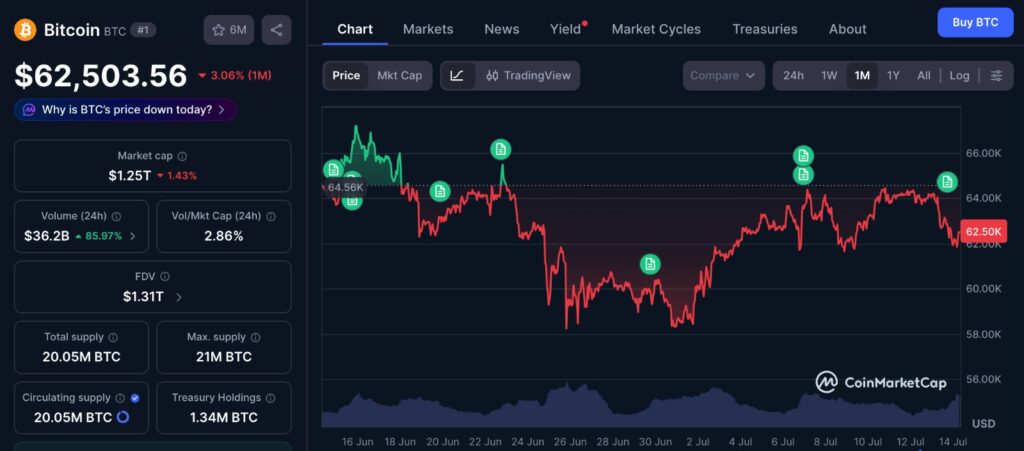
The 1-month Bitcoin chart shows how BTC has moved toward the $62,000 area as renewed US-Iran tension, elevated oil prices and weaker risk appetite increased pressure across markets. The important signal is not the decline alone, but how Bitcoin behaves around this zone while sellers remain active. A steady hold would suggest spot buyers are absorbing risk-off supply, while a weak response could bring the $60,000 area back into focus.
Why The Strait Of Hormuz Matters For BTC
The connection between the Strait of Hormuz and Bitcoin runs through the broader financial system. Bitcoin’s earlier reaction to Iran and Hormuz developments also showed how quickly changes in geopolitical expectations can influence oil prices and demand for risk assets.
If markets believe oil shipments could face disruption, crude prices may remain elevated. Higher energy costs can then affect transport, manufacturing and consumer prices across several economies.
That creates a three-stage pressure mechanism for Bitcoin.
First, rising oil prices can weaken economic confidence by increasing costs for businesses and households.
Second, stronger inflation expectations may make central banks less willing to ease monetary policy. Bond yields can also rise if investors expect interest rates to remain higher for longer.
Third, tighter financial conditions can reduce demand for high-volatility assets, including Bitcoin.
The deeper issue is how higher energy prices redirect capital. When investors expect tighter policy or slower growth, money tends to move toward cash, short-term bonds and defensive positions. Leverage becomes harder to maintain, while buyers become less willing to chase rebounds.
That is the mechanism behind the Hormuz test: higher oil prices tighten the macro backdrop, while Bitcoin only stabilizes if spot buyers absorb the risk-off supply before sellers force price into a lower range.
The Strait itself does not determine Bitcoin’s value. What matters is how uncertainty around the route changes energy prices, financial conditions and investors’ willingness to hold risk.
Bitcoin Behaves Like A Risk Asset Under Geopolitical Stress
Bitcoin is often described as digital gold, but its short-term response to geopolitical stress remains mixed.
During some periods, BTC benefits from concerns about currency debasement, capital restrictions or instability in traditional financial systems. During others, it declines alongside technology stocks as investors reduce leverage and prioritize liquidity.
The current reaction is closer to the second pattern.
Bitcoin weakened as equities came under pressure and oil prices rose, suggesting that short-term participants are prioritizing BTC’s risk-asset characteristics over its longer-term scarcity narrative.
This does not weaken Bitcoin’s potential role as a long-term, non-sovereign scarcity asset. It shows that different participants operate under different constraints.
A long-term holder may view geopolitical instability as a reason to own an asset with fixed supply. A leveraged trader facing falling equities, rising oil and tighter liquidity may sell BTC to reduce immediate risk.
Both behaviors can exist at the same time. The stronger force near $62,000 will depend on whether longer-term demand absorbs sales from short-term and leveraged participants.
Bitcoin’s identity does not change from one session to the next. The participant setting the price does.
Aggressive Shorting Raises The Risk Of A Volatile Rebound
Market observers also noted aggressive short positioning as Bitcoin approached the lower end of its recent range.
Fresh bearish positions can add pressure when spot buyers remain cautious. Short sellers act immediately, while larger buyers may wait for steadier prices and deeper liquidity before committing meaningful capital.
This creates a temporary imbalance: sellers execute now, while natural demand waits.
Liquidity is not evenly distributed across every price. Once nearby buy orders are absorbed, Bitcoin may need to move lower to find the next group of willing buyers, allowing a modest increase in selling to produce a sharper decline.
Aggressive shorts can pressure BTC lower, but they also create rebound risk if spot buyers begin absorbing supply. Traders who entered late bearish positions may then be forced to close, adding buying pressure.
A short-covering bounce can lift price temporarily without repairing the underlying demand problem. A more durable recovery would require spot buyers to remain active after forced buying from shorts fades.
Recent sessions have shown how quickly Bitcoin rebounds can lose momentum when follow-through demand remains limited.
What The $62K Bitcoin Level Actually Represents
The $62,000 area is important because it has become a market absorption zone rather than a guaranteed floor. The same principle shaped Bitcoin’s earlier supply-absorption test, where the strength of demand mattered more than the support level alone.
If Bitcoin stabilizes near the level while oil remains elevated and stocks remain weak, it would suggest that buyers are increasingly willing to absorb supply despite an unfavorable macro backdrop.
A stronger signal would come from a recovery supported by sustained spot activity and less dependence on leveraged futures positioning.
By contrast, a clear loss of the area could bring the $60,000 region back into focus. That would suggest sellers are reaching a market without enough immediate demand to absorb their supply. That region has already acted as an important reference point during Bitcoin’s earlier liquidation reset near $60,000, when forced selling tested whether underlying buyers were prepared to absorb the decline.
The quality of the reaction still matters. A brief move below support followed by firm buying would carry a different message from a sustained decline met by repeated selling.
Support is not defined by where Bitcoin touches. It is defined by where buyers repeatedly accept the risk of owning it.
Oil Prices Could Keep Bitcoin Volatility Elevated
Bitcoin’s near-term environment now depends partly on whether the Hormuz dispute remains a persistent market concern.
If tensions ease and oil prices retreat, some pressure on risk assets may fade. If shipping uncertainty continues, oil could retain a geopolitical premium, keeping attention on inflation, interest rates and economic growth.
That backdrop may also keep Bitcoin liquidity uneven.
During uncertain periods, market makers often reduce the size of orders they are willing to quote. This can widen spreads and allow relatively large trades to move price more sharply.
Some volatility may therefore reflect thinner liquidity and execution pressure rather than a major shift in long-term conviction.
Recent sessions have shown that Bitcoin remains sensitive to global risk appetite. The market is pricing not only crypto-specific developments, but also energy routes, military decisions and their effect on broader liquidity conditions.
Bitcoin’s $62K Test Comes Down To Spot Demand
Bitcoin’s move toward $62,000 is not simply another attempt to identify technical support.
The decline is testing whether BTC can absorb a geopolitical shock linked to one of the world’s most important energy routes. Hormuz uncertainty is supporting oil prices, weakening risk appetite and encouraging short-term participants to reduce exposure.
Aggressive bearish positioning may intensify the pressure, but it can also create rebound risk if committed buyers begin accepting available supply. That distinction is especially important while Bitcoin’s broader demand recovery continues to lag, because futures-driven rebounds can fade when spot participation does not strengthen.
The key signal will not be a brief move above or below $62,000. It will be whether spot demand continues to execute while oil pressure, geopolitical uncertainty and risk-off selling remain active.
The level matters, but the balance behind it matters more. Bitcoin will stabilize only when committed spot demand can absorb the supply that urgent sellers are still bringing to market.
Disclaimer: This content is for informational purposes only and does not constitute financial advice.
 Bitcoin
  Ethereum
  Tether
  BNB
BNB  XRP
XRP  Solana
  TRON
TRON  Dogecoin
  Litecoin
  Pepe
Pepe