

Bitcoin Absorbs Strategy’s $216M BTC Sale as Spot Buyers Return
Bitcoin moved back above $64,000 after the market absorbed Strategy’s reported $216 million BTC sale, giving traders an early sign that selling pressure from one of the largest corporate Bitcoin holders did not immediately damage market structure.
The sale was significant. According to the disclosure, Strategy sold 3,588 BTC for around $216 million, reducing its total Bitcoin holdings to 843,775 BTC. For a company closely tied to the corporate Bitcoin treasury trade, that move could have triggered a deeper confidence shock.
Instead, Bitcoin recovered after an initial drop, showing that buyers were willing to step in once the sale became public. That does not remove the risk. It shows the market passed the first absorption test.
The bigger question now is whether Bitcoin’s recovery above $64,000 is being supported by real spot demand, or whether the first leg of the move was mostly a futures-driven rebound from crowded bearish positioning.
Bitcoin Holds After Strategy Sale
Strategy’s Bitcoin sale attracted attention because the company has long been viewed as one of the strongest symbols of corporate BTC conviction. When a holder of that size sells, the market does not only react to the coins. It also reacts to what the sale may say about balance-sheet pressure, shareholder obligations, and the durability of the Bitcoin treasury model. This builds on the earlier concern that a Strategy Bitcoin sale could create market risk if traders started treating corporate BTC treasuries as less reliable sources of long-term demand.
That is why the market response was important.
Bitcoin initially weakened after the disclosure, with market data showing price falling near $61,335 before recovering. A deeper sell-off would have suggested that traders saw the sale as the start of a larger corporate unwind. Instead, the market absorbed the headline and moved higher.
This is the difference between selling pressure and failed absorption.
Selling pressure means supply has entered the market. Failed absorption happens when buyers cannot take that supply without forcing price into a lower range. For now, Bitcoin avoided the second outcome.
That does not make the move fully bullish. It shows the market was less fragile than the first reaction suggested.
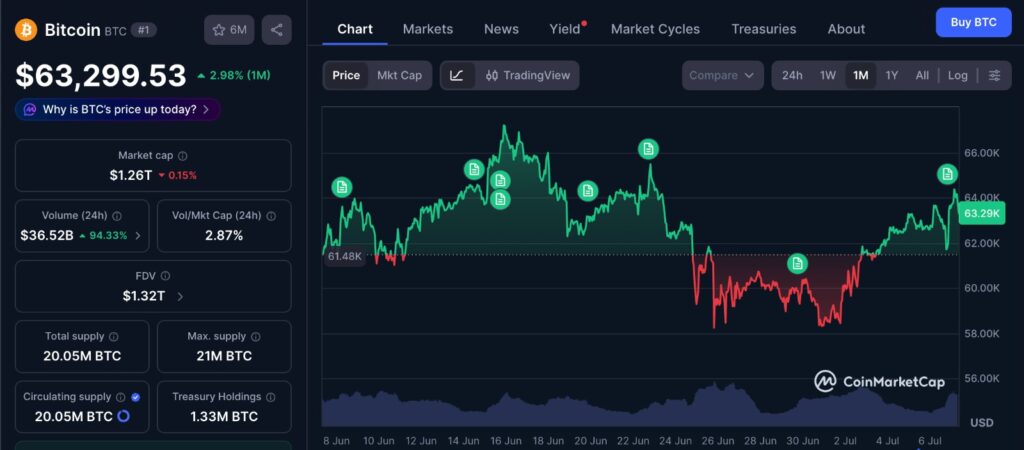
The 1-month Bitcoin chart from CoinMarketCap helps show why the recovery above the $64,000 area matters in context. BTC did not simply bounce in isolation. It reacted to Strategy’s reported $216 million sale, tested lower levels, and then moved back into a stronger range as buyers absorbed the pressure. The key point now is whether Bitcoin can hold this reclaimed area after the initial short-covering move fades. If price stays firm, it would suggest spot buyers are still taking supply. If the move weakens quickly, the rebound would remain more of a reaction than a confirmed demand shift.
Why The Rebound Above $64K Matters
Bitcoin’s move back above $64,000 came after a headline that could have damaged sentiment at a sensitive time. The market was already dealing with weaker momentum, ETF outflow concerns, and uncertainty around whether large holders would keep providing support.
A recovery after a major sale tells traders that buyers are still present. However, the quality of that buying matters more than the price level itself. That is why the rebound should also be viewed alongside the broader question of whether Bitcoin bull run demand is still lagging beneath the surface.
If the rebound was mostly driven by short covering, the move can fade once forced buying slows. If spot buyers continue to absorb supply, the recovery becomes more meaningful.
Markets do not recover because bad news disappears. They recover when sellers lose control of the next move.
That is the key point for Bitcoin now. Strategy’s sale gave the market a visible supply shock. The fact that BTC climbed after it suggests bearish pressure may have become crowded in the short term. But a lasting recovery still needs steady spot demand, not only futures traders rushing to close losing positions.
That is the mechanism behind the test: a sale can be absorbed by short covering at first, but the recovery only becomes durable if spot buyers keep taking supply after forced futures buying fades.
The strongest rebounds are not always the fastest ones. They are the ones that hold after forced buying fades.
Futures Helped The First Move
Bitcoin’s rebound should not be treated as clean confirmation of fresh demand yet.
The first leg of the move appears to have been helped by derivatives positioning. When traders lean too aggressively short after a bearish headline, even a modest price recovery can force short positions to close. That creates buying pressure, but it is not the same as long-term accumulation.
This matters because futures-led rebounds can move quickly, but they are often unstable if spot markets do not follow.
A healthier Bitcoin recovery would show several signs. Spot volumes would remain firm after the initial bounce. Price would hold above reclaimed levels instead of giving back the move during regular trading hours. Funding rates would avoid becoming overheated. Open interest would stop expanding faster than actual demand. That makes Bitcoin funding rates and cautious leverage important signals to watch, because a futures-led rebound can weaken if traders become too aggressive too quickly.
The mechanism is simple. Liquidity is not continuous. Once nearby sell orders are absorbed and short positions begin closing, price can move quickly to find the next area where sellers are willing to act.
That makes a futures-led bounce easier to trigger, but harder to sustain without real spot demand underneath it.
Without those signals, a futures-driven rebound can become another liquidity trap.
That is why the move above $64,000 should be viewed as an important improvement, but not a finished reversal.
Spot Buyers Need To Confirm The Move
The next test is simple. Bitcoin needs spot buyers to keep showing up.
If BTC holds above the recovery zone and continues building higher lows, the market can argue that Strategy’s sale was absorbed without lasting damage. That would be a stronger signal than the bounce itself because it would show that buyers are willing to defend price after the short-covering effect fades.
If Bitcoin quickly falls back toward the low-$60,000 area, the rebound will look more like a reaction trade than a demand shift.
This is where the current setup becomes important for traders. Bitcoin has already shown that one major sale did not automatically trigger panic. But the market still needs to prove that demand is strong enough to handle future supply from large holders, ETFs, or leveraged liquidations. That makes Bitcoin supply absorption the central issue, because the recovery only becomes stronger if buyers keep taking supply after the first reaction move fades.
Recent sessions have shown that BTC can still react sharply to treasury-related headlines, especially when leverage is already crowded. The difference now is that the market has also shown it can absorb one of those headlines without extending the sell-off.
That gives bulls room to rebuild the case, but it does not remove the need for confirmation.
Strategy Sale Changes The Treasury Narrative
The sale also changes how traders may look at corporate Bitcoin treasuries.
For years, Strategy was seen as a one-way buyer. That made its Bitcoin position psychologically important beyond the size of its holdings. When the company bought BTC, it supported the idea that corporate treasury demand could help absorb supply during downturns.
Strategy’s sale does not end the corporate treasury narrative, especially since the company still holds a very large Bitcoin position. But it does make the market price that narrative with more discipline.
The market now has to consider that corporate holders may not always be permanent buyers. They can still support demand, but they may also use BTC as a liquidity source when funding needs, dividends, debt costs, or shareholder pressure become more important.
Bitcoin’s reaction suggests traders are not treating Strategy’s sale as a full loss of confidence. But the event has changed the conversation. The Bitcoin treasury model is no longer being judged only by accumulation. It is also being judged by how companies behave when capital markets tighten or balance-sheet pressure rises.
In simple terms, the market is no longer only asking how much Bitcoin these firms can buy. It is also asking how much pressure they can absorb without becoming sellers.
Bitcoin Bulls Still Face A Crowded Leverage Risk
The main risk now is that leverage remains crowded.
If traders chase the recovery too aggressively, the market can become vulnerable again. A move that begins with short liquidations can quickly turn into excessive long positioning if traders assume the rebound is already confirmed. That can create a fresh liquidation zone below price.
This is why Bitcoin needs a slower and more balanced recovery.
The stronger bullish case would be a steady hold above the reclaimed zone, moderate leverage, and continued spot accumulation. The weaker case would be a fast move higher led by futures, followed by a failure to hold support once momentum slows.
For now, Bitcoin’s recovery above $64,000 is constructive because it shows absorption. But absorption is only the first stage. Confirmation comes when buyers keep defending the move after the headline has passed.
Editor’s View
Bitcoin’s reaction to Strategy’s $216 million BTC sale was more important than the sale itself.
The market had a reason to break lower. A major corporate holder sold Bitcoin, sentiment was already fragile, and traders had enough reason to price in more downside. Instead, BTC recovered above $64,000, showing that buyers were still willing to absorb supply.
That is meaningful, but it should not be overstated. This is resilience, not full confirmation.
The stronger signal now would be continued spot demand after short-covering pressure fades. Until then, Bitcoin has shown that it can absorb the first wave of supply, but not yet that the recovery is fully secure.
The move does not begin when sellers disappear. It begins when buyers absorb supply and force the market to search higher for the next willing seller. Strategy’s sale created the test; spot demand will decide whether the reclaimed level becomes structure or just another reaction move.
Disclaimer: This content is for informational purposes only and does not constitute financial advice.
Keep yourself updated with the latest crypto news with FYI Gazette
 Bitcoin
  Ethereum
  Tether
  BNB
BNB  XRP
XRP  Solana
  TRON
TRON  Dogecoin
  Litecoin
  Pepe
Pepe