Zcash Price Surges as Privacy Coins Return to Crypto Market Focus
Zcash price action has moved sharply back into focus after ZEC posted one of the strongest weekly rallies among major privacy-focused crypto assets. The move has attracted attention because it is not only about short-term momentum. It also reflects a broader market conversation around financial privacy, artificial intelligence, surveillance, and how transparent blockchains may be used in the future.
ZEC recently climbed from around $346 on May 1 to a seven-day high near $593.86, before holding near the upper end of that move. The rally placed Zcash back in front of traders who had largely ignored privacy coins while Bitcoin, Ethereum, and higher-liquidity altcoins dominated market attention.
That does not mean Zcash has entered a clean long-term repricing phase.
However, it does show that privacy is becoming harder for the market to ignore. In crypto, narratives often return before fundamentals are fully priced in. Zcash’s latest move suggests traders are beginning to treat privacy not only as an old crypto theme, but as a newer response to AI-driven data tracking and rising concerns around financial visibility.
Recent sessions have shown how quickly attention can return to a sector when price strength, narrative interest, and trader positioning begin to align.
Zcash Price Rally Shows Privacy Coins Are Back in Rotation
The latest Zcash price rally appears to be part of a broader rotation into privacy-focused crypto assets. Traders often move into specific sectors when a theme gains attention, and privacy coins have become one of the clearer examples of that behavior in recent sessions.
Zcash is built around the idea that users should be able to transact with stronger confidentiality than traditional public blockchains allow. While many crypto networks display wallet balances and transaction histories openly, Zcash allows shielded transactions that can hide sensitive details.
That distinction matters more now than it did during earlier crypto cycles.
The market is becoming more aware that public blockchains are not automatically private. A wallet address may not show a real-world name at first, but once it is connected to an exchange account, business wallet, NFT profile, or public transaction history, visibility can increase quickly.
This is where the Zcash price rally becomes more than a simple altcoin move. It reflects a growing debate over whether crypto users, funds, institutions, and businesses will need stronger privacy tools as blockchain analytics, AI systems, and compliance monitoring become more advanced.
Markets do not rotate only because a token is rising. They rotate when a theme starts answering a problem traders believe will matter later.
AI and Surveillance Concerns Add Fuel to the Privacy Narrative
One reason privacy coins are gaining attention again is the rapid growth of AI-powered data analysis. Public blockchain data has always been transparent, but artificial intelligence can make that data easier to organize, connect, and interpret at scale.
That changes the way traders think about privacy.
In the past, on-chain visibility was often seen as a feature because it allowed anyone to verify transfers, supply flows, and wallet behavior. That transparency still matters. But the same visibility can become a risk when large amounts of financial data are continuously scanned, labeled, and linked across platforms.
For ordinary users, this may raise concerns about personal financial exposure. For companies, it may raise concerns about treasury movements, supplier payments, trading activity, or strategic transactions becoming visible before the market is meant to read them.
This is why privacy is starting to look less like a niche crypto feature and more like financial infrastructure.
The reason this matters structurally is simple. When information becomes easier to extract, controlling what remains visible becomes more valuable. Wallet flows, large transfers, and repeated transaction patterns can influence how other participants position themselves.
If AI makes blockchain activity easier to read, privacy tools may become more important for users who do not want every transaction to become a signal for someone else.
The market is not only asking whether privacy coins can rally. It is asking whether privacy itself becomes more valuable as the internet becomes more automated, searchable, and surveillance-heavy.
Zcash Is Benefiting From a Wider Privacy Shift
Zcash is not moving in isolation. The broader crypto industry has started to introduce more privacy-focused tools across different ecosystems.
Polygon recently introduced private stablecoin payments that allow users to send stablecoins without publishing the sender, receiver, or transaction amount on-chain. Aptos has also moved forward with Confidential APT, a privacy-focused feature designed to conceal balances and transfer amounts while still keeping certain transaction elements visible.
These developments matter because they show that privacy is no longer only a legacy privacy coin topic. It is spreading into payments, stablecoins, enterprise use cases, and newer blockchain infrastructure.
That gives the Zcash price rally more context.
If privacy tools are being added across major ecosystems, Zcash may be benefiting from a larger market revaluation of the privacy sector. Traders are not only buying a chart. They are reacting to a theme that appears to be gaining fresh relevance across multiple parts of crypto.
This is how sector rotations often begin. Capital first moves toward the most recognizable asset in a theme, then spreads into related names if the narrative keeps building. Zcash has become one of the clearest assets for traders to use when expressing interest in privacy, which helps explain why its move became so visible.
Still, there is an important difference between a strong narrative and lasting demand. That same gap between price strength and deeper buyer support has also appeared in Bitcoin, where bull run demand has lagged behind market optimism during key phases of the cycle.
A strong narrative can push price quickly. Lasting demand requires continued usage, liquidity, developer activity, exchange access, and broader confidence that privacy assets can remain relevant despite regulatory pressure.
Why the Zcash Price Move Still Needs Caution
The Zcash price move is impressive, but sharp rallies can also create risk. When an asset climbs quickly in a short period, part of the move may come from momentum traders rather than long-term buyers.
That matters because privacy coins often trade with thinner liquidity compared with larger crypto assets. When liquidity is thinner, price can move faster in both directions. A strong rally can attract buyers quickly, but profit-taking can also become aggressive if momentum slows.
Thin liquidity does not only make rallies faster. It makes execution more fragile. If buyers chase price into a shallow order book, even moderate selling can create a sharp reaction once demand pauses. Sharp moves can unwind quickly when positioning becomes crowded, as seen when crypto liquidations surged across Bitcoin positions during a recent leverage reset.
Liquidity is not continuous. Once nearby orders are absorbed, price must move to find the next available interest, which is why crowded moves can stretch further than expected and reverse faster than expected.
That is why the current ZEC move should not be treated as automatic confirmation of a long-term trend.
The better question is whether Zcash can hold investor attention after the first wave of excitement fades. If the rally is mainly driven by social media interest and sector rotation, the move may become unstable. If privacy continues to grow as a serious crypto theme, ZEC may remain part of a larger market discussion.
A similar issue has appeared in Ethereum, where price rallies have faded when network demand failed to strengthen alongside the move.
Price can rise on attention, but structure is tested when attention cools.
The difference between those outcomes will likely depend on whether buyers continue to view privacy as a necessity rather than a short-term trade.
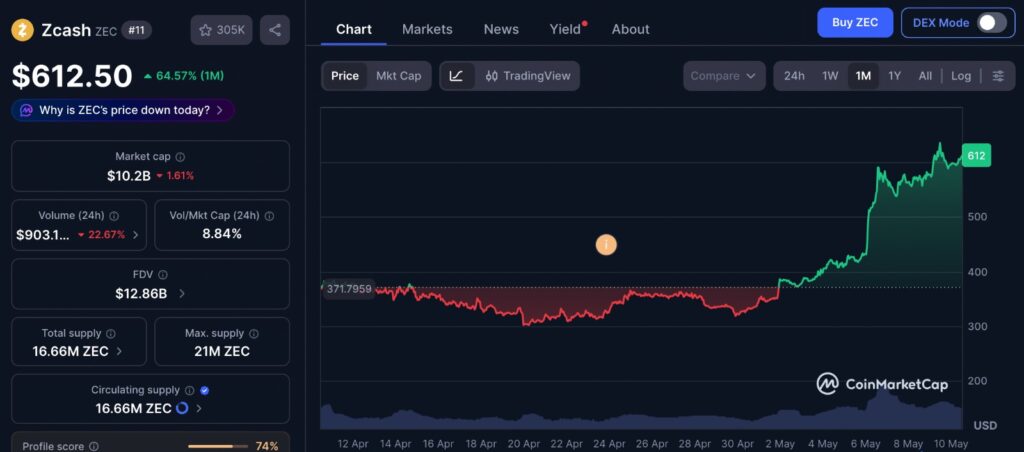
Over the past month, Zcash price action has shifted from a quiet market structure into a much stronger momentum phase. The latest rally shows how quickly capital can rotate into privacy-focused assets when a clear narrative returns. However, the chart should be read carefully because vertical moves often include both genuine demand and short-term speculation. For ZEC, the key signal now is not only how high price moved, but whether it can hold a stronger range after the surge.
Editor’s View: Privacy Is Becoming a Market Question Again
The most important part of this Zcash price rally is not the percentage gain alone. It is the reason traders are paying attention again.
Crypto has spent years promoting transparency as a strength. Open ledgers help verify supply, track flows, and reduce the need for blind trust. But full transparency also creates a problem. Financial behavior becomes easier to monitor, map, and interpret.
That is where privacy coins regain relevance.
Zcash is benefiting because the market is starting to recognize a simple tension. Users want transparent systems they can verify, but they may not want every financial action permanently exposed to the public internet.
This tension is unlikely to disappear. If anything, AI could make it more important.
What makes this moment interesting is that privacy is no longer only being discussed as ideology. It is becoming a practical market question. If wallets, flows, and balances can be analyzed more efficiently, some users may start valuing privacy as protection rather than preference.
That does not guarantee lasting demand for ZEC. But it does explain why traders are willing to pay attention again.
How This Affects the Global Crypto Market
The Zcash price surge could influence the wider crypto market by pushing privacy back into the center of sector rotation. If traders continue to reward privacy-focused assets, other projects with confidentiality features may receive more attention.
This could also affect how investors view blockchain infrastructure. Instead of treating privacy as a separate category, the market may begin to expect privacy tools inside payments, stablecoins, DeFi, and institutional settlement products.
That would be a meaningful shift.
For now, Bitcoin and Ethereum still dominate broader liquidity. But privacy coins can act as an early signal of what smaller sectors are starting to value. When capital rotates into a theme like privacy, it often shows that traders are looking beyond simple price charts and searching for narratives that match real-world concerns.
This matters because broader sentiment has remained uneven, with the Crypto Fear and Greed Index staying neutral near Bitcoin’s $80K zone even as smaller narratives begin attracting capital.
Zcash has become one of the clearest examples of that shift.
If this theme continues, the impact may not be limited to privacy coins alone. It could influence how newer networks design payment tools, how stablecoin systems handle confidentiality, and how investors judge the next wave of blockchain infrastructure.
Final Thoughts
Zcash price strength shows that privacy coins are no longer being treated as a forgotten corner of the crypto market. The rally has been helped by sector rotation, AI surveillance concerns, and a broader industry push toward confidential transactions.
Still, the next phase matters more than the first move.
If ZEC holds attention after the initial rally, the market may start viewing privacy as a serious 2026 crypto theme. If momentum fades quickly, the move may look more like a short-term rotation than a structural shift.
For now, Zcash has reminded traders that privacy still has a place in crypto. The move becomes meaningful if privacy stops being a narrative trade and starts being treated as a market need.
Disclaimer: This content is for informational purposes only and does not constitute financial advice.
Read more about Memecoins with FYI Gazette
Keep yourself updated with the latest Altcoin News with FYI Gazette
 Bitcoin
  Ethereum
  Tether
  BNB
BNB  XRP
XRP  Solana
  TRON
TRON  Dogecoin
  Litecoin
  Pepe
Pepe