

Bitcoin Nasdaq Weakness Tests BTC Decoupling As $60K Support Holds
Bitcoin Nasdaq weakness is becoming one of the clearest tests for BTC after its latest rebound from the $60,000 region.
Bitcoin has spent much of the recent cycle trading like a high-beta risk asset. When liquidity improves, tech stocks and crypto often rise together. When equity markets weaken, Bitcoin is usually expected to feel the same pressure, often with greater volatility.
That relationship is now being tested again.
BTC recently recovered from a local low near $59,100 to an intraday high around $62,950, even as the Nasdaq suffered a sharp decline. The move raised a bigger question than whether Bitcoin can produce a short-term bounce.
The real question is whether Bitcoin still follows tech-led risk appetite, or whether the market is beginning to treat BTC differently while equity momentum cools.
That distinction matters because Bitcoin does not need to fully decouple from tech stocks to show strength. It only needs to absorb selling better than the Nasdaq when macro pressure rises.
Recent sessions have shown that Bitcoin is no longer being judged only by its own chart. Traders are now watching whether BTC can hold structure while one of the market’s biggest risk benchmarks weakens.
Why Bitcoin Holding $60K Matters Now
The $60,000 area is not just a round number. It has become a psychological line for traders watching whether Bitcoin’s latest decline is a breakdown or a stress test.
It is also structurally important because it sits close to Bitcoin’s long-term support zone. That makes the area more than a headline level. It is where sentiment, positioning, and long-term market structure meet.
BTC’s recovery from below that zone suggests sellers have not yet forced a full loss of structure. However, the rebound does not confirm strength by itself. A support level only matters if buyers continue absorbing supply after the first reaction.
That is why the 200-week simple moving average has become central to the current setup. This also connects with the broader Bitcoin 200-week SMA support test, where long-term structure becomes more important than short-term volatility. Bitcoin holding above its long-term moving average near the low-$60,000 range gives bulls a clear structure to defend.
Historically, the 200-week SMA has marked important long-term support zones during previous market cycles. That does not mean it must produce the same result again. It means traders are likely to treat a sustained hold above it as a sign that Bitcoin’s broader cycle structure remains intact.
This matters because widely watched levels attract both sides of the market. Buyers look for value near long-term support, while sellers look for a clean break to confirm weakness. The next move depends on which side finds enough liquidity to execute.
The real test is not whether price touched support. It is whether sellers can still find enough liquidity to push through it. That makes the recent Bitcoin liquidation reset important because forced selling often reveals whether support is backed by real demand or only short-term relief. If BTC keeps defending that area, the market may begin viewing the recent dip below $60,000 as a shakeout rather than a confirmed trend failure.
If it loses that area cleanly, the conversation changes. At that point, Bitcoin would no longer be showing resilience against equity weakness. It would be confirming that macro risk is still in control.
Bitcoin Price Chart Shows the Test
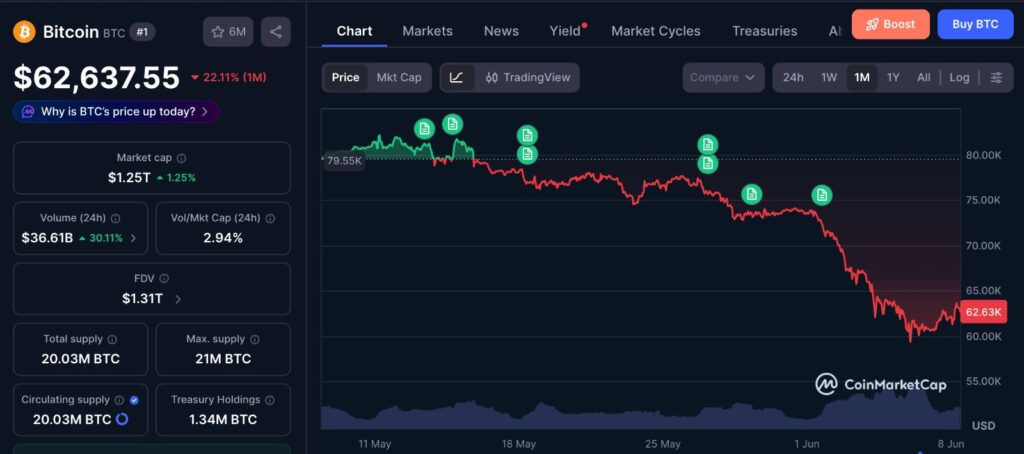
The 1-month Bitcoin chart shows why the $60,000 region has become important in the current setup. BTC’s rebound from the recent low shows that buyers have stepped in near long-term support, but the chart also makes clear that the recovery is still being tested. The key point is not simply that Bitcoin bounced. It is whether BTC can keep holding above this area while Nasdaq weakness continues to pressure risk assets. If the chart shows Bitcoin absorbing selling better than tech stocks, it strengthens the relative-strength argument. If the rebound fades quickly, it would suggest BTC is still moving with broader risk sentiment.
Nasdaq Weakness Makes This Test More Important
The Nasdaq’s sharp decline adds pressure to the Bitcoin setup because it challenges the idea that BTC can hold firm while growth and tech stocks cool.
For much of the past few years, Bitcoin has traded alongside high-duration risk assets. When investors want exposure to liquidity-driven upside, BTC benefits. When they reduce exposure to volatile growth assets, Bitcoin often becomes part of the same selling basket.
That is why the latest Nasdaq weakness matters.
If the Nasdaq continues falling toward its own key moving-average support, Bitcoin will face a harder demand test. Traders will be watching whether BTC can remain stable while equity risk cools, or whether the Nasdaq decline eventually pulls crypto lower.
If Bitcoin holds firm while the Nasdaq weakens, it would suggest BTC demand is not only being driven by the same macro trade that supports tech stocks. It would also show that crypto-specific buyers are willing to step in while broader risk appetite remains under pressure.
If Bitcoin fails while the Nasdaq continues lower, then BTC would still look like a leveraged version of the same risk trade.
This is where liquidity behavior matters. When equity markets fall quickly, many traders reduce risk across portfolios at the same time. Bitcoin can then become a source of cash, even if its own setup has not changed much.
Liquidity is not continuous. Once nearby bids are absorbed, price must move lower to find the next layer of buyers willing to take the other side.
Markets do not break because support is visible. They break when sellers need execution and buyers step back.
Is Bitcoin Starting To Decouple From Tech Stocks?
The word “decoupling” is often overused in crypto. Bitcoin does not need to completely disconnect from equities to show relative strength.
A more realistic version of decoupling is simpler: BTC falls less aggressively than tech stocks during risk-off moves, then recovers faster when pressure eases.
That is how relative strength starts: not by Bitcoin ignoring macro pressure completely, but by absorbing selling better than the assets it usually follows.
Bitcoin’s ratio against the Nasdaq has reportedly reached an extreme oversold zone, which suggests BTC has become unusually weak relative to the tech-heavy index. In past cases, similar oversold conditions have sometimes preceded strong Bitcoin rebounds.
Still, an oversold signal is not confirmation. It only shows that positioning has become stretched. For the signal to matter, buyers need to turn that stretched setup into actual demand. That is why earlier signs of Bitcoin demand weakness remain relevant, because relative strength only matters if buyers continue absorbing supply during macro pressure.
When a ratio becomes deeply oversold, it can mean two different things. It can signal that sellers have gone too far, too fast. Or it can show that one asset is being repriced lower because investors no longer want the same level of risk exposure.
That is why the next reaction matters more than the signal itself.
If BTC holds above its long-term support while the Nasdaq continues to correct, traders may begin treating Bitcoin as stronger relative to equity risk. That could support a mean-reversion setup, especially if short-term sellers become exhausted.
However, if the Nasdaq decline deepens and Bitcoin fails to hold support, the oversold ratio may simply show that BTC was weaker for a reason.
Bitcoin does not decouple because analysts say it should. It decouples when real buyers absorb selling while other risk assets remain under pressure.
Why The $92K Level Is Being Watched
Some traders are now watching whether Bitcoin can eventually mean-revert toward its 50-week simple moving average, which sits much higher than current prices.
That level has been discussed as a possible upside area if BTC continues defending its 200-week SMA and avoids a deeper breakdown.
However, it should not be treated as a direct target. Bitcoin cannot move toward higher moving-average levels simply because support has held once. The path would require improving demand, reduced forced selling, stronger spot absorption, and a broader shift in market confidence.
The cleaner way to frame it is this: holding the 200-week SMA keeps the recovery scenario alive. Losing it weakens that scenario.
That framing is more useful than treating any single moving average as a guaranteed destination.
BTC’s current setup is not about whether one chart level can create a bull market. It is about whether long-term buyers are still willing to defend the asset when macro conditions are not friendly.
A higher level only becomes relevant after the market proves that lower levels are no longer attracting aggressive selling.
What This Means For The Global Crypto Market
Bitcoin’s reaction to Nasdaq weakness matters far beyond BTC.
If Bitcoin continues to hold firm while tech stocks correct, it could improve confidence across the wider crypto market. Altcoins, DeFi tokens, and high-beta crypto assets often depend on Bitcoin stability before traders are willing to take more risk.
A resilient BTC would not automatically trigger an altcoin recovery, but it would reduce pressure on the broader market. It would tell traders that Bitcoin is not being dragged lower simply because equity risk is weakening.
On the other hand, if BTC loses its long-term support while the Nasdaq continues falling, the effect could spread quickly. In that case, traders may reduce exposure across crypto, not because every token has a weak setup, but because Bitcoin would have failed its macro resilience test.
That is how broad crypto weakness often develops. It does not always begin with bad news across every sector. It begins when the market’s main liquidity anchor stops holding.
In crypto, Bitcoin is still the market’s main confidence anchor. When BTC holds structure, risk appetite can rebuild. When BTC loses structure, liquidity usually becomes more defensive.
Editor’s View
Bitcoin’s current setup is not only a price chart story. It is a market identity test.
For years, BTC has been described as digital gold, a liquidity asset, a risk asset, and a hedge depending on the market cycle. Right now, the market is asking a simpler question: when the Nasdaq weakens, does Bitcoin still get sold like tech, or can it hold better than the assets it usually follows?
That answer will not come from one green candle.
It will come from whether BTC can keep defending the $60,000 region, stay above its long-term moving-average support, and attract buyers while equity markets remain under pressure.
This is what makes the current setup important. Bitcoin does not need to prove complete independence from equities. It only needs to prove that sellers cannot force the same downside reaction traders expect from a high-beta tech proxy.
If that happens, Bitcoin Nasdaq weakness could become a relative-strength story rather than another macro warning sign.
If it does not, the market will likely treat the latest rebound as temporary relief inside a broader risk-off reset.
For now, Bitcoin has not proven full decoupling. It has only created the first condition that makes the question worth asking: it held its ground while the Nasdaq started to crack.
The move does not begin when Bitcoin looks different from tech on paper. It begins when sellers test that link and fail to pull BTC into the same risk-off path.
Disclaimer: This content is for informational purposes only and does not constitute financial advice.
Keep yourself updated with the latest crypto news with FYI Gazette
 Bitcoin
  Ethereum
  Tether
  BNB
BNB  XRP
XRP  Solana
  TRON
TRON  Dogecoin
  Litecoin
  Pepe
Pepe