

Bitcoin Break Below $60K Puts $54K Confluence Zone in Focus
Bitcoin’s break below $60,000 has changed the market conversation. The question is no longer only whether the old floor can hold. It is where real demand is willing to appear next.
After slipping toward the $58,000 area, BTC erased much of its recent June advance and pushed traders back into a defensive setup. The move matters because $60,000 was not only a round number. It was the level that helped define whether buyers still had enough strength to defend the broader range.
Now that level has failed, attention is shifting lower.
The clearest area in focus is near $54,000, where several signals are beginning to point toward the same downside zone. Technical breakdown targets and on-chain pricing bands do not always align this cleanly. When they do, the level becomes harder to ignore because different market participants start watching the same area for confirmation, defense, or capitulation risk.
That does not mean Bitcoin must fall straight to $54,000. It means rebounds may now be judged less by their size and more by whether they can reclaim lost structure.
Bitcoin Loses $60K as Downside Structure Builds
Bitcoin’s move below $60,000 came as risk appetite weakened across broader markets, with pressure in major technology stocks adding to an already fragile crypto backdrop. For BTC, the timing was important because the decline did not come from a position of strength. It arrived after momentum had already started to fade.
The break also confirmed a weaker short-term structure. Buyers had gradually lost control, with upward pressure fading into lower highs before support finally gave way.
That matters because it reflects exhaustion rather than one sudden liquidation event. Bitcoin did not only drop because sellers appeared. It dropped because buyers stopped absorbing supply at the same level. A previous Bitcoin liquidation reset near the $60K support area already showed how quickly leverage can turn a support test into a broader structure problem when buyers fail to absorb selling pressure.
This is how support usually fails. First, bids absorb pressure. Then each bounce gets weaker. Eventually, sellers do not need to become much more aggressive because buyers are no longer stepping in with the same urgency.
That is the mechanism behind the shift: once buyers stop defending the old floor, sellers do not need to force price lower as aggressively because the market starts waiting for the next accepted demand zone.
According to analysts, the rounded-top structure points toward a measured target near the region just below $54,000. The exact figure matters less than the change in behavior. Bitcoin has moved from defending a visible support level to testing whether lower demand zones are strong enough to slow the decline.
Support does not fail all at once. It weakens when buyers start waiting lower and sellers no longer have to chase price down.
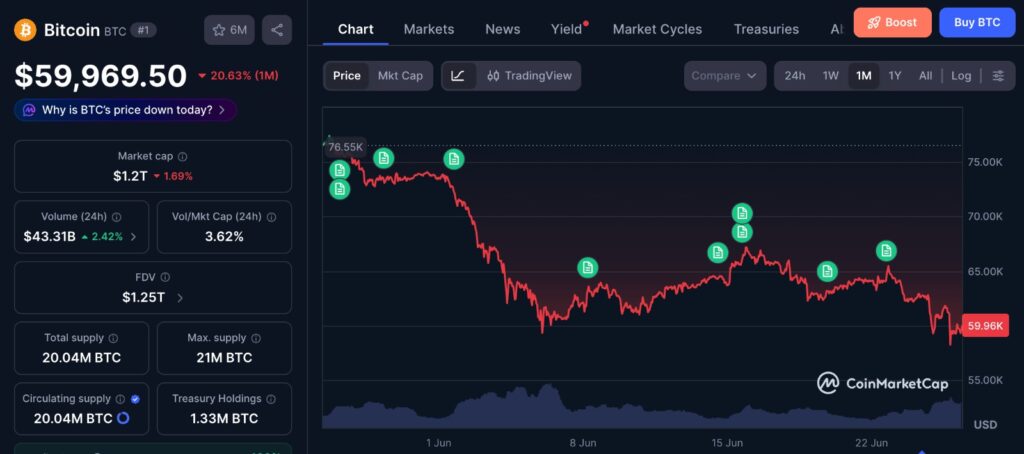
The 1-month Bitcoin chart shows how BTC lost the $60,000 area after momentum weakened, shifting attention toward the next lower demand zone. The key point is not only that support failed, but how rebounds behave after the break. If buyers can reclaim the former floor with strength, the immediate $54K risk would ease. If rebounds keep fading below $60,000, the $54K confluence zone remains the main area traders are likely to watch.
Why The $54K Area Is Getting More Attention
The $54,000 region is important because it is not coming from only one chart setup.
A daily bear flag breakdown is also pointing toward a similar zone. Instead of treating that pattern as a textbook signal, the more useful point is what it shows about positioning. After a sharp move lower, Bitcoin paused, but buyers were unable to rebuild enough pressure to recover lost ground.
For Bitcoin, that weak pause keeps the downside structure focused near $54,000.
This creates a confluence zone, where different forms of analysis begin to overlap. One signal alone can fail. Multiple signals pointing toward the same area can increase market attention because more traders begin to treat that zone as a decision point.
That matters for execution. Short-term sellers may look at the area as a profit-taking zone. Dip buyers may wait for lower prices instead of buying early. Leveraged traders may also reduce exposure before price reaches it, especially if failed rebounds keep confirming weakness. That weaker follow-through also fits the broader Bitcoin demand lag seen in recent market structure, where price rebounds have struggled to turn into sustained buyer control.
Liquidity is not continuous. Once nearby orders are absorbed, price often has to move toward the next area where buyers are actually willing to step in.
This is why the break below $60,000 matters more than the headline number. Once BTC lost that level, the market started looking for the next area where sellers may take profit, buyers may step in, and leveraged positioning may reset.
Markets do not move when a line breaks. They move when enough participants change behavior around that line.
On-Chain Bands Also Point Toward The Same Zone
The technical picture is only one side of the story. On-chain pricing bands are also adding weight to the $54,000 area.
Bitcoin’s MVRV pricing bands compare market price with realized price, which reflects the average price at which coins last moved on-chain. In simple terms, these bands help show whether Bitcoin is trading far above its average cost basis, near a neutral zone, or under deeper stress.
The 1.0 MVRV band was recently estimated near $53,390, placing it close to the same region suggested by the technical breakdown targets. That makes the $53,000 to $54,000 area more important than a normal chart level because it also sits near an on-chain valuation zone watched by longer-term market analysts.
This is where Bitcoin’s next test becomes more serious.
If BTC reaches that region, the question will not simply be whether price touches $54,000. The question will be whether buyers treat that area as value, or whether selling pressure continues through it without meaningful absorption.
A clean defense could help stabilize sentiment. A weak reaction could make traders look toward deeper on-chain bands.
The reaction matters more than the tag. Strong markets do not just reach support. They show demand when support is tested.
A Deeper Breakdown Would Shift Focus Toward Capitulation Risk
If Bitcoin fails to respond near the $54,000 confluence zone, the next phase of analysis becomes more uncomfortable.
The lower 0.8 MVRV band was recently estimated near $42,700. Historically, that lower band has been associated with more severe bear-market stress, where unrealized losses become larger and capitulation risk rises. That makes Bitcoin realized losses an important stress signal to watch if the $54K area fails without meaningful absorption.
That does not make $42,700 a second price target. It shows why the $54,000 area carries weight. Deeper bands only become relevant if Bitcoin cannot attract demand near the first major overlap between technical pressure and on-chain value.
This is where market psychology can change quickly. Above $60,000, the debate was about support. Below $60,000, the debate becomes whether the market is only correcting or entering a deeper repricing phase.
The difference is important. A correction usually finds buyers before confidence fully breaks. A deeper repricing happens when buyers keep waiting for lower levels because they no longer trust the first support zone.
For now, $54,000 remains the cleaner test because it sits where short-term technical pressure and on-chain valuation support begin to meet.
Bitcoin Needs Reclaim Strength, Not Just A Bounce
A short-term bounce from the $58,000 area would not be enough by itself to repair the structure.
Bitcoin now needs to show that buyers can reclaim lost levels and hold them. Any rebound toward $60,000 will matter because failed support can turn into resistance. If BTC cannot recover that area with strength, traders may treat the move as a relief bounce inside a weaker trend. That is why cautious Bitcoin funding rates matter here, because leverage that does not expand with conviction can leave rebounds exposed to faster fades.
Recent sessions have shown that Bitcoin is still highly sensitive to broader risk conditions. Weakness in major equity markets, pressure on risk assets, and fading crypto momentum have made support zones less reliable when liquidity thins.
Over the past week, the stronger signal has not been the size of each bounce, but the lack of follow-through after buyers step in. That is what keeps attention on whether demand can return above lost support, rather than only appear lower.
A strong reclaim of $60,000 would weaken the immediate bearish case. A failed bounce below that level would keep the $54,000 confluence zone in focus.
Bitcoin is not only testing price support now. It is testing whether demand is strong enough to absorb a market that has already lost its most visible short-term floor.
Editor’s View
The $54,000 zone matters because it is no longer just a chart target. It is where technical breakdown projections and on-chain pricing bands begin to overlap.
That kind of confluence can become a magnet during weak markets because traders, analysts, and longer-term holders start watching the same area for different reasons. Short-term traders may see it as a measured move target. On-chain analysts may see it as a valuation reset. Dip buyers may see it as the first major area where risk reward begins to improve.
The real signal will come from the reaction.
If Bitcoin reaches that zone and buyers absorb supply quickly, the market may treat the move as a deeper correction within a broader range. If the level fails without a strong response, the conversation could shift from a normal pullback to a more serious repricing phase.
For now, the market has moved past the question of whether $60,000 can hold. The next test is whether buyers can defend the first zone where technical pressure and on-chain value begin to meet.
A price target is only a reference point. A confluence zone is only an area of interest. The real confirmation comes when the market shows enough demand to absorb selling where it matters.
Disclaimer: This content is for informational purposes only and does not constitute financial advice.
Keep yourself updated with the latest crypto news with FYI Gazette
 Bitcoin
  Ethereum
  Tether
  BNB
BNB  XRP
XRP  Solana
  TRON
TRON  Dogecoin
  Litecoin
  Pepe
Pepe