

Crypto Q3 Setup Shows Less Leverage but Weaker Liquidity Absorption
Crypto enters the third quarter with a cleaner market structure, but not necessarily a safer one.
After a difficult second quarter marked by forced liquidations, ETF outflows, weaker spot demand, and thinner order books, the market now looks less crowded than it did earlier in the year. That lowers the risk of another sharp leverage-driven cascade. However, it also creates a different problem.
There may be fewer leveraged positions left to unwind, but there is also less liquidity available to absorb large trades.
That is the main tension facing Bitcoin, Ether, and the broader crypto market as Q3 begins. According to Talos market data cited in the report, Bitcoin and Ether long liquidations totaled $8.35 billion during Q2, helping clear out speculative positioning. Bitcoin open interest fell to $33.5 billion, down 32% from its Q2 peak, while Ether open interest dropped to $16.2 billion, a 40% decline.
At first glance, that reset can look constructive. When open interest falls sharply, fewer crowded long positions usually remain in the market. This can reduce the risk of falling prices forcing leveraged traders to close positions, adding more sell pressure.
However, the same reset does not automatically create strong demand.
A cleaner market can still fall if buyers are not deep enough, and that is where the Q3 setup becomes more complicated.
Crypto Q3 Liquidity Looks Thinner After Deleveraging
The key issue is not only how much leverage has left the market. It is also how much liquidity remains behind.
Talos reported that Bitcoin’s 2% order-book depth fell to roughly $35 million to $40 million by late June, down from about $70 million in early May. Spot exchange volume also declined 28% quarter-over-quarter to $2.32 trillion.
This matters because order-book depth shows how much buy and sell interest exists near the current market price. When depth is strong, large trades can be absorbed with less price movement. When depth weakens, the same amount of selling can push price further. This is similar to the earlier Bitcoin order-book depth test, where the market’s ability to hold structure depended less on the headline price level and more on whether bids were deep enough to absorb selling.
That is the mechanism behind the Q3 risk: deleveraging reduces forced selling pressure, but thinner liquidity means new selling can still move price quickly if real buyers are not waiting nearby.
In a deep market, sellers can exit without forcing price too far away from the last traded level. In a thin market, the exit itself becomes the pressure. Liquidity is not continuous. Once nearby orders are absorbed, price has to move to find the next available buyer.
CMC Chart Analysis
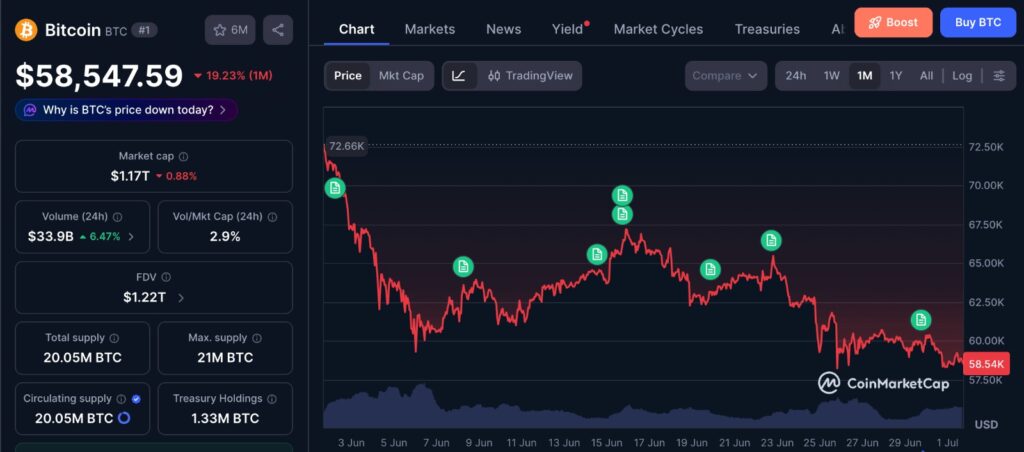
The 1-month Bitcoin chart shows why liquidity matters more than the headline leverage reset alone. BTC’s recent price action should be read through the lens of absorption: whether buyers can keep price stable after Q2’s liquidations, weaker ETF flows, and thinner order books. If Bitcoin holds firm despite softer volume, it suggests demand is still present near spot levels. If price reacts sharply to fresh selling, it would show that lower leverage has not fully solved the market’s liquidity problem.
Bitcoin and Ether Face a Different Type of Q3 Test
For Bitcoin, the Q3 test is now less about whether excessive leverage can be flushed out and more about whether real demand can return.
During Q2, ETF outflows added pressure to that demand picture. US spot Bitcoin ETFs recorded $696.3 million in net outflows on June 25, while June outflows reached about $4.5 billion, pushing year-to-date outflows to around $5.5 billion, according to the report. That pressure builds on a broader Bitcoin ETF outflows trend, where weakening fund demand made it harder for spot buyers to offset selling pressure.
That does not mean ETF demand has disappeared permanently. However, it shows that institutional flows became less supportive during the quarter. When ETF demand weakens while order-book depth declines, the market has less cushion against selling pressure. That makes Bitcoin demand weakness a central issue for Q3, because lower leverage only helps if real buyers return to absorb supply.
This is important because Bitcoin’s role in this cycle has been tied to institutional access, ETF flows, and balance-sheet demand. If those flows slow, the market needs other buyers to step in.
Strategy’s Bitcoin purchases also slowed in June. According to the report, the company bought roughly 3,600 BTC during the month, compared with about 25,000 BTC in May and more than 50,000 BTC in April. It also reportedly recorded a small net sale of 32 BTC earlier in June.
That does not erase its long-term Bitcoin position. However, slower buying removes one visible demand signal that traders had relied on earlier in the year.
For Ether, the issue is similar but not identical. The drop in Ether open interest shows that speculative exposure has cooled. That can help reduce forced selling risk. But ETH still needs stronger spot demand, healthier network-related flows, and better market depth to turn a leverage reset into a durable recovery. That makes the recent Ether leverage reset important, but not enough on its own unless ETH also sees stronger demand and cleaner liquidity conditions.
A lower open interest reading can stop the market from being too crowded. It cannot, by itself, create buyers.
That is the difference between a reset and a recovery. A reset clears pressure. A recovery requires fresh demand to replace it.
Why Thin Liquidity Can Make Q3 Volatile
The danger of thinner liquidity is that price can move faster than the market’s headline data suggests.
When leverage is high, the main concern is liquidation risk. A sharp move lower can trigger forced selling, which can then trigger more forced selling. That creates a visible cascade.
When liquidity is thin, the risk is different. The market may not need a massive liquidation event to move sharply. A large sell order, weak ETF flow day, macro shock, or sudden risk-off move can have a bigger impact because fewer resting bids are available near spot price.
The reason this happens is simple. When volatility rises, liquidity providers often become more cautious. Instead of placing deeper bids, they may pull orders back or quote at wider levels, leaving fewer buyers exactly when selling pressure needs to be absorbed.
That means Q3 could still produce sharp moves even without the same level of leverage that existed earlier in the year.
This is why the current setup should not be read as fully bullish or fully bearish. It is more balanced than that.
The constructive side is that the market has already cleared a large amount of speculative excess. With fewer crowded long positions, downside moves may be less likely to turn into uncontrolled liquidation spirals.
The risk is that liquidity has weakened. If new selling appears, the market may still struggle to absorb it cleanly.
Both can be true at the same time.
Crypto may be cleaner than it was in Q2, but cleaner does not mean stronger.
Thin liquidity does not always create direction, but it can make direction sharper once real flow appears.
The Real Q3 Question Is Absorption
The most important word for Q3 may be absorption.
If Bitcoin and Ether can absorb selling without breaking sharply lower, the leverage reset could help rebuild confidence. That would show that the market is no longer being held together only by speculative positioning.
However, if even moderate selling creates outsized price moves, it would suggest that the market remains fragile despite lower open interest.
That is why traders may focus less on headline liquidation numbers and more on how price reacts to flow. ETF activity, spot volume, stablecoin liquidity, and order-book depth may matter more than broad sentiment alone.
Recent sessions have shown that crypto can look calmer after leverage resets, but calm conditions matter only if buyers remain present when pressure returns.
For now, Q3 begins with a mixed structure.
The market has less leverage, which lowers one major risk. But it also has thinner liquidity, weaker trading volume, and less visible demand support than earlier in the year. That combination makes the next phase more dependent on real buying strength.
The cleanest version of the Q3 crypto setup is this: the market has fewer forced sellers, but it also has fewer obvious shock absorbers.
Markets do not become stronger when leverage leaves. They become stronger when real demand can absorb pressure without price needing to search much lower.
That makes liquidity depth the real Q3 test for Bitcoin and Ether. The signal is not just that leverage has been cleared. It is whether buyers can handle fresh supply before thinner liquidity turns pressure into a larger move.
Disclaimer: This content is for informational purposes only and does not constitute financial advice.
Keep yourself updated with the latest crypto news with FYI Gazette
Keep yourself updated with the latest Altcoin News with FYI Gazette
 Bitcoin
  Ethereum
  Tether
  BNB
BNB  XRP
XRP  Solana
  TRON
TRON  Dogecoin
  Litecoin
  Pepe
Pepe