

Bitcoin Nears $63.5K as Monday Weakness Pattern Tests Rebound
Bitcoin moved back toward $63,500 over the weekend, but the rebound is facing a bigger test than the price level itself.
The move gave traders a short-term recovery signal after several days of pressure. The bigger question is whether Bitcoin can hold those gains once weekday liquidity returns. Recent Mondays have repeatedly brought renewed weakness for BTC, making the start of the trading week a test of whether the rebound reflects real demand or a weekend squeeze.
That distinction matters because Bitcoin’s latest recovery did not happen under normal trading conditions. The move came during a quieter weekend period, with thinner exchange order books and a three-day U.S. holiday backdrop. In that environment, smaller flows and short-covering can push price higher more easily than during a regular trading session.
Bitcoin briefly reached around $63,450 on Saturday, putting price near its highest level in almost two weeks. The move also brought BTC back toward the 200-week simple moving average, a long-term trend level watched closely by traders. That area, near $62,600 to $62,700, is now becoming the key line between recovery and rejection.
The market does not simply need Bitcoin to trade above that level. It needs buyers to defend it when liquidity becomes deeper and sellers get a clearer chance to test the move.
Bitcoin Rebound Faces A Monday Test
The timing of the move is important. Weekend rallies often appear stronger because fewer orders are needed to move price. When liquidity is thin, forced buying from short liquidations can create a sharp move higher, but that alone does not confirm a lasting recovery.
This is why Monday matters.
A trader cited in the latest market discussion warned that the past seven Mondays had been “absolutely terrible” for Bitcoin price action. That does not mean the pattern must repeat, but it explains why traders are watching the next session closely. If Bitcoin weakens again after the weekend recovery, the latest move may look more like a liquidity-driven rally than the start of a stronger trend.
A short squeeze can lift price quickly, but only sustained buying can keep it there.
That is the mechanism behind the Monday test: thin weekend liquidity can lift price quickly, but weekday depth decides whether real buyers are still willing to absorb supply once participation returns.
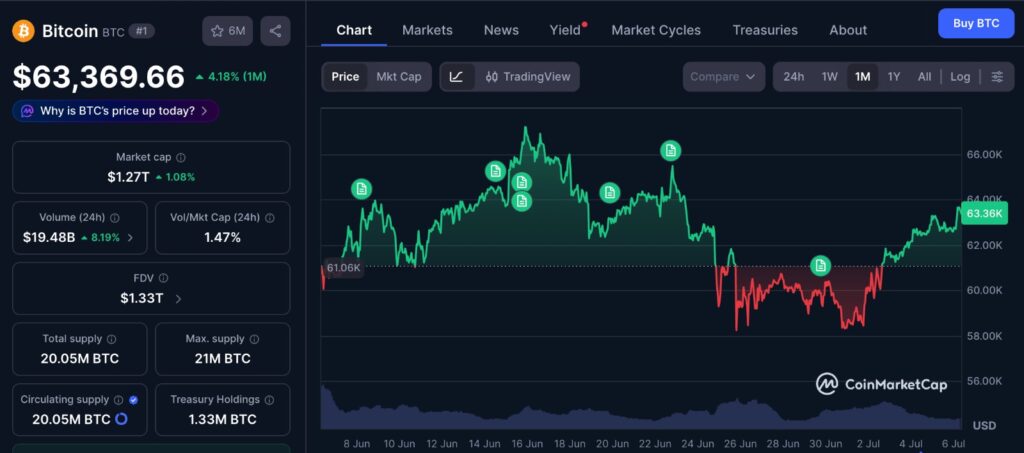
The 1-month Bitcoin chart shows why the latest move matters beyond the weekend bounce. BTC has recovered from recent weakness and moved back toward the $63.5K area, bringing price near the 200-week moving average zone discussed in the article. The key point is not simply that Bitcoin rebounded, but whether it can hold this area once weekday liquidity returns. If buyers continue absorbing supply after the short-covering pressure fades, the recovery becomes more credible. If price struggles again near this zone, the chart would show that Bitcoin still needs stronger demand confirmation.
Short Liquidations Helped Lift BTC
The weekend rally was also supported by forced positioning. Market data cited in the report showed total crypto liquidations near $167 million over 24 hours, with traders pointing to short liquidations as one reason Bitcoin pushed higher.
Liquidation-driven moves can be powerful but fragile. When short sellers are forced to close positions, they buy back into the market, adding fuel to the rally. Once that buying ends, fresh demand still has to step in if price is going to hold its gains. That same positioning dynamic was visible in the earlier Bitcoin liquidation reset near $60K support, where the market had to prove whether a leverage flush had created real support or only cleared excess risk.
Traders covering shorts can create momentum, but they are not always making new bullish bets. Without new buyers entering the market, the recovery can lose strength once the forced buying fades.
Liquidity is not continuous. Once nearby orders are absorbed and shorts are forced out, price must find the next layer of real buying interest to stay elevated.
Markets do not hold higher when pressure disappears. They hold higher when new demand continues absorbing available supply.
That is why Monday could carry more weight than the weekend high itself. A successful hold above the 200-week moving average would suggest buyers are supporting the move. A rejection would indicate the rally was driven more by positioning than conviction.
200-Week Moving Average Becomes The Key Line
Bitcoin’s 200-week simple moving average has become the main technical level in focus because it reflects long-term market structure rather than short-term price swings. This is not the first time the long-term average has shaped Bitcoin’s recovery setup, with a previous Bitcoin 200-week SMA long liquidation flush showing how forced selling near major trend levels can turn them into key confidence tests.
When Bitcoin trades near the 200-week moving average, the market often treats it as a confidence zone. Holding above it can improve sentiment, while losing it can make traders more cautious. In the current setup, that level matters even more because BTC is trying to recover from recent weakness rather than extend an established uptrend.
That makes the reaction around $62.6K to $62.7K critical.
If Bitcoin holds above this area, the rebound may gain credibility. It would show that buyers were able to absorb selling pressure after the initial squeeze. If Bitcoin slips back below it, traders may begin to view the latest move as another failed recovery.
Recent sessions have shown that Bitcoin can rebound quickly after positioning becomes stretched. The harder part has been turning those rebounds into sustained buying once normal trading conditions return.
ETF Flows Offer A Supportive Signal, But Not Confirmation
There are also early signs that demand may be improving. Spot Bitcoin ETFs reportedly snapped a six-session outflow streak with $224 million in inflows on Thursday. That followed roughly $2.4 billion in redemptions, making the latest inflow an encouraging signal.
However, one positive ETF session does not erase the impact of a longer outflow period. It suggests some buyers are returning, but it does not yet prove institutional demand has become consistently stronger. That caution matters because the earlier Bitcoin ETF outflows market exhaustion setup showed how ETF redemptions can weaken momentum when price needs steady demand to absorb selling pressure.
This is where Bitcoin’s price action and ETF flows need to support each other.
If ETF inflows continue while BTC holds above the 200-week moving average, confidence in the recovery could improve. If inflows fade and price struggles near resistance, the rebound may remain vulnerable.
ETF demand matters because it tends to reflect steadier investment flows than leveraged futures trading. For now, it should be viewed as supportive, but not confirmation that the broader trend has changed.
Macro Conditions Add Another Layer
The broader macro backdrop is also influencing sentiment. Softer U.S. labor data has reduced some hawkish pressure around Federal Reserve expectations, while traders are watching upcoming inflation data for confirmation.
According to the report, market pricing showed a near-80% chance that the Federal Reserve would hold rates steady at its July 29 meeting. That suggests investors are not expecting a major policy shift, but they remain focused on data that could influence liquidity conditions.
For Bitcoin, this matters because liquidity expectations shape appetite for risk assets. Still, macro relief alone cannot sustain the move. Buyers need to defend key levels before confidence can improve.
Why Monday Could Decide The Rebound
The risk for Bitcoin is not that it failed to bounce. It is that the bounce happened during one of the quietest trading periods of the week.
Thin weekend liquidity can exaggerate price moves. Monday trading often provides the first meaningful test of whether that strength can survive once participation increases. If Bitcoin holds above the 200-week moving average as liquidity returns, the rebound becomes more convincing. If it fades again, the recent pattern of early-week weakness remains intact.
That is why the move toward $63.5K is better viewed as a timing test than a simple bullish signal.
Over the past week, Bitcoin has repeatedly shown it can recover after periods of heavy selling pressure. The next step is proving those recoveries can hold once broader market participation returns. That is also why the broader Bitcoin bull run demand lags analysis remains relevant, since rebounds become more durable only when fresh demand keeps pace with supply returning to the market.
Editor’s View
Bitcoin’s move toward $63.5K looks encouraging, but the more important takeaway is where and when it happened. Weekend rallies often benefit from thinner liquidity, making it easier for price to rise on limited buying.
The real test comes after the weekend.
The 200-week moving average now gives the market a clear level to judge conviction. A brief move above it can happen during a squeeze, but holding above it requires buyers to keep absorbing supply when regular trading conditions return.
If Bitcoin remains firm as liquidity improves, confidence in the recovery is likely to strengthen. If selling quickly returns, the market may conclude that the weekend rally reflected positioning more than lasting demand.
The move does not become meaningful because BTC touched a watched level. It becomes meaningful when sellers return, liquidity deepens, and buyers still choose to absorb the supply.
Disclaimer: This content is for informational purposes only and does not constitute financial advice.
Keep yourself updated with the latest crypto news with FYI Gazette
 Bitcoin
  Ethereum
  Tether
  BNB
BNB  XRP
XRP  Solana
  TRON
TRON  Dogecoin
  Litecoin
  Pepe
Pepe